‘China holds the cards’: Why Putin’s visit to Beijing after Trump matters
A lack of progress in US-China talks makes Putin confident to head to Beijing, while for China, hosting the back-to-back visits is a diplomatic flex.
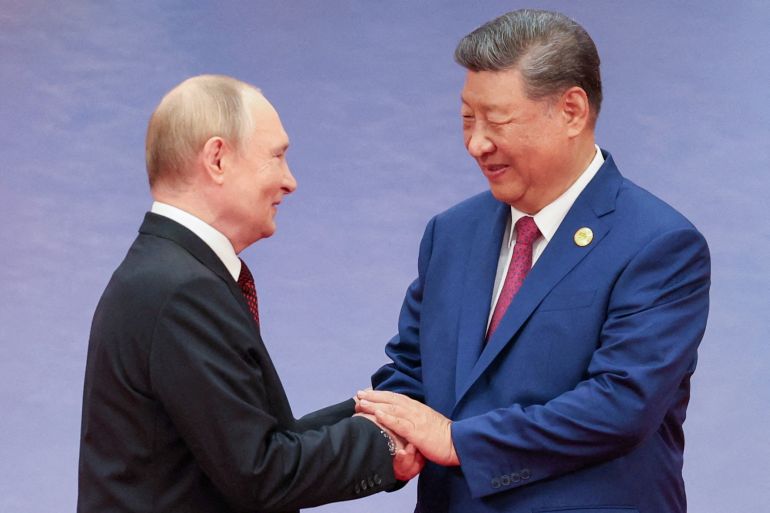

When Russian President Vladimir Putin lands in Beijing on Tuesday evening, his official agenda will be to join his Chinese counterpart, Xi Jinping, in commemorating a quarter-century-old agreement, the unambiguously described 2001 Treaty of Good-Neighborliness and Friendly Cooperation.
Yet, say analysts, the significance of the Xi-Putin summit, likely to be held on Wednesday morning, runs much deeper — as does its timing.
Recommended Stories
list of 4 items- list 1 of 4Trump-Xi summit: China, US disagree on what they agreed on
- list 2 of 4Russian drone hits Chinese ship off Ukraine before Putin meets Xi Jinping
- list 3 of 4Russia’s Putin to visit China following Trump’s trip
- list 4 of 4BRICS talks end without joint statement as divisions over Iran war deepen
Putin’s visit was announced just a day after United States President Donald Trump’s departure from China following the American leader’s summit with Xi last week. While Trump touted broad trade deals, there is little evidence that the US and China made significant progress on the most contentious issues dividing Washington and Beijing, including Taiwan and the US-Israel war on Iran.
That, say analysts, suits Putin well, allowing him to head to Beijing confident that China has no plans to sidestep its relationship with Russia. For Beijing, meanwhile, the back-to-back visits are a flex of its growing diplomatic leverage, positioning China as a central player capable of engaging rival powers on its own terms.
United by Western sanctions and a view of Trump’s foreign policy as reckless, Putin and Xi have forged a right partnership in recent years — and no major shifts are expected during the Russian president’s visit. But its timing underscores how Beijing is consolidating its role at the centre of an increasingly fragmented global order, analysts say.
‘Putin needs this more than Xi’
Despite China’s posturing, no breakthroughs are expected from Putin’s visit, but rather a continuity of their strategic relationship. “I don’t think that there is going to be a major shift,” Marina Miron, a postdoctoral researcher in defence studies at King’s College London, told Al Jazeera.
“It’s going to be a deepening of bilateral relations when it comes to economic cooperation, business, exchange of military technologies and so on.”
Oleg Ignatov, a senior Russia analyst at Crisis Group, echoed that assessment.
“The relationship between the two countries is strategic — they are partners, strategic partners, but they are not military allies, and I don’t expect that they will go anywhere further,” he told Al Jazeera.
“Russia and China’s relationships [are] very stable, very important for both countries, and there is no negative agenda in this relationship.”
Both sides are expected to advance joint projects, particularly in energy. China wants access to Russia’s energy resources “at discount”, while Russia depends on many of China’s dual-use technologies, specifically for drone production, said Miron.
Still, the meeting is more important for Putin.
“Putin needs this more than Xi. Russia is now the junior, dependent partner, following Putin’s disastrous war in Ukraine. Putin might be looking for increased military support from China,” Timothy Ash, an associate fellow at the Russia and Eurasia Programme at Chatham House, told Al Jazeera.
“Rather as Trump went cap in hand to Beijing, so will Putin,” he added. “China has all the cards.”
Ignatov, however, cautioned against reading the relationship through a purely hierarchical lens, stating that the countries’ conduct is because they are ultimately vying for a multipolar world.
“Both sides say that … they’re going to build a multipolar world so they don’t think there [should be] dominant powers [who] should push other countries to do something,” he said.
“That’s not how they look at the international relationships.”
‘Neutral superpower’ against the backdrop of war
What makes the back-to-back summits so significant, however, is what they say about Beijing’s broader diplomatic posture. China is positioning itself as the indispensable interlocutor in an increasingly fractured international order, the analysts said.
“China is trying to position itself as a mediator, as a kind of neutral player — without any sort of adversaries,” Miron said.
“China is trying not to align itself, at least not publicly, with any superpower, despite the fact that China is much closer to Russia,” she added.
“In the diplomatic sphere, they’re trying to display their neutrality as a kind of neutral superpower.”
Looming over the visit is the ongoing US-Israel war on Iran — a conflict that has shaken global energy markets by largely closing the Strait of Hormuz — with more consequences for China’s economy than Russia’s, said Miron.
Russia is benefitting from the disruption in the short term, she said, with Gulf energy competitors sidelined. But analysts agree that long-term stability matters to Russia too, with both countries wanting to see an end to the conflict, even while they have shared intelligence and technology with Iran.
Ash noted that Moscow will have drawn quiet satisfaction from what the Trump-Xi summit failed to produce.
“China did not give Trump what he wanted — an end to the Iran war,” he said. “Moscow will be content that Beijing is not going to abandon Tehran, or Moscow for that matter.”
Russia’s war on Ukraine will also almost certainly come up, but the analysts do not anticipate China pressuring Moscow towards any particular outcome.
“Ukraine will certainly be discussed, and China will certainly say that it is for mediation and for peaceful negotiations,” Miron said.
“But China is also not wishing to see Russia humiliated in any way … I don’t think it’s going to be something of an ultimatum in any way or form.”
While the visit may not produce a profound diplomatic outcome, it has made one thing clear: Beijing, in hosting the US president one day and the Russian leader the next, has made itself impossible to ignore.