Skip linksSkip to Content
play
Live
Navigation menu
  • News
    • Africa
    • Asia
    • US & Canada
    • Latin America
    • Europe
    • Asia Pacific
  • Middle East
  • Explained
  • Opinion
  • Sport
  • Video
    • Features
    • Economy
    • Human Rights
    • Climate Crisis
    • Investigations
    • Interactives
    • In Pictures
    • Science & Technology
    • Podcasts
    • Travel
play
Live

In Pictures

Gallery|Arts and Culture

In Pictures: The Uyghurs of Xinjiang

China has enforced a de facto state of emergency on Uyghurs in Xinjiang following a particularly violent spring.

Save

Share

facebookxwhatsapp-strokecopylink
A 20-year-old Uyghur man poses in an Urumqi mosque. He acts as the assistant to the mosque(***)s main imam. He and his boss are enthusiastic as they give an impromptu tour of their place of worship. There are five security cameras set up in the main chamber.
By Brent Crane
Published On 7 Aug 20147 Aug 2014

The Uyghurs are a Turkic people who mostly live in Xinjiang, a province in China’s far northwestern frontier. They are culturally, ethnically and linguistically distinct from the Han Chinese, who are the majority ethnic group within China.

Most Uyghurs practise Sufism, described as the inner, mystical dimension of Islam. They claim Xinjiang as their historical homeland, but the Chinese government asserts that the Han had settled Xinjiang before the Uyghurs arrived. They claim Xinjiang as an indisputable part of the Chinese polity. It is considered by many to be China’s most restive province.

Uyghurs and western human rights organisations claim that the unrest stems from Beijing’s oppressive policies against the Uyghur people. Beijing asserts that its policies are beneficial to the province’s development and that the unrest is a product of influence from abroad, citing Islamic radical elements within Pakistan and Afghanistan.

The fasting month of Ramadan has just ended, and after a particularly violent spring, in which several bombings by alleged Uyghur radicals rocked Xinjiang and other provinces of China, this year’s holy month faced closer government oversight than previous years. A de facto state of emergency has been put in place in the province and a heavy military presence could be seen in both the provincial capital of Urumqi and the Uyghur’s cultural capital of Kashgar located in the south of the province.

Watermelons, called West Melon in Chinese, are hugely popular throughout Xinjiang. Due to their hydrating qualities, they are a stable food of Ramadan here and are offered every night during breaking-the-fast meals.
Advertisement
Throughout the twisting ancient streets of Kashgar(***)s old town, one can find a small neighbourhood mosque on nearly every corner. During the call to prayer, an imam will stand on the roof, cup his hands over his mouth and call out a melodic reminder to pray.
There are two timezones in Xinjiang province, local time and Beijing time. Officially, all of China is under Beijing time but the Uyghurs in Xinjiang live by the local time which lags two hours behind Beijing. Every night during Ramadan, at around 8pm local time, people start to set up food for breaking the fast, which would happen around 8:30. All of the food is given away free of charge.
The Id Kah Mosque dates back to 1442. It is the oldest and largest mosque in China, located within Kashgar(***)s old town. It can hold up to 20,000 worshippers and is one of the most iconic structures in Kashgar.
Believers wait by plates of fruit inside the Id Kah Mosque for the breaking of the fast.
Wherever there is a street wide enough for a cart in Kashgar(***)s old town, you will find vendors hawking all sorts of foods, even during Ramadan. This vendor was selling Hami melons.
Advertisement
The square by the Id Kah Mosque is always bustling with people. During the hour leading up to sunset the square becomes electrified with Uyghurs travelling to where they will break their fast.
To mark the end of the fasting month and the beginning of the Eid festival, thousands of Muslims flock to the square in front of Id Kah to pray in the early morning hours. These early risers wait for others to gather.
A heavy military presence accompanies the end of Ramadan service in the Id Kah square. Taking pictures of the soldiers is not allowed.
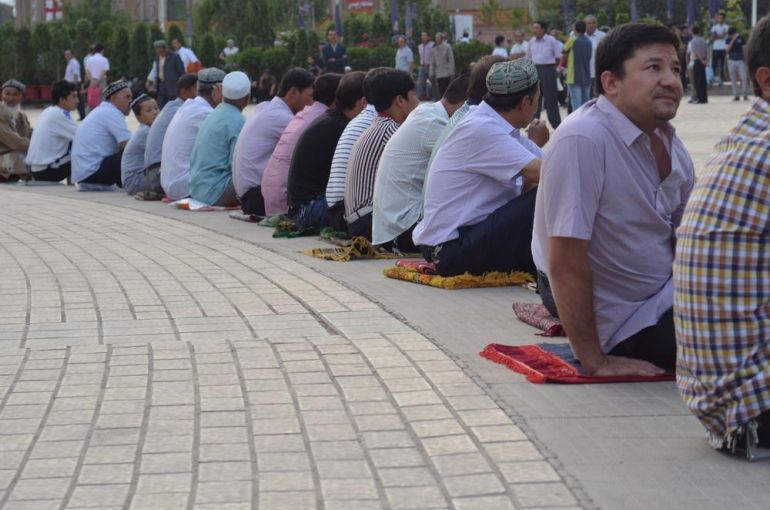
As the imam(***)s sermon booms from the mosque loudspeakers, thousands of Uyghurs congregate in the square. Each brings with him his own prayer carpet.
In unison the worshippers pray, and listen intently for instructions from the imam.
On the second day of Eid, in the early morning hours, the imam who delivered the sermon at the Eid service was murdered on a street just outside the Id Kah mosque. The funeral, which must occur as soon as possible following a death, was arranged for that day. The military was there in full force to oversee the event, marching in battalions all around the mosque with riot shields, assault rifles, and metal bludgeons.
An old Uyghur man rests under the shade near the mosque. Soldiers sit on the edge of the square in the distance.

Related

  • Photos: Mughal-era pigeon training survives in heart of India’s capital

    Pigeon-keeping remains a therapeutic and communal escape for Delhi residents amid the city’s chaos and demands.

    Published On 21 Apr 202621 Apr 2026
    Mughal-era pigeon training survives in heart of India's capital
    This gallery article has 11 imagescamera11
  • ‘Take up space’: Young models on mission to showcase South Sudanese talent

    Longing to stride down international runways often collides with reality of conservatism and lack of structural support.

    Published On 17 Apr 202617 Apr 2026
    South sudan models
  • ‘Vengeance for all’: How Iran’s Lego videos won narrative war against Trump

    The viral videos by Iranian creators, say analysts, are high-quality though cheap, and hit fissures in US politics.

    Published On 17 Apr 202617 Apr 2026
    Courtesy: Explosive Media social media
  • Could the US oil blockade snuff out the Cuban cigar?

    Since January, the Trump administration has blocked foreign oil to Cuba. Will the island’s cigars survive the crisis?

    Published On 15 Apr 202615 Apr 2026
    A Havana local smokes a cigar on the Malecón - the city’s waterfront area. Both domestically and abroad, Cuban cigars are becoming an increasingly rare luxury. [Euan Wallace/ Al Jazeera]

More from Gallery

  • Photos: Mughal-era pigeon training survives in heart of India’s capital

    Mughal-era pigeon training survives in heart of India's capital
    This gallery article has 11 imagescamera11
  • Photos: Displaced Lebanese families return home despite Israeli attacks

    Tens of thousands return to southern Lebanon despite warnings and risks
    This gallery article has 13 imagescamera13
  • Photos: Afghan villagers turn to gold-panning to sustain livelihoods

    Afghan villagers turn to gold panning to sustain livelihoods
    This gallery article has 9 imagescamera9
  • Photos: Families across Sudan endure years of displacement, hunger, loss

    Crowd of children sits under a tree and listens to a teacher.
    This gallery article has 17 imagescamera17

Most popular

  • Lebanon says no deal without Israeli withdrawal; US-Iran talks stalled

    BEIRUT, LEBANON - APRIL 20: Lebanese people walk among the rubble of destroyed buildings as they begin returning their homes following the implementation of the ceasefire between Israel and Lebanon, in Beirut, Lebanon on April 20, 2026. In the Dahieh district in southern Beirut, daily life has started to regain momentum while heavy damage was reported to infrastructure and residential areas due to Israeli attacks. ( Elif Öztürk - Anadolu Agency )
  • How Iran raised Hormuz stakes by capturing ships

    Armed men wearing head coverings climb on board a ship.
  • Who is John Phelan, the US Navy Secretary fired by Pete Hegseth?

    (FILES) US Navy Secretary John Phelan speaks about the US Navy’s new Golden Fleet initiative, unveiling a new class of warships, at Mar-a-Lago in Palm Beach, Florida, on December 22, 2025.
  • US to ‘shoot and kill’ Iranian boats laying mines in Hormuz, Trump says

    A boat of the Iranian Revolutionary Guard sails, at undisclosed place off the coast of Bandar Abbas, Iran August 22, 2019. Nazanin Tabatabaee/WANA (West Asia News Agency) via REUTERS. ATTENTION EDITORS - THIS IMAGE HAS BEEN SUPPLIED BY A THIRD PARTY.

  • About

    • About Us
    • Code of Ethics
    • Terms and Conditions
    • EU/EEA Regulatory Notice
    • Privacy Policy
    • Cookie Policy
    • Cookie Preferences
    • Accessibility Statement
    • Sitemap
    • Work for us
  • Connect

    • Contact Us
    • User Accounts Help
    • Advertise with us
    • Stay Connected
    • Newsletters
    • Channel Finder
    • TV Schedule
    • Podcasts
    • Submit a Tip
    • Paid Partner Content
  • Our Channels

    • Al Jazeera Arabic
    • Al Jazeera English
    • Al Jazeera Investigative Unit
    • Al Jazeera Mubasher
    • Al Jazeera Documentary
    • Al Jazeera Balkans
    • AJ+
  • Our Network

    • Al Jazeera Centre for Studies
    • Al Jazeera Media Institute
    • Learn Arabic
    • Al Jazeera Centre for Public Liberties & Human Rights
    • Al Jazeera Forum
    • Al Jazeera Hotel Partners

Follow Al Jazeera English:

  • facebook
  • twitter
  • youtube
  • instagram-colored-outline
  • rss
Al Jazeera Media Network logo
© 2026 Al Jazeera Media Network