Skip linksSkip to Content
play
Live
Navigation menu
  • News
    • Africa
    • Asia
    • US & Canada
    • Latin America
    • Europe
    • Asia Pacific
  • Middle East
  • Explained
  • Opinion
  • Sport
  • Video
    • World Cup
    • Features
    • Economy
    • Human Rights
    • Climate Crisis
    • Investigations
    • Interactives
    • In Pictures
    • Science & Technology
    • Podcasts
    • Travel
play
Live

In Pictures

Gallery|Health

Healing on the Syria-Turkey border

In special postoperative centres set up in Turkish border towns, Syrian fighters dream of returning to battle.

Save

Share

facebookxwhatsapp-strokecopylink
Please do not use/‘Healing on the Syrian-Turkish Border’
A rebel fighter waits for a medical checkup in a field hospital on the Syria-Turkey border. The 18-year-old says he decided to fight because he could no longer stand the abuses of the Syrian regime. He was injured when a landmine exploded, but says he intends to return to battle, even as his wife is pregnant in Turkey. 'I will be a martyr, inshallah,' he professes. [Al Jazeera]
By Maya Hautefeuille
Published On 2 Jan 20162 Jan 2016

As the number of dead continues to rise in Syria, other people are struggling to cope with devastating injuries that will stay with them forever, such as the loss of limbs or impaired mobility.

Yet throughout Syria, it has becoming increasingly difficult for victims to access life-saving care. Government hospitals are inaccessible or carry the risk of detention, while medical facilities in opposition-controlled areas are regularly targeted by air strikes. Smaller field hospitals, meanwhile, do not have sufficient equipment.

Urgent cases are granted entry across the border into Turkey. In a series of transfers at designated points along the border, Syrian and Turkish medical teams coordinate ambulances to shuttle the wounded to Turkish state hospitals.

From there, Syrians who require longer-term treatment are turned over to postoperative recovery centers in Turkish border towns, including Reyhanli, Sanliurfa and Kilis. Known as “houses of healing”, they are operated by Syrians with support from international NGOs.

Bed-ridden, in wheelchairs or on crutches, the men here recount battles against regime forces and the Islamic State of Iraq and the Levant (ISIL) group, describing the circumstances of their life-changing injuries with a sense of pride.

Though grateful for the chance to physically recover in these safe spaces, their thoughts remain riveted on Syria, and on one day returning to the fight.

Please do not use/‘Healing on the Syrian-Turkish Border’
A man injured by barrel bombs in Aleppo is helped into a Turkish ambulance on call at a Syrian field hospital near the border. For emergency cases, the field hospital is a first point of transfer between Syria and Turkey. [Al Jazeera]
Advertisement
Please do not use/‘Healing on the Syrian-Turkish Border’
A Syrian doctor dresses the wound of an opposition fighter who says he was injured by a regime sniper. [Al Jazeera]
Please do not use/‘Healing on the Syrian-Turkish Border’
A Turkish ambulance transports a Syrian patient injured by barrel bombs in Aleppo to a state hospital across the border. During periods of escalated hostilities in opposition-held areas of northern Syria, Turkish and Syrian medical teams coordinate the transfer of the wounded across the border several times a day. [Al Jazeera]
Please do not use/‘Healing on the Syrian-Turkish Border’
Free Syrian Army members rest in one of the largest rehabilitation centers in Reyhanli, where they are able to stay for months as they work towards regaining their mobility. Despite the much-needed opportunity to physically recover in safer territory, the long wait takes a toll on many of the young men, who say they feel unproductive in Turkey and are eager to return to Syria. [Al Jazeera]
Please do not use/‘Healing on the Syrian-Turkish Border’
This 26-year-old man, who ran a bus-tour company in eastern Syria, was paralysed from the waist down after ISIL invaded Deir Ezzor. He is now recovering with his son in the Turkish border town of Sanliurfa. [Al Jazeera]
Please do not use/‘Healing on the Syrian-Turkish Border’
An 18-year-old opposition fighter displays his injured leg at a recovery home in Reyhanli. Deployed as a kalashnikov operator in his battalion, he was struck by shelling from a Syrian government tank in Homs. As he learns to walk again in Turkey, he reminisces about his time as a fighter: 'We formed a close-knit group, always at arms, always ready to fight. I was defending my country and would do it again and again.' [Al Jazeera]
Advertisement
Please do not use/‘Healing on the Syrian-Turkish Border’
Residents of a recovery house in Reyhanli pray together. New patients arrive frequently due to the proximity to a main border crossing, and the centre accommodates as many men as possible in bunk beds. [Al Jazeera]
Please do not use/‘Healing on the Syrian-Turkish Border’
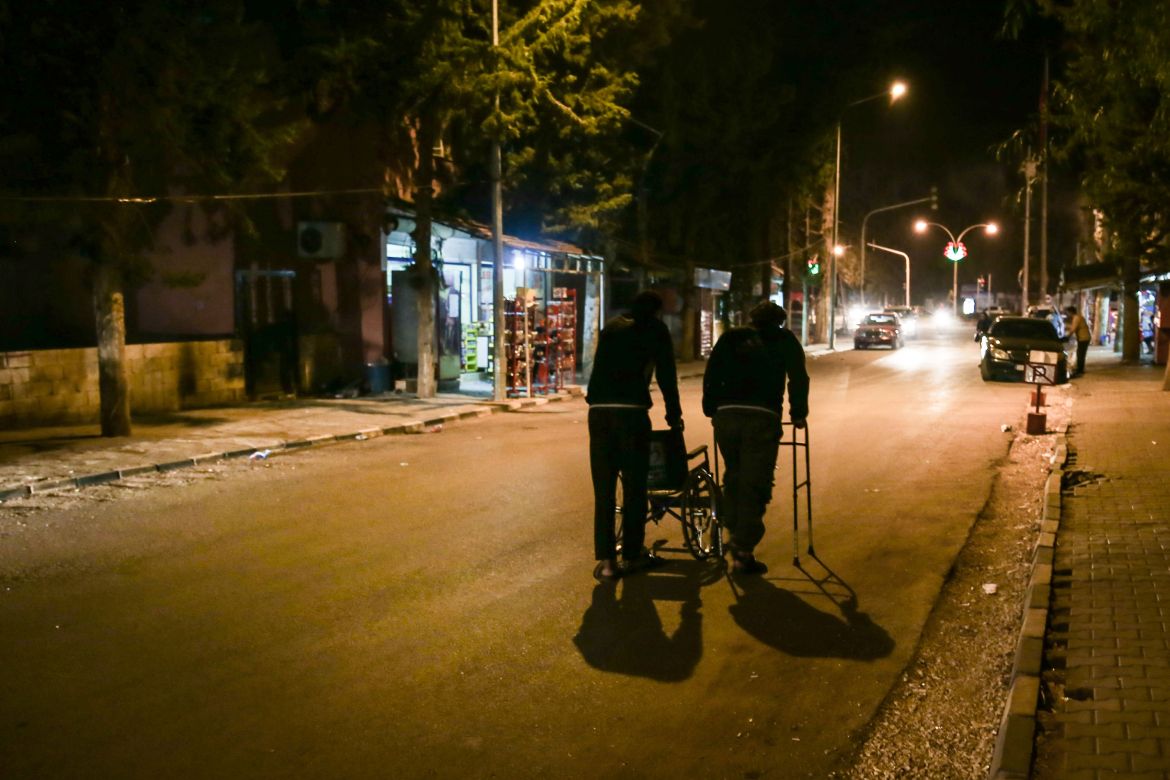
Long-term residents from a rehabilitation centre in Reyhanli walk down the road towards the town centre. This has become a common sight in the Turkish border town, a constant reminder of war raging a few kilometres away. [Al Jazeera]
Please do not use/‘Healing on the Syrian-Turkish Border’
A 21-year-old injured by an air strike in eastern Ghouta gets an artificial leg fitted in a prosthetic limb clinic. The process of fitting a new limb can be lengthy, with months of adjustment, but it remains a vital option for regaining mobility. [Al Jazeera]
Please do not use/‘Healing on the Syrian-Turkish Border’
A former Free Syrian Army fighter from Hama gets a prosthetic arm fitted in Reyhanli. [Al Jazeera]
Please do not use/‘Healing on the Syrian-Turkish Border’
Every month, dozens of Syrian amputees - both fighters and civilians alike - can be fitted with upper and lower limbs in this clinic in Reyhanli. The limbs are manufactured locally in Turkey, and although they cost hundreds of dollars, the clinic provides them free of charge to the amputees. [Al Jazeera]
Please do not use/‘Healing on the Syrian-Turkish Border’
Syrians in Reyhanli healing from war injuries attend the inauguration party of a Syrian-run centre dedicated to helping disabled people. The centre will bring injured Syrians together to socialise and attend vocational skills training, in hopes of deterring them from returning to the frontlines in Syria. [Al Jazeera]
Please do not use/‘Healing on the Syrian-Turkish Border’
A mother kisses her bed-ridden son in Sanliurfa as he lays in bed, his eyes fixed on the TV, which is tuned to footage from the ongoing battles in Syria. The 30-year-old Deir Ezzor native was paralysed by sniper fire while fighting with the Free Syrian Army against government forces. Two years since his injury, he remains psychologically fragile, and he is convinced he will be able to move again and return to the fight in Syria. [Al Jazeera]

Related

  • Israel preventing more than 16,500 Palestinians from accessing medical treatment

    Israel has systematically destroyed Gaza’s healthcare system since launching its genocidal war in October 2023.

    Published On 9 Jun 20269 Jun 2026
    A Palestinian woman with kidney failure who hopes to leave Gaza through the Rafah crossing to have further treatment abroad, undergoes dialysis treatment
  • Photos: Kenya’s police crack down on protest against US Ebola centre

    Protesters clash with police in Kenya as they march against a US-run Ebola quarantine centre near the town of Nanyuki.

    Published On 9 Jun 20269 Jun 2026
    Kenya Ebola
    This gallery article has 8 imagescamera8
  • One killed as hundreds protest in Kenya against US Ebola quarantine centre

    Anger grows as locals accuse the US of offloading Ebola risks onto Kenyans.

    Published On 9 Jun 20269 Jun 2026
    Demonstrators chant slogans as they confront Kenyan police officers during clashes at a demonstration against a controversial US-built Ebola quarantine centre slated to begin operations at Laikipia Air Base in Nanyuki on June 9, 2026.
  • UN human rights leader calls for Cuba sanctions to be ‘lifted immediately’

    Volker Turk, the UN’s high commissioner for human rights, warns that ‘children are dying’ as result of US oil blockade.

    Published On 8 Jun 20268 Jun 2026
    U.N. High Commissioner for Human Rights Volker Turk speaks to the media during a press conference in Seoul, South Korea, Wednesday, May 13, 2026. (AP Photo/Lee Jin-man)

More from Gallery

  • Photos: Kenya’s police crack down on protest against US Ebola centre

    Kenya Ebola
    This gallery article has 8 imagescamera8
  • Photos: Trump courts boos at historic New York NBA Finals appearance

    Trump courts boos at historic New York NBA Finals appearance
    This gallery article has 13 imagescamera13
  • Photos: Southern Philippines hit by 7.8-magnitude earthquake

    Earthquake Philippines
    This gallery article has 7 imagescamera7
  • Photos: Crowds flood Madrid streets to see Pope Leo’s procession

    Spain Pope
    This gallery article has 8 imagescamera8

Most popular

  • Iran vows response after US launches strikes over downing of helicopter

    TEHRAN, IRAN - JUNE 08: People go about their daily lives as usual in Tehran, Iran on June 08, 2026, despite escalating tensions and reciprocal statements and attacks between Iran, Israel, and the US. ( Fatemeh Bahrami - Anadolu Agency )
  • Iran war updates: Trump claims Iran shot down helicopter, vows to ‘respond’

    A US Army AH-64D Apache helicopter
  • US attacks Iran after Apache helicopter downed in Strait of Hormuz

    This handout photo released by US Central Command via their X account (@CENTCOM) on April 18, 2026 shows AH-64 Apaches flying above the Strait of Hormuz during a patrol on April 17, 2026. Iran's military declared the Strait of Hormuz closed again on April 18, prompting ships to abandon attempts to transit and President Donald Trump to warn Tehran against trying to "blackmail" the United States. On April 17, Tehran had declared the strait, which usually carries a fifth of the world's oil and liquefied natural gas, open after a ceasefire was agreed in Israel's war with Iran's ally Hezbollah in Lebanon. (Photo by US Central Command (CENTCOM) / AFP) / RESTRICTED TO EDITORIAL USE - MANDATORY CREDIT "AFP PHOTO / US CENTRAL COMMAND " - HANDOUT - NO MARKETING NO ADVERTISING CAMPAIGNS - DISTRIBUTED AS A SERVICE TO CLIENTS
  • World Cup opening ceremony: Who’s performing, when it starts, how to watch

    This aerial view shows the Banorte stadium (formerly known as Azteca).

  • About

    • About Us
    • Code of Ethics
    • Terms and Conditions
    • EU/EEA Regulatory Notice
    • Privacy Policy
    • Cookie Policy
    • Cookie Preferences
    • Accessibility Statement
    • Sitemap
    • Work for us
  • Connect

    • Contact Us
    • User Accounts Help
    • Advertise with us
    • Stay Connected
    • Newsletters
    • Channel Finder
    • TV Schedule
    • Podcasts
    • Submit a Tip
    • Paid Partner Content
  • Our Channels

    • Al Jazeera Arabic
    • Al Jazeera English
    • Al Jazeera Investigative Unit
    • Al Jazeera Mubasher
    • Al Jazeera Documentary
    • Al Jazeera Balkans
    • AJ+
  • Our Network

    • Al Jazeera Centre for Studies
    • Al Jazeera Media Institute
    • Learn Arabic
    • Al Jazeera Centre for Public Liberties & Human Rights
    • Al Jazeera Forum
    • Al Jazeera Hotel Partners

Follow Al Jazeera English:

  • facebook
  • twitter
  • youtube
  • instagram-colored-outline
  • rss
Al Jazeera Media Network logo
© 2026 Al Jazeera Media Network