Skip linksSkip to Content
play
Live
Navigation menu
  • News
    • Africa
    • Asia
    • US & Canada
    • Latin America
    • Europe
    • Asia Pacific
  • Middle East
  • Explained
  • Opinion
  • Sport
  • Video
    • Features
    • Economy
    • Human Rights
    • Climate Crisis
    • Investigations
    • Interactives
    • In Pictures
    • Science & Technology
    • Podcasts
    • Travel
play
Live

In Pictures

Gallery|Migration

Fleeing by foot: The Venezuela exodus grows

Fleeing Venezuela, caminantes travel hundreds of kilometres by foot to Colombia, Ecuador, Peru, Chile and beyond.
Save

Share

facebookxwhatsapp-strokecopylink
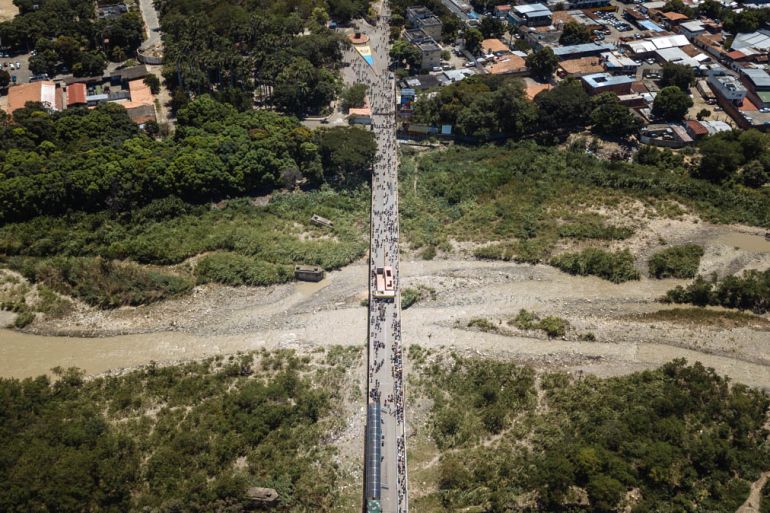
Venezuelans cross the Puente Internacional Simón Bolívar, the busiest border point between Venezuela and Colombia’s Department of Norte de Santander. Approximately 50,000 Venezuelans cross into Colomb
Venezuelans cross the Puente Internacional Simon Bolivar, the busiest border point between Venezuela and Colombia's Department of Norte de Santander. Approximately 50,000 Venezuelans cross into Colombia through the three official border crossings in this department daily. While most come to Colombia to work or access services during the day and return at night, between 3,000 and 5,000 who cross the bridge remain in Colombia or continue onward. [Muse Mohammed/IOM]
By Angela Wells and Muse Mohammed
Published On 6 Dec 20196 Dec 2019

Cucuta, Colombia – Caminantes, as millions of Venezuelan walkers are known, trek along South American highways, cross mountain ranges where temperatures dip below zero and move across low arid lands where temperatures soar to 40 degrees.

Political instability, economic collapse and rising insecurity in Venezuela have triggered the flight of nearly 4.5 million people from their home country in recent years. Four out of five have remained in South American and Caribbean countries where the availability of work, healthcare and education services offer the chance to carve out a brighter future.

They are day labourers and nurses, teachers and shopkeepers. Some travel with their families, others hope to send money to cash-strapped relatives back home where the cost of living has spiralled out of control and a typical month’s salary won’t buy more than a bag of rice.

The movement of Venezuelans out of their country represents one of the fastest-growing displacement crises in the world and the most severe in Latin America’s modern history – a humanitarian emergency stretching thousands of kilometres across multiple countries – to sparsely populated highlands of Colombia, the streets of Ecuador, Peru and Chile’s largest cities, and beyond.

Governments and humanitarian agencies responding to the crisis see the numbers of departures continuing unabated. The International Organization for Migration (IOM) and the UN Refugee Agency (UNHCR) estimate that another two million Venezuelans will leave by the end of 2020 if outflows continue as they have for the past two years.

Advertisement

Some have the resources to travel by plane, land and sea, but many have no choice but to walk for days on end with only their most valuable possessions, relying on the generosity of strangers. 

Many of the caminantes are compelled to travel through trochas, informal and dangerous border crossings through rivers and forests. They spend their nights under bridges, in open fields or, at times, in shelters established along the route. 

Transit centres run by humanitarian or church organisations offer Venezuelans some respite – the chance for a medical check-up, a warm meal, a new set of clothes, an internet connection or a counselling session. 

Although some countries, including Colombia, have largely maintained open-door policies, others, including Ecuador and Peru have recently put in place restrictions for Venezuelans wishing to enter the country. Many Venezuelans benefit from social services, despite the increasing strain their needs place on other nations’ already limited resources. 

Nevertheless, Venezuelans on the move must mainly rely on their own resources, resilience and hope for a better tomorrow. 

Every few days Marimar crosses the Simon Bolivar International Bridge with plastic bottles she collects in Venezuela to sell across the border in Colombia.    “When I come to Cucuta, I have to sleep
Every few days, Marimar crosses the Simon Bolivar International Bridge with plastic bottles she collects in Venezuela to sell across the border in Colombia. "When I come to Cucuta, I have to sleep on the street all alone. I am going to sell these bottles and bring back all the money I earn to help my three-year-old daughter who I left with my mother in Venezuela. My daughter’s father died when I was pregnant. I am the only one supporting my family now," she says. After selling the plastic at a recycling centre in the border town of Cucuta, she returns home with the money earned to help feed her mother and child. [Muse Mohammed/IOM]
Advertisement
It is the day before Neida is due to deliver. She has been staying at a transit centre in Cucuta with her husband and two children while she awaits the Caesarian Section she could not get at home. “
Neida, who is nine months pregnant, has been staying at a transit centre in Cucuta with her husband and two children while she awaits the caesarian section she could not get at home. "I've already lost two children to miscarriages in Venezuela," she says. "Tomorrow I’ll give birth to my child. I hope it is a boy," she adds. "I was scared to leave, because my country is my country, but fear wasn’t enough to stop me. I thought about my family, my daughter, to give them a better life. Colombia is a country that opened its doors to me." A new policy enacted by the Colombian government will allow her newborn child to be a Colombian citizen. Until the operation, she will stay at the International Organization for Migration's transit centre in Cucuta, Colombia where Venezuelans can receive food, medical assistance and a safe place to stay and rest during their journey. [Muse Mohammed/IOM]
Venezuelans walk along the side of the road from the Colombian border town of Cucuta toward Pamplona, one of the first major cities along the migration route to the capital, Bogota. Healthy and able-b
Venezuelans walk along the side of the road from the Colombian border town of Cucuta toward Pamplona, one of the first major cities along the migration route to the capital, Bogota. Healthy and able-bodied travellers usually complete the 75km (46-mile) stretch from Cucuta to Pamplona in three days; the journey is much longer for children, the elderly and disabled. Most of these caminantes have thousands of kilometres left to walk before they reach their destination. [Muse Mohammed/IOM]
Steven is trying to hitchhike over the Paramo de Berlin highland pass between Cucuta and Bogota, Colombia – 3,000 metres above sea level. “I made this same journey last year and this part was really
Steven is trying to hitchhike over the Paramo de Berlin highland pass between Cucuta and Bogota, Colombia – 3,000 metres (9,842 feet) above sea level. "I made this same journey last year and this part was really horrendous. People warned me not to walk up because I would freeze but I told myself I had to do it and I just kept going," he says. By the time I reached the top, I didn't think I would survive. I was freezing; my hands had turned purple." He hopes a passer-by will help him and his three friends safely over the mountain this time. [Muse Mohammed/IOM]
José Quero (second on the left) departed Venezuela with four friends in the middle of the night, leaving behind his three children. “We’re more like brothers and sisters. When we laugh, we laugh
Jose Quero (second from left) departed Venezuela with four friends in the middle of the night, leaving behind his three children. "We're more like brothers and sisters. When we laugh, we laugh together; when we cry, we cry together. When we stop, we stop together and when we move, we move together," he says. "We do more than just accompany each other; we are a family." The group has stopped at an International Organization for Migration humanitarian tent where caminantes receive medical attention and emergency kits with supplies like drinking water, food and sunscreen – to make their journey a little less arduous. [Muse Mohammed/IOM]
Caminantes have their injuries treated by aid workers at an International Organization for Migration Humanitarian Tent along the road to Pamplona, Colombia. Their long journeys, often made in flip flo
Caminantes have their injuries treated by aid workers at an International Organization for Migration humanitarian tent along the road to Pamplona, Colombia. Their long journeys, often made in flip-flops or sneakers, result in many foot injuries. [Muse Mohammed/IOM]
Advertisement
Rigoberto pauses on the side of the road on the outskirts of Pamplona, Colombia. He has been walking for three days toward San Gil where he hopes to find work on a coffee plantation. “I used to wor
Rigoberto pauses on the side of the road on the outskirts of Pamplona, Colombia. He has been walking for three days towards San Gil where he hopes to find work on a coffee plantation. "I used to work for an electrical company," he says. "I was paid exactly enough to buy half a dozen eggs per week. The electricity shuts down all the time. People wonder why we don’t protest the situation, but the reason why is simple: we are hungry." [Muse Mohammed/IOM]
Charlotte and Pedro walked 14 days from their home in Venezuela to Bogota, Colombia, taking turns carrying their six-month-old son. Charlotte’s brother is waiting for them in Ecuador, where they hope
Charlotte and Pedro walked 14 days from their home in Venezuela to Bogota, Colombia, taking turns carrying their six-month-old son. Charlotte’s brother is waiting for them in Ecuador, where they hope to find work. “On the journey, many people helped us, other Venezuelan caminantes and Colombians who we met. We would eat only bread that people would give us. In Venezuela, our salary didn't even cover a loaf of bread." Pedro and Charlotte stayed at a shelter in Bogota for a few nights before continuing their journey onward. [Muse Mohammed/IOM]
The border between Colombia and Ecuador serves as a major artery along the Andean Corridor for Venezuelans travelling south. Some cross the Rumichaca Bridge regularly while others who cannot secure vi
The border between Colombia and Ecuador serves as a major artery along the Andean Corridor for Venezuelans travelling south. Some cross the Rumichaca Bridge regularly while others who cannot secure visas pass through informal and more dangerous pathways across mountains and rivers. [Muse Mohammed/IOM]
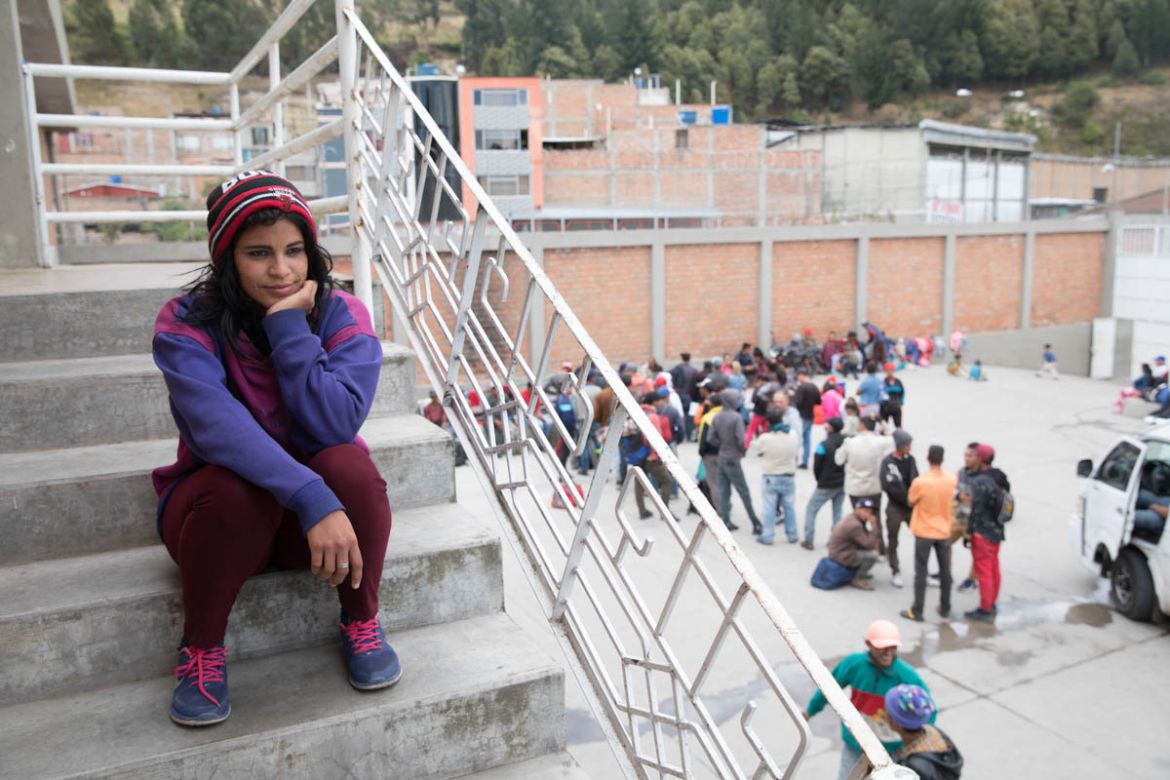
Daniela, 25, walked through Venezuela and Colombia with her boyfriend and two friends for almost one month, walking during the day and taking rides at night. She left her four and two-year-old child
Daniela, 25, walked through Venezuela and Colombia with her boyfriend and two friends for nearly a month, walking during the day and taking rides at night. She left her four and two-year-old children with relatives in Caracas. Now pregnant with twins, she is resting at one of seven shelters in the area around Ipiales, a border town on Ecuador's frontier. She hopes to reach Peru where her mother is waiting. "When I was growing up in Venezuela life was good. I could go to the park, go out to eat a burger and I had toys, and the education was high quality. Life is so different for my children," she says. "When I talk to my daughter on the phone, I ask her what I should bring back for her, but she tells me, 'Don’t bring anything back. I want you to be here and bring me to school. Come home and put me to sleep.' My baby couldn't talk when I left but now when I call, he says, 'Mama' on the phone. Sometimes when I find soup or something to eat, I wonder to myself what they are eating at home in Venezuela. My dream is for us to all be together." [Muse Mohammed/IOM]
Ana, a lawyer, shows a photo of her father on her phone. When she first came to Ecuador, she could not bring her father along. Ana would send her what little money she could save to help pay for his m
Ana, a lawyer, shows a photo of her father on her phone. When she first came to Ecuador, she could not bring her father along. Ana would send her what little money she could save to help pay for his medicine but knew that he would not live long if he stayed in Venezuela without medical care. "I feared the day I would get a phone call telling me to stop sending money for his medicine and instead send money for his coffin," she says. Ana's father had to travel through Venezuela to the border of Colombia while sick. After this, he was reunited with his daughter in Quito with help from the International Organization for Migration (IOM). [Muse Mohammed/IOM]
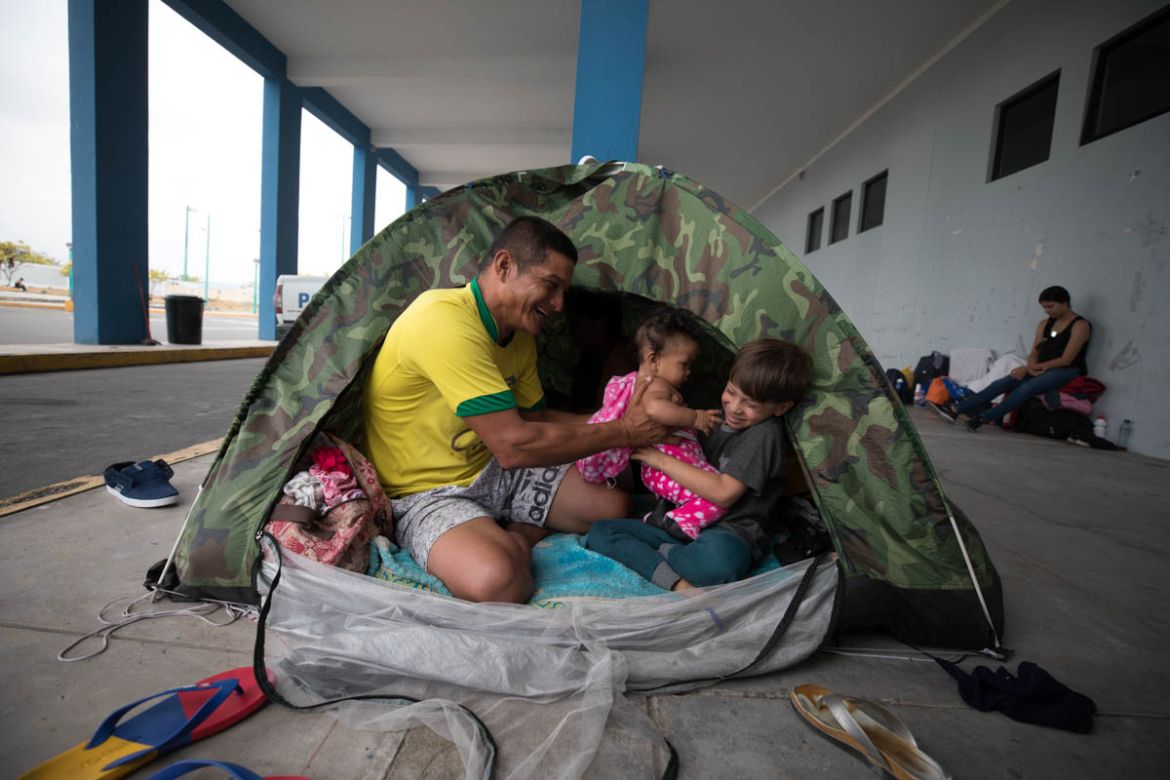
Cesar plays with his daughter and nephew in a makeshift tent on the border between Ecuador and Peru. The former mechanic left the country with his family when his salary could no longer feed his famil
Cesar plays with his daughter and nephew in a makeshift tent on the border between Ecuador and Peru. The former mechanic left the country with his family when his salary could no longer feed his family. The family reached the border a month ago. They are waiting on the border until their daughter's visa can be processed and they can cross safely and regularly to Peru. Many Venezuelans in South America live in limbo while waiting for visas and other documents that will allow them to reach their desired destinations through official routes. [Muse Mohammed/IOM]
Yesina is staying at a shelter for Venezuelans in Tumbes, Peru. She was lucky enough to make the journey across Colombia, Ecuador and Peru by bus but she had to sell all her possessions to afford the
Yesina is staying at a shelter for Venezuelans in Tumbes, Peru. She was able to make the journey across Colombia, Ecuador and Peru by bus, but she had to sell all her possessions to afford the ticket. "One of the hardest things was looking out the window and seeing all the people who could not afford to be on the bus just walking and weathering the cold. They would just be there on the side of the road bundled up, freezing, begging for a ride along with their children," she recounts, holding back tears. "I would try to plead with the driver, ''Stop! Stop! Let's pick them up.'' But there are so many people out there you would need a magic bus to help them all." [Muse Mohammed/IOM]

Related

  • Fighting over access to water in Chad kills at least 42, army intervenes

    Dispute over water spirals into reprisal attacks, government says situation is ‘under control’.

    Published On 27 Apr 202627 Apr 2026
    A Chadian soldier display at patch on his arm at the Baga Sola military base, Lake Chad Province, Chad, on 26 November, 2025. The new commander-in-chief of the Multinational Joint Task Force (MNJTF) for counter-jihadist efforts in the Lake Chad Basin assured on Wednesday to AFP that securing waterways is a priority mission in this border region of Central Africa. Establishing secure navigation corridors is "one of the main priorities," according to General Saidou Tanko Audu, who has been leading the regional counter-jihadist force since mid-November. (Photo by Joris Bolomey / AFP)
  • Family longest held in US immigration detention re-arrested after release

    Lawyers say El Gamal family detained by Trump administration hours after returning home from 10-month detention.

    Published On 25 Apr 202625 Apr 2026
    SAN PEDRO SULA, HONDURAS - JANUARY 31: US Air force flight carrying deported migrants by the US government arrive at Ramon Villeda Morales International Airport on January 31, 2025 in San Pedro Sula, Honduras. Honduras receives 126 migrants in two different flights as part of mass deportation plans by the Trump's administration. People were captured once they got into the US or during the raids conducted by the authorities. (Photo by Jorge Salvador Cabrera/Getty Images)
  • Deporting soldiers? Why immigrant veterans fear removal from the US

    Trump’s push for mass deportation has heightened fears that immigrant veterans of the US military could be expelled.

    Published On 25 Apr 202625 Apr 2026
    Johnny Odom, 52, a resident of Logan Heights, during the Day of the Dead ceremony honoring deported veterans.
  • Trump to again end legal status of people who entered US with CBP One app

    Judge had previously blocked move to end temporary legal status for those who entered US via Biden-era application.

    Published On 24 Apr 202624 Apr 2026
    CBP One

More from Gallery

  • Photos: Somalia hunger crisis worsens as drought displaces more than 500,000

    Hawa Moalim, 33, fled Wajid in the Bakool region after the drought destroyed her livelihood. She began the journey to Baidoa with her six children and the few goats that had survived, determined to give her family a chance. One by one, the animals died on the road. By the time the family arrived at Wayamo displacement camp two weeks ago, they had nothing left. "We arrived here hoping for help," she says. "But since we came, we have received nothing. There is no food, no water, and no proper shelter." Wayamo displacement camp, Baidoa, Southwest State, Somalia. [Abdulkadir Mohamed/NRC]
    This gallery article has 14 imagescamera14
  • Photos: North Korea opens museum for troops killed fighting for Russia

    North Korea opens museum for troops killed fighting for Russia
    This gallery article has 9 imagescamera9
  • Photos: Bomb attack on Colombia highway kills 19 ahead of election

    Bomb attack on Colombia highway kills 19 ahead of election
    This gallery article has 9 imagescamera9
  • Photos: Chornobyl’s ‘liquidators’ return 40 years after nuclear disaster

    Survivors return to Chernobyl, 40 years after devastating explosion
    This gallery article has 15 imagescamera15

Most popular

  • US reviews Iran peace plan as dozens of nations call for Hormuz to reopen

    Smoke rises following explosions in southern Lebanon, near the Israel-Lebanon border, as seen from northern Israel, April 27, 2026.
  • Iran offers Hormuz deal without nuclear talks, as it seeks broader buy-in

    Iranian Foreign Minister Abbas Araqchi meets Pakistan’s Army Chief, Field Marshal Asim Munir
  • Top US officials review Iran’s proposal to end war and open Hormuz Strait

    Iran War
  • Melania Trump blasts Kimmel, calls on ABC to ‘take stand’ against comedian

    (COMBO) This combination of pictures created on April 27, 2026 shows (L/R) US First Lady Melania Trump attending the White House Correspondents' dinner at the Washington Hilton in Washington, DC, on April 25, 2026 and TV host Jimmy Kimmel in Santa Monica, California, on January 4, 2026.

  • About

    • About Us
    • Code of Ethics
    • Terms and Conditions
    • EU/EEA Regulatory Notice
    • Privacy Policy
    • Cookie Policy
    • Cookie Preferences
    • Accessibility Statement
    • Sitemap
    • Work for us
  • Connect

    • Contact Us
    • User Accounts Help
    • Advertise with us
    • Stay Connected
    • Newsletters
    • Channel Finder
    • TV Schedule
    • Podcasts
    • Submit a Tip
    • Paid Partner Content
  • Our Channels

    • Al Jazeera Arabic
    • Al Jazeera English
    • Al Jazeera Investigative Unit
    • Al Jazeera Mubasher
    • Al Jazeera Documentary
    • Al Jazeera Balkans
    • AJ+
  • Our Network

    • Al Jazeera Centre for Studies
    • Al Jazeera Media Institute
    • Learn Arabic
    • Al Jazeera Centre for Public Liberties & Human Rights
    • Al Jazeera Forum
    • Al Jazeera Hotel Partners

Follow Al Jazeera English:

  • facebook
  • twitter
  • youtube
  • instagram-colored-outline
  • rss
Al Jazeera Media Network logo
© 2026 Al Jazeera Media Network