Skip linksSkip to Content
play
Live
Navigation menu
  • News
    • Africa
    • Asia
    • US & Canada
    • Latin America
    • Europe
    • Asia Pacific
  • Middle East
  • Explained
  • Opinion
  • World Cup
  • Video
    • Features
    • Economy
    • Sport
    • Human Rights
    • Climate Crisis
    • Investigations
    • Interactives
    • In Pictures
    • Science & Technology
    • Podcasts
    • Travel
play
Live

In Pictures

Gallery|Climate Crisis

Climate crisis: How Bangladeshis are fighting rising sea levels

Global Climate Risk Index says Bangladesh is seventh among the nations most affected by extreme weather in the past 20 years.

Save

Share

facebookxwhatsapp-strokecopylink
Farmers wade through an inundated field past vegetables growing on seedbeds. [Munir uz Zaman/AFP]
By AFP
Published On 28 Oct 202128 Oct 2021

Rising sea levels and deadly floods are already putting tens of millions of lives at risk in Bangladesh, but they bring another problem that threatens the entire nation: waterlogged land and high salinity in streams and soil are killing crops.

Bangladesh ranks seventh for countries most affected by extreme weather in the past two decades, according to the Global Climate Risk Index.

Farmers are desperately trying to adjust to these ever more destructive and unpredictable conditions caused by global warming – from using floating seedbeds to developing salt-resistant rice.

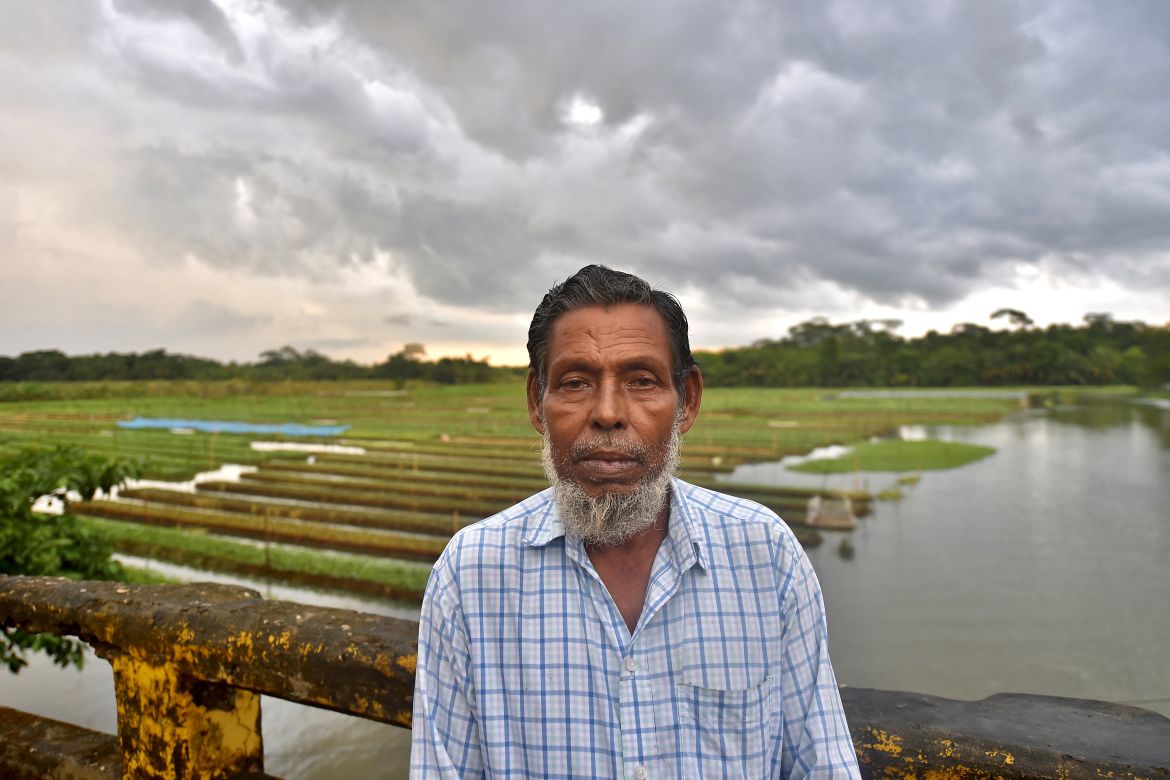
“Even 25 years ago, we could grow crops throughout the year … but then water started to stay here seven months. We were clueless how to survive,” said Altaf Mahmud.

“Most of the farmers here are poor and the land is scarce. But if we can’t grow anything during the seven months, we would starve,” neighbour Mohammad Mostofa added.

So they and other local farmers in Mugarjhor, a region 200km (120 miles) south of Dhaka, revived a century-old technique of using seedbeds that sit atop the water.

They stack layers of water hyacinth and bamboo tied together by their roots to create a raft, 2-4 feet (0.6-1.2 metres) high, on which to plant seeds – often using wood chippings and coconut coir as a fertiliser.

This forms a light, floating vegetable garden – bitter gourds, spinach and okra can all be grown this way – able to rise and fall with the water levels.

The floating farms have become community initiatives, and in some villages, women spend months preparing the beds before boatmen take them across waterlogged fields.

Advertisement

Ever-more frequent cyclones, rising sea levels, floods, erosion, drought and unreliable rains have already displaced millions, either into city slums or abroad.

Those that stay have no choice but to find new ways of working.

Some farmers have stopped growing crops, opting instead to grow shrimp in the brackish water, or crab-fattening – capturing wild crabs and feeding them up to then sell – as well as rearing ducks, which fetch a high price in Dhaka eateries.

Bangladesh Rice Research Institute (BRRI) has created new salt-resistant varieties of the staple crop.

“Normal rice does not grow in saline water. Salinity saps the energy of rice stalks,” explained scientist Alamgir Hossain.

BRRI has now created a strain that can grow in water with triple the saline levels that normal rice can cope with, he said.

This has offered “new hope” to farmers in coastal regions, where seawater is increasingly encroaching the land, he added.

But Saiful Islam, a climate expert at Bangladesh University of Engineering and Technology, said such efforts are a drop in the ocean.

“We need to spend billions to raise and strengthen embankments along our big coastline. We need to create mangrove forests along the coastal belt to work as natural barriers to cyclones, subsidence and sea level rise.”

“We need to build new roads, preserve rainwater and create alternate livelihoods for millions of people. Just inventing crops won’t do. Bangladesh alone can’t do it,” said Islam.

He added that Western nations were “responsible for emitting most of the greenhouse gases” and so needed to help.

Islam said Bangladesh received “barely any” of proposed $100bn set aside by developed nations for adaptation to and mitigation of climate change.

Rising sea levels and deadly floods are already putting tens of millions of lives at risk in Bangladesh, but they bring another problem that threatens the entire nation: waterlogged land and high salinity in streams and soil are killing crops. [Munir uz Zaman/AFP]
Advertisement
Bangladesh ranks seventh among the countries most affected by extreme weather in the past two decades, according to the Global Climate Risk Index. [Munir uz Zaman/AFP]
Farmers are desperately trying to adjust to these ever more destructive and unpredictable conditions caused by global warming. [Munir uz Zaman/AFP]
'Even 25 years ago, we could grow crops throughout the year ... but then water started to stay here seven months. We were clueless how to survive,' said Altaf Mahmud. [Munir uz Zaman/AFP]
Farmers in Mugarjhor, a region 200km (120 miles) south of Dhaka, revived a century-old technique of using seedbeds that sit atop the water. [Munir uz Zaman/AFP]
The floating farms have become community initiatives, and in some villages, women spend months preparing the beds before boatmen take them across waterlogged fields. [Munir uz Zaman/AFP]
Advertisement
Some farmers have stopped growing crops opting instead to grow shrimp in the brackish water, or crab-fattening - capturing wild crabs and feeding them up to then sell - as well as rearing ducks, which fetch a high price in Dhaka eateries. [Munir uz Zaman/AFP]

Related

  • Life Below Sea Level: Bangladesh and our climate future

    We take a look at what the latest IPCC report means for rising sea levels and the future of climate change.

    Published On 3 Sep 20213 Sep 2021
    Bangladesh is often considered a front line of the climate fight when it comes to water [Mohammad Ponir Hossain/Reuters]
  • ‘Climate catastrophe’: World faces 2.7C temperature rise

    UN chief says latest report a ‘thundering wake-up call’ as leaders prepare for crucial Glasgow climate talks.

    Published On 26 Oct 202126 Oct 2021
    Drought in Afghanistan's Badghis province.
  • Through refugee eyes: Deadly floods in Bangladesh Rohingya camps

    The Norwegian Refugee Council asked two Rohingya photographers to document the flood’s aftermath. This is what they saw.

    Published On 3 Aug 20213 Aug 2021
    “There is no dry land. It stopped raining for a while and the water started to go down. But it rained again and the water is rising. It is much worse than what you see.” [Zia for NRC]
    This gallery article has 8 imagescamera8
  • Attacks, land grabs leave Bangladesh’s Indigenous groups on edge

    From targeted attacks to land grabs, the country’s most marginalised people suffer as little help comes from government.

    Published On 30 Jul 202130 Jul 2021
    indigenous identity in Bangladesh

More from Gallery

  • Photos: Cockroach Janta Party rallies in New Delhi for youth protests

    Cockroach Janta Party (CJP) founder Abhijeet Dipke (C) shouts slogans during a protest
    This gallery article has 9 imagescamera9
  • Photos: Foreign nationals among 21 dead in New Delhi building fire

    Foreign nationals among 21 dead in New Delhi building fire
    This gallery article has 7 imagescamera7
  • ‘Service is the rent we pay’: Muhammad Ali remembered 10 years on

    Heavyweight champion Muhammad Ali stands over fallen challenger Sonny Liston.
    This gallery article has 9 imagescamera9
  • Photos: Refugee women in CAR face childbirth risks amid US funding cuts

    Refugee women in CAR face childbirth risks amid US funding cuts
    This gallery article has 11 imagescamera11

Most popular

  • Iran says US ‘lacks will’ for stability after latest Gulf exchange of fire

    A man holds an Iranian flag near an anti-U.S. billboard depicting U.S. President Donald Trump and the Strait of Hormuz, in Tehran, Iran, May 30, 2026. Majid Asgaripour/WANA (West Asia News Agency) via REUTERS ATTENTION EDITORS - THIS PICTURE WAS PROVIDED BY A THIRD PARTY. ISRAEL OUT. NO COMMERCIAL OR EDITORIAL SALES IN ISRAEL. NO ACCESS FOR ISRAELI MEDIA. NO USE BBC PERSIAN. NO USE VOA PERSIAN. NO USE MANOTO. NO USE IRAN INTERNATIONAL. NO USE RADIO FARDA. DIGITAL: NO USE BBC PERSIAN. NO USE VOA PERSIAN. NO USE MANOTO. NO USE IRAN INTERNATIONAL. NO USE RADIO FARDA.
  • ‘Badge of honour’: Israeli settlers shrug off global condemnation

    An Israeli settler argues with a Palestinian farmer.
  • At least 49 people die of thirst after truck breakdown in Niger desert

    A sandal lies on the ground in Niger's Tenere desert region of the south central Sahara on June 3, 2018.
  • Ballistics Putin’s ‘last argument’ as Ukraine brings his army to standstill

    A serviceman of the 44th Separate Artillery Brigade of the Ukrainian Armed Forces reacts as he fires a Ukrainian self-propelled howitzer 2S22 Bohdana towards Russian positions, amid Russia's attack on Ukraine, on a frontline in Zaporizhzhia region, Ukraine May 25, 2026. REUTERS/Stringer TPX IMAGES OF THE DAY

  • About

    • About Us
    • Code of Ethics
    • Terms and Conditions
    • EU/EEA Regulatory Notice
    • Privacy Policy
    • Cookie Policy
    • Cookie Preferences
    • Accessibility Statement
    • Sitemap
    • Work for us
  • Connect

    • Contact Us
    • User Accounts Help
    • Advertise with us
    • Stay Connected
    • Newsletters
    • Channel Finder
    • TV Schedule
    • Podcasts
    • Submit a Tip
    • Paid Partner Content
  • Our Channels

    • Al Jazeera Arabic
    • Al Jazeera English
    • Al Jazeera Investigative Unit
    • Al Jazeera Mubasher
    • Al Jazeera Documentary
    • Al Jazeera Balkans
    • AJ+
  • Our Network

    • Al Jazeera Centre for Studies
    • Al Jazeera Media Institute
    • Learn Arabic
    • Al Jazeera Centre for Public Liberties & Human Rights
    • Al Jazeera Forum
    • Al Jazeera Hotel Partners

Follow Al Jazeera English:

  • facebook
  • twitter
  • youtube
  • instagram-colored-outline
  • rss
Al Jazeera Media Network logo
© 2026 Al Jazeera Media Network