Skip linksSkip to Content
play
Live
Navigation menu
  • News
    • Africa
    • Asia
    • US & Canada
    • Latin America
    • Europe
    • Asia Pacific
  • Middle East
  • Explained
  • Opinion
  • Sport
  • Video
    • Features
    • Economy
    • Human Rights
    • Climate Crisis
    • Investigations
    • Interactives
    • In Pictures
    • Science & Technology
    • Podcasts
    • Travel
play
Live

In Pictures

Gallery|Coronavirus pandemic

India COVID crisis: Tragic scenes at a hospital in Uttar Pradesh

India’s brutal second wave has reached its small towns and the countryside, ripping through a fragile healthcare system not equipped to deal with such a large public health crisis.
Save

Share

facebookxwhatsapp-strokecopylink
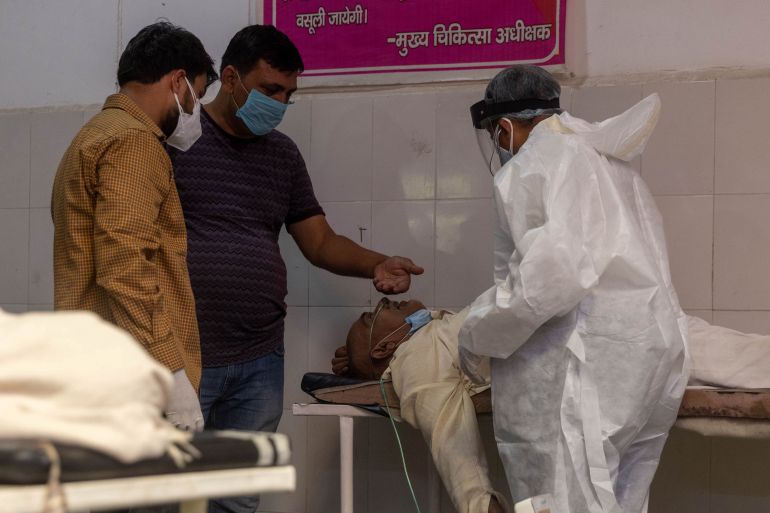
A medic tends to Bhagirath Singh, 77, who is experiencing breathing problems, inside an emergency ward of a government-run hospital, amidst the coronavirus disease (COVID-19) pandemic, in Bijnor district, Uttar Pradesh. India [Danish Siddiqui/Reuters]
By Reuters
Published On 13 May 202113 May 2021

In the emergency room of a public hospital in northern India, a man is trying to revive his mother who had just died from COVID-19 symptoms.

On another bed, a young man who had tested positive is sitting up and making an effort to breathe while two members of his exhausted family sprawl on the tiny bed.

The one doctor on duty in the ER in this hospital in Bijnor, a small town in India’s most populous Uttar Pradesh state 180km (112 miles) east of Delhi, can barely attend to the stream of patients that are coming in, in rickety ambulances or in the backs of cars.

India’s brutal second wave has reached its small towns and the countryside, ripping through a fragile healthcare system not equipped to deal with such a large public health crisis.

Doctors are hard to come by, intensive care units are expensive and scarce, and patients are packing into emergency rooms.

People flit in and out, trying to help with everything from procuring oxygen cylinders to artificial resuscitation.

“We are trying our best, the numbers are large,” said Ramakant Pandey, the top district official at Bijnor. Unlike the first wave, this one is more severe, he said.

“We are also not getting much time between the time a person gets infected to the time he becomes serious.”

On Tuesday, four people died in Bijnor hospital within the space of an hour, including Jagdish Singh, 57, who had arrived just a few minutes before. His son Gajendra said he took him to the hospital believing it would help raise his oxygen levels.

Advertisement

At the hospital, he said he ran around trying to get the oxygen going and then he lost his father.

Dr Naresh Johri, who was running the ER along with two assistants, said he was not in a position to speak to the press, in line with service rules.

Medical oxygen has become a major concern with top hospitals in Delhi and other large cities issuing SOS calls that they were running out of supplies of the life-saving gas because of the crush of patients.

The government is now trying to arrange supplies from abroad and from local industry. While the situation in Delhi has improved, smaller towns like Bijnor are struggling.

Many choose not to go to hospitals believing they will not get much care. In Jhaalu village, 11km (7 miles) from Bijnor, family members of Shakeel Ahmed were reading the Quran as he lay gasping for breath.

“We are trying to avoid hospitals, we don’t trust the system,” his brother Bhure Ahmed said.

A man speaks on the phone as a doctor tries to revive his wife inside the emergency ward of Bijnor's government-run hospital. [Danish Siddiqui/Reuters]
Advertisement
Patients receive treatment inside a COVID-19 ward at the hospital as India's brutal second wave reaches its small towns and the countryside. [Danish Siddiqui/Reuters]
Relatives carry Bhagirath Singh, 77, who is experiencing breathing problems. While the oxygen crisis in Delhi has improved, smaller towns like Bijnor are struggling. [Danish Siddiqui/Reuters]
Medics tend to a man with breathing problems inside a COVID-19 ward of the government-run hospital. [Danish Siddiqui/Reuters]
Relatives help Jagdish Singh, 57, out of an ambulance outside the hospital in Bijnor. [Danish Siddiqui/Reuters]
A man stands next to the body of his wife who died due to breathing difficulties. [Danish Siddiqui/Reuters]
Advertisement
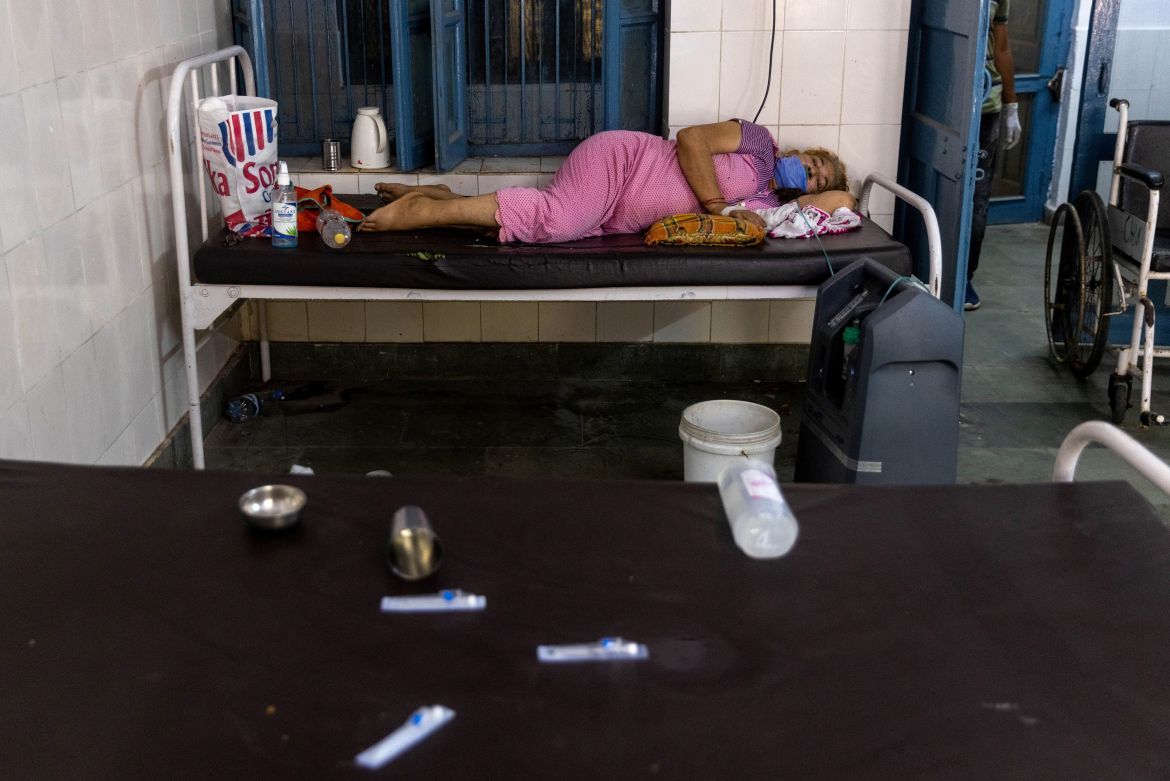
A woman receives treatment inside a COVID-19 ward of the government-run hospital. [Danish Siddiqui/Reuters]
Jagdish Singh sits inside an ambulance waiting to enter the government-run hospital for treatment. [Danish Siddiqui/Reuters]
A man wheels the body of his relative who died from the coronavirus disease. [Danish Siddiqui/Reuters]

Related

  • Over 4,000 Indians die of COVID as pandemic ravages rural areas

    India’s caseload at 23.7 million now while deaths climb by 4,120, as the disease rampages through the countryside.

    Published On 13 May 202113 May 2021
    A woman mourns after seeing the body of her son who died due to COVID-19, outside a mortuary of a hospital in New Delhi [Adnan Abidi/Reuters]
  • COVID cases across India being traced to weeks-long Kumbh Mela

    Dozens of cases across India being traced to mega Hindu festival held at the banks of Ganges in Haridwar last month.

    Published On 13 May 202113 May 2021
    Devotees on their way to take a holy dip in the Ganges River during the Kumbh Mela at Haridwar, Uttarakhand on April 14, 2021 [File: Idrees Mohammed/EPA]
  • ‘True hero’: Indian police officer helping with COVID cremations

    Rakesh Kumar has gone beyond call of duty to help perform last rites of as many as 1,300 coronavirus victims in Delhi.

    Published On 12 May 202112 May 2021
    Police officer Rakesh Kumar, left, helping families perform the last rites of their loved ones at Lodhi Crematorium in New Delhi [Courtesy of Rakesh Kumar]
  • Bodies of dozens of suspected COVID dead found in India’s Ganges

    Residents in the area think bodies were dumped because crematoriums were overwhelmed or funeral pyres too expensive.

    Published On 11 May 202111 May 2021
    Relatives perform the last rites before the cremation of their loved one, who died due to COVID-19, on the banks of the Ganges river [File: Prakash Singh/AFP]

More from Gallery

  • Photos: Mughal-era pigeon training survives in heart of India’s capital

    Mughal-era pigeon training survives in heart of India's capital
    This gallery article has 11 imagescamera11
  • Photos: Displaced Lebanese families return home despite Israeli attacks

    Tens of thousands return to southern Lebanon despite warnings and risks
    This gallery article has 13 imagescamera13
  • Photos: Afghan villagers turn to gold-panning to sustain livelihoods

    Afghan villagers turn to gold panning to sustain livelihoods
    This gallery article has 9 imagescamera9
  • Photos: Families across Sudan endure years of displacement, hunger, loss

    Crowd of children sits under a tree and listens to a teacher.
    This gallery article has 17 imagescamera17

Most popular

  • Lebanon truce extended; Trump says ‘clock is ticking’ for Iran to make deal

    Smoke rises from a village in southern Lebanon as the Israeli army operates in it as seen from the Israeli side of the border, April 23, 2026 REUTERS/Gil Eliyahu ISRAEL OUT. NO COMMERCIAL OR EDITORIAL SALES IN ISRAEL TPX IMAGES OF THE DAY
  • Iran war updates: Trump announces three-week Lebanon ceasefire extension

    BEIRUT, LEBANON - APRIL 20: Lebanese people walk among the rubble of destroyed buildings as they begin returning their homes following the implementation of the ceasefire between Israel and Lebanon, in Beirut, Lebanon on April 20, 2026. In the Dahieh district in southern Beirut, daily life has started to regain momentum while heavy damage was reported to infrastructure and residential areas due to Israeli attacks. ( Elif Öztürk - Anadolu Agency )
  • How Iran raised Hormuz stakes by capturing ships

    Armed men wearing head coverings climb on board a ship.
  • Decapitating cartels? Mexico leans into ‘kingpin strategy’ but at a cost

    Members of the Jalisco New Generation Cartel (CJNG), led by Nemesio Oseguera, known as “El Mencho,” pose for a photo at an undisclosed location in Michoacan state, Mexico, July 1, 2021.

  • About

    • About Us
    • Code of Ethics
    • Terms and Conditions
    • EU/EEA Regulatory Notice
    • Privacy Policy
    • Cookie Policy
    • Cookie Preferences
    • Accessibility Statement
    • Sitemap
    • Work for us
  • Connect

    • Contact Us
    • User Accounts Help
    • Advertise with us
    • Stay Connected
    • Newsletters
    • Channel Finder
    • TV Schedule
    • Podcasts
    • Submit a Tip
    • Paid Partner Content
  • Our Channels

    • Al Jazeera Arabic
    • Al Jazeera English
    • Al Jazeera Investigative Unit
    • Al Jazeera Mubasher
    • Al Jazeera Documentary
    • Al Jazeera Balkans
    • AJ+
  • Our Network

    • Al Jazeera Centre for Studies
    • Al Jazeera Media Institute
    • Learn Arabic
    • Al Jazeera Centre for Public Liberties & Human Rights
    • Al Jazeera Forum
    • Al Jazeera Hotel Partners

Follow Al Jazeera English:

  • facebook
  • twitter
  • youtube
  • instagram-colored-outline
  • rss
Al Jazeera Media Network logo
© 2026 Al Jazeera Media Network