Skip linksSkip to Content
play
Live
Navigation menu
  • News
    • Africa
    • Asia
    • US & Canada
    • Latin America
    • Europe
    • Asia Pacific
  • Middle East
  • Explained
  • Opinion
  • Sport
  • Video
    • Features
    • Economy
    • Human Rights
    • Climate Crisis
    • Investigations
    • Interactives
    • In Pictures
    • Science & Technology
    • Podcasts
    • Travel
play
Live

In Pictures

Gallery|Environment

Senegalese plant circular gardens in Green Wall defence

The project aims to create hundreds of specially designed circular gardens in a bid to boost food security.

Save

Share

facebookxwhatsapp-strokecopylink
A newly built Tolou Keur garden in Boki Diawe, within the Great Green Wall area, in Matam region, Senegal. [Zohra Bensemra/Reuters]
By Reuters
Published On 29 Jul 202129 Jul 2021

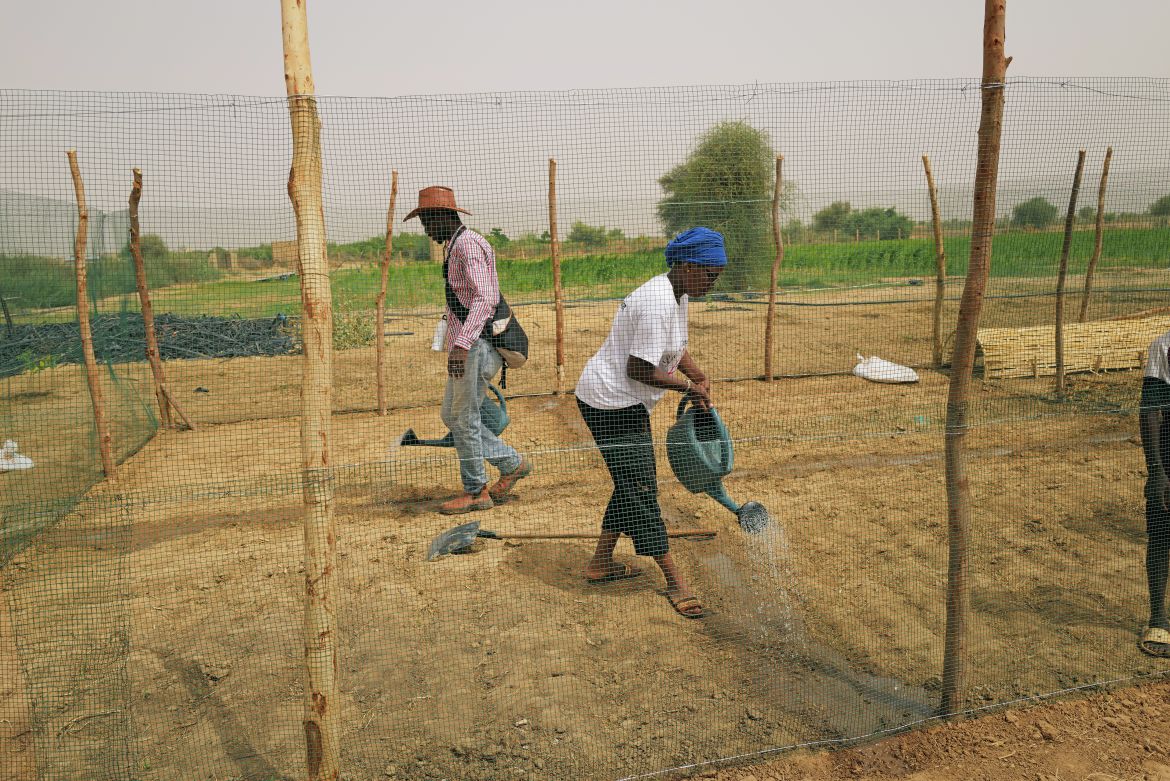
Every night, Moussa Kamara works at his bakery preparing hundreds of loaves. But at sunrise, instead of going home to sleep, he now starts a second back-breaking job – hoeing the earth and tending newly sown seeds in a specially designed circular garden.

Kamara, 47, believes the garden will prove even more important than the bakery in the future for feeding his extended family, including 25 children, and other residents of Boki Dawe, a Senegalese town near the border with Mauritania.

He is part of a project that aims to create hundreds of such gardens – known as “Tolou Keur” in Senegal’s Wolof language – that organisers hope will boost food security, reduce regional desertification and engage thousands of community workers.

“This project is incredibly important,” said Kamara, finally at home after a night spent at the bakery followed by 10 hours of cultivating edible and medicinal plants in the garden.

“When you grow one tree, over 20 years people and animals will benefit from it,” said Kamara, whose commitment and hard work have earned him the role of garden caretaker.

The project marks a new, more local approach to what is known as the Green Wall initiative, launched in 2007, that aims to slow desertification across Africa’s Sahel region, the arid belt south of the Sahara Desert, by planting an 8,000km (4,970 miles) line of trees from Senegal to Djibouti.

The wider initiative has only managed to plant 4 percent of the pledged 100 million hectares (247 million acres) of trees, and completing it by 2030, as planned, could cost up to $43bn, according to United Nations estimates.

Advertisement

Self-sufficiency

By contrast, the Tolou Keur gardens have flourished in the seven months since the project began and now number about two dozen, said Senegal’s reforestation agency.

Three months after a garden is completed, its agents begin a series of monthly visits over two years to assess progress.

The gardens hold plants and trees resistant to hot, dry climates, including papaya, mango, moringa and sage. Circular beds allow roots to grow inwards, trapping liquids and bacteria and improving water retention and composting.

Project manager Karine Fakhoury said it was important that local people felt fully engaged: “This is not an external project, where somebody comes from outside and tells people what to do. It is something entirely indigenous.”

The gardens are partly a response to the COVID-19 pandemic.

Senegal shut its borders early last year to try to curb the spread of the coronavirus, cutting imports and exposing rural communities’ dependence on foreign food and medicines.

This prompted the reforestation agency to seek ways to help villages become more self-sufficient.

Aly Ndiaye, a Senegalese agricultural engineer based in Brazil who got stuck in Senegal when the borders closed, stressed the importance of “smaller actions that are permanent”.

“A thousand Tolou Keur is already 1.5 million trees,” said Ndiaye, the mastermind behind the circular bed design. “So if we start, we can do a lot.”

Not all the gardens have succeeded. In the remote village of Walalde, the desert has already begun to reclaim the land set aside and there have been problems with the solar-powered pump.

But in the eastern town of Kanel, the garden is thriving. Its caretakers solved a water pump issue by digging traditional irrigation canals. A concrete wall and guard dogs help keep out rodents that would eat the lush mint and hibiscus plants inside.

Kamara, the baker, believes the gardens could offer a further benefit – discouraging sub-Saharan Africans from embarking on long, perilous journeys in search of better lives elsewhere.

“The day people realise the full potential of the Great Green Wall, they will stop these dangerous migration routes where you can lose your life at sea,” he said. “It’s better to stay, work the soil, cultivate and see what you can earn.”

Moussa Kamara shows a sketch of a Tolou Keur garden, which holds plants and trees resistant to hot, dry climates. They are planted with circular beds that allow roots to grow inwards, trapping liquids and bacteria and improving water retention and composting. [Zohra Bensemra/Reuters]
Advertisement
Khadidiatou Diouf, 32, a Tolou Keur programme trainer at the eco-villages department of the Senegalese Agency for Reforestation and the Great Green Wall, shows how to install a watering system at a newly built garden in Boki Diawe. [Zohra Bensemra/Reuters]
A chicken cage at a Tolou Keur garden in Boki Diawe. [Zohra Bensemra/Reuters]
Ibrahima Samba Diop, 75, who is one of the beneficiaries of the Tolou Keur garden scheme, checks plants within the Great Green Wall target area in Kanel, Matam region. [Zohra Bensemra/Reuters]
Kamara helps to install a water reserve at a Tolou Keur garden. [Zohra Bensemra/Reuters]
A Fulani nomadic tribe member sits on a cart as she travels in the Barkedji-Dodji Forest, in Linguere department, Louga region, Senegal, July 14, 2021
A Fulani nomadic tribe member sits on a cart as she travels in the Barkedji-Dodji Forest, an area which is part of the Great Green Wall of the Sahara and the Sahel. [Zohra Bensemra/Reuters]
Advertisement
The Green Wall initiative was launched in 2007 to slow desertification across Africa's Sahel region. [Zohra Bensemra/Reuters]

Related

  • From: Featured Documentaries

    Blood, Sweat and Sugar

    The sugar industry’s bitter legacy, built on slavery, exploitation and environmental damage, is still resonating today.

    Published On 15 Apr 202615 Apr 2026
    Video Duration 01 hours 32 minutes 07 seconds play-arrow01:32:07
  • From: NewsFeed

    Waist-deep floodwaters force hundreds to evacuate Java, Indonesia

    Hundreds of houses were affected in Indonesia’s West Java due to flooding from heavy rainfall.

    Published On 13 Apr 202613 Apr 2026
    Video Duration 01 minutes 20 seconds play-arrow01:20
  • From: NewsFeed

    Video: Severe flooding closes schools in Saudi Arabia

    Saudi Arabia has ordered schools to close after severe flooding swept through parts of the country.

    Published On 12 Apr 202612 Apr 2026
    Video Duration 00 minutes 42 seconds play-arrow00:42
  • Argentina MPs approve bill allowing mining in glaciers

    Thousands of people have demonstrated against the bill, which scientists and activists say threatens water resources.

    Published On 9 Apr 20269 Apr 2026
    Demonstrators pose during a protest against the modifications of the Glaciers Law in front of the Congress building in Buenos Aires, on April 8, 2026.

More from Gallery

  • Photos: Afghan villagers turn to gold-panning to sustain livelihoods

    Afghan villagers turn to gold panning to sustain livelihoods
    This gallery article has 9 imagescamera9
  • Photos: Families across Sudan endure years of displacement, hunger, loss

    Crowd of children sits under a tree and listens to a teacher.
    This gallery article has 17 imagescamera17
  • Photos: Maradona’s childhood home becomes soup kitchen for those in need

    A woman rides a bicycle past murals depicting the late football star Diego Maradona.
    This gallery article has 11 imagescamera11
  • Nigerian artisans preserve handwoven fabric amid rising global demand

    Nigerian artisans preserve handwoven fabric amid rising global demand
    This gallery article has 14 imagescamera14

Most popular

  • Iran says no date set for talks with US, Strait of Hormuz to stay closed

    Tankers anchored in the Strait of Hormuz, Saturday, April 18, 2026.
  • Trinidad and Tobago police uncover 56 bodies, mostly children, at cemetery

    FILE - Trinidad and Tobago Prime Minister Kamla Persad-Bissessar stands at the State Department in Washington, Sept. 30, 2025. (AP Photo/Mark Schiefelbein, File)
  • Iran war updates: IRGC says Hormuz closed until US blockade lifted

    People walk near an anti-U.S. billboard on a building in Tehran, Iran, April 16, 2026. REUTERS/Thaier Al-Sudani Foreign media in Iran operate under guidelines set by the Ministry of Culture and Islamic Guidance, which regulates press activity and permissions. TPX IMAGES OF THE DAY
  • Iran navy says any ship trying to pass Strait of Hormuz will be targeted

    A drone view shows the Malta-flagged tanker Agios Fanourios I, an oil tanker that sailed through the Strait of Hormuz, arriving in Iraq’s territorial waters off Basra, Iraq, April 17, 2026. REUTERS/Mohammed Aty

  • About

    • About Us
    • Code of Ethics
    • Terms and Conditions
    • EU/EEA Regulatory Notice
    • Privacy Policy
    • Cookie Policy
    • Cookie Preferences
    • Accessibility Statement
    • Sitemap
    • Work for us
  • Connect

    • Contact Us
    • User Accounts Help
    • Advertise with us
    • Stay Connected
    • Newsletters
    • Channel Finder
    • TV Schedule
    • Podcasts
    • Submit a Tip
    • Paid Partner Content
  • Our Channels

    • Al Jazeera Arabic
    • Al Jazeera English
    • Al Jazeera Investigative Unit
    • Al Jazeera Mubasher
    • Al Jazeera Documentary
    • Al Jazeera Balkans
    • AJ+
  • Our Network

    • Al Jazeera Centre for Studies
    • Al Jazeera Media Institute
    • Learn Arabic
    • Al Jazeera Centre for Public Liberties & Human Rights
    • Al Jazeera Forum
    • Al Jazeera Hotel Partners

Follow Al Jazeera English:

  • facebook
  • twitter
  • youtube
  • instagram-colored-outline
  • rss
Al Jazeera Media Network logo
© 2026 Al Jazeera Media Network