Skip linksSkip to Content
play
Live
Navigation menu
  • News
    • Africa
    • Asia
    • US & Canada
    • Latin America
    • Europe
    • Asia Pacific
  • Middle East
  • Explained
  • Opinion
  • Sport
  • Video
    • Features
    • Economy
    • Human Rights
    • Climate Crisis
    • Investigations
    • Interactives
    • In Pictures
    • Science & Technology
    • Podcasts
    • Travel
play
Live
Navigation menu
  • Russia-Ukraine war
  • What are Russia’s gains from the Iran war?
  • ‘We are not losers; we are winners’
  • Four years later: War in Ukraine
  • How Putin stays strong in Russia

In Pictures

Gallery|Hunger

Photos: Hunger killing children in forgotten corner of Uganda

More than 91,000 children are suffering from acute malnutrition in one of Uganda’s poorest regions.

Save

Share

facebookxwhatsapp-strokecopylink
Mothers stay with malnourished children at Kaabong hospital in Kaabong, Karamoja region, Uganda
Mothers stay with malnourished children at Kaabong hospital in Kaabong, Karamoja region. [Badru Katumba/AFP]
By AFP
Published On 15 Jun 202215 Jun 2022

In Karamoja, one of Uganda’s poorest regions, anxious mothers clutch bone-thin infants in a malnutrition ward, terrified their child could be the next to succumb to starvation.

One of Maria Logiel’s youngsters, too weak to sit up, bears telltale skin lesions caused by extreme hunger. The other, strapped to her back, stares gauntly from sunken eyes.

“I came with these two because they were badly off, and going to die,” Logiel told AFP at a hospital in Karamoja, a vast and isolated northeastern border region afflicted by drought, disease and armed bands. “(But) I left two others home, and I worry that by the time I get back, they’ll be no more,” the 30-year-old mother said.

More than half a million people are going hungry in Karamoja, approximately 40 percent of the population of this neglected, long-suffering rural region between South Sudan and Kenya.

Natural disasters, plagues of locusts and armyworms, and raids by heavily armed cattle thieves have left little to eat.

As food has become ever more scarce, Karamoja’s most vulnerable residents are struggling to survive.

“In three months we have lost more than 25 children under five due to the malnutrition,” said Doctor Sharif Nalibe, the district health officer in Kaabong, one of Karamoja’s worst-hit districts. “And these were the ones under our care, but (who) were brought at the last minute to the hospital. But there are many who die and (are) not reported in the communities.”

Starvation in Karamoja is going largely unnoticed as higher-profile crises, including looming famine in the Horn of Africa, and the war in Ukraine, compel global attention.

Advertisement

Even in Uganda, the desperation is out of sight, unfolding 500 kilometres (310 miles) from the capital, Kampala, in a part of the country long written off as harsh and volatile.

Across the region, about 91,600 children and 9,500 pregnant or breastfeeding women are suffering from acute malnutrition and need treatment, according to the latest assessment by humanitarian agencies.

“In terms of acute malnutrition … this year we have experienced the worst that we have had in the last 10 years,” said Alex Mokori, a nutrition specialist from UNICEF, which is screening for malnutrition in Karamoja with local authorities.

Logiel said she resorted to foraging to put food on the table, but the wild plants often made her children sicker.

In desperation, she would sometimes buy the mealy dregs from a popular locally made sorghum brew called “malwa”, even if the effect was mildly alcoholic.

Half a litre of this residue goes for about 40 US cents – often more than she could afford.

“Often we failed to raise money and the children sleep hungry,” Logiel said.

With a porous border and thriving illicit trade, Karamoja has endured decades of tit-for-tat armed cattle raids between nomadic clans that wander the lawless frontier between Uganda, South Sudan and Kenya.

These incursions make life even harder for Karimojong communities entirely reliant on livestock and crops to survive, and government interventions to disarm rustlers have not stopped the cycles of violence.

The erratic effects of a changing climate – Karamoja is experiencing harsh drought, but last year witnessed damaging floods and landslides – have only multiplied the hardships bearing down on the region.

“Now, with the prolonged drought, and cattle rustlers, and communities left with no source of livelihood, we are heading for the worst,” said Nalibe, the Kaabong district health officer.

For some, the worst has already happened.

Nangole Lopwon went to sell firewood in a nearby village and left her hungry twins with one of her older children, only to return and find one of the young ones had died.

“What could I do? The child was not sick. It was purely hunger that killed him,” said the mother of five from Kaabong.

Now she, too, is malnourished, and the surviving twin is in a dire state.

“Even this one is about to die,” she wailed.

A woman stays with a malnourished child at Kaabong hospital in Kaabong
A woman stays with a malnourished child at Kaabong hospital. More than half a million people are going hungry in Karamoja. [Badru Katumba/AFP]
Advertisement
Mothers and their children sit under a tree during a nutrition screening at Nadunget Health Centre
Mothers and their children sit under a tree during a nutrition screening at Nadunget Health Centre in Nadunget, Karamoja region. [Badru Katumba/AFP]
A nurse examines a malnourished child during a nutrition screening at Nadunget Health Centre
A nurse examines a malnourished child during a screening at Nadunget Health Centre. [Badru Katumba/AFP]
A nurse weighs a baby during a nutrition screening at Nadunget Health Centre
Across the region, about 91,600 children and 9,500 pregnant or breastfeeding women are suffering from acute malnutrition and need treatment. [Badru Katumba/AFP]
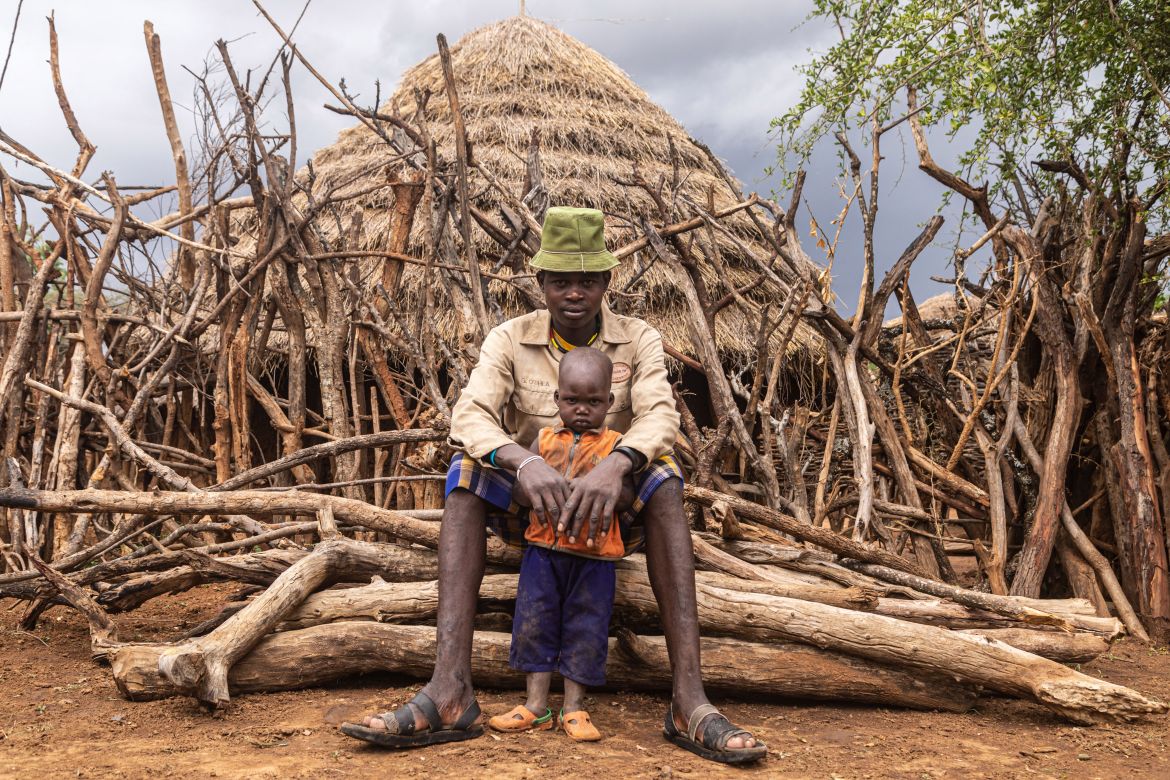
A Karamojong man poses with his son in Kotirae, Karamoja region
A Karamojong man poses with his son in Kotirae. Natural disasters, invasive pests like locusts and armyworms, and raids by heavily armed cattle thieves have left the battered region's rural inhabitants with little to eat. [Badru Katumba/AFP]
A family plant groundnuts in Kachinga,
A family plant groundnuts in Kachinga. [Badru Katumba/AFP]
Advertisement
A man works in a marble quarry in Rupa
A man works in a marble quarry in Rupa. [Badru Katumba/AFP]
Karamojong men pose in Kotirae
As food has become ever more scarce, Karamoja's most vulnerable residents are struggling to survive. [Badru Katumba/AFP]
Elderly women attend a village meeting on malnutrition in Rupa
Elderly women attend a village meeting on malnutrition in Rupa. [Badru Katumba/AFP]

Related

  • What can stop hunger in the Sahel?

    United Nations warns millions of people in region are at imminent risk of starvation.

    Published On 31 May 202231 May 2022
    Hunger-Niger
    Video Duration play-arrow
  • Ugandan communities battle to benefit from mining on their land

    Communities in Karamoja face an uphill task organising to beat international capital and authoritarian politics.

    Published On 11 Mar 202211 Mar 2022
    Small-scale miners breaking rocks in Rupa sub-county, Moroto district, Uganda, on 24 November 2021
  • UN: 18 million people facing severe hunger in Sahel region

    It cites the effects of Russia’s war in Ukraine, COVID-19 pandemic, climate-induced shocks and rising costs as reasons.

    Published On 20 May 202220 May 2022
    A Fulani nomadic tribe member sits on a cart as she travels in the Barkedji-Dodji Forest, in Linguere department, Louga region, Senegal, July 14, 2021
  • Could Ukraine war prompt another hunger crisis in Africa?

    African Union says disruption of Ukraine grain exports risks ‘catastrophic scenario’ of food shortages and price rises.

    Published On 11 Jun 202211 Jun 2022
    Video Duration play-arrow

More from Gallery

  • Photos: Mughal-era pigeon training survives in heart of India’s capital

    Mughal-era pigeon training survives in heart of India's capital
    This gallery article has 11 imagescamera11
  • Photos: Displaced Lebanese families return home despite Israeli attacks

    Tens of thousands return to southern Lebanon despite warnings and risks
    This gallery article has 13 imagescamera13
  • Photos: Afghan villagers turn to gold-panning to sustain livelihoods

    Afghan villagers turn to gold panning to sustain livelihoods
    This gallery article has 9 imagescamera9
  • Photos: Families across Sudan endure years of displacement, hunger, loss

    Crowd of children sits under a tree and listens to a teacher.
    This gallery article has 17 imagescamera17

Most popular

  • Iran says no talks under siege; Trump cancels envoys’ trip to Pakistan

    A woman walks past images of Iran's late supreme leaders Ayatollah Ruhollah Khomeini (above L) and Ayatollah Ali Khamenei (Above C) next to newly elected supreme leader Mojtaba Khamenei (above R), and photos strung along the wall of children killed on the first day of the war in an alleged US-Israeli missile strike on a school in the southern Iranian city of Minab, outside a mosque in the capital Tehran on April 25, 2026. On February 28, Israel and the United States launched strikes on Iran, killing its supreme leader and triggering a war that spread across the Middle East.
  • Trump updates: Suspect arrested after shooting at correspondents’ dinner

    Secret service agents respond during the White House Correspondents Dinner, Saturday, April 25, 2026, in Washington.
  • Trump unhurt after shots fired at White House correspondents’ dinner

    Trump
  • Iran war updates: Trump cancels Witkoff, Kushner trip to Pakistan for talks

    In this photo provided by the Pakistan Ministry of Foreign Affairs, Iranian Foreign Minister Abbas Araghchi, center, is greeted by Pakistan Foreign Minister Ishaq Dar, second right, and Army Chief Field Marshal Asim Munir, third left, upon his arrival at Nur Khan airbase in Rawalpindi, Pakistan, Friday, April 24, 2026. (Pakistan Ministry of Foreign Affairs via AP)

  • About

    • About Us
    • Code of Ethics
    • Terms and Conditions
    • EU/EEA Regulatory Notice
    • Privacy Policy
    • Cookie Policy
    • Cookie Preferences
    • Accessibility Statement
    • Sitemap
    • Work for us
  • Connect

    • Contact Us
    • User Accounts Help
    • Advertise with us
    • Stay Connected
    • Newsletters
    • Channel Finder
    • TV Schedule
    • Podcasts
    • Submit a Tip
    • Paid Partner Content
  • Our Channels

    • Al Jazeera Arabic
    • Al Jazeera English
    • Al Jazeera Investigative Unit
    • Al Jazeera Mubasher
    • Al Jazeera Documentary
    • Al Jazeera Balkans
    • AJ+
  • Our Network

    • Al Jazeera Centre for Studies
    • Al Jazeera Media Institute
    • Learn Arabic
    • Al Jazeera Centre for Public Liberties & Human Rights
    • Al Jazeera Forum
    • Al Jazeera Hotel Partners

Follow Al Jazeera English:

  • facebook
  • twitter
  • youtube
  • instagram-colored-outline
  • rss
Al Jazeera Media Network logo
© 2026 Al Jazeera Media Network