Skip linksSkip to Content
play
Live
Navigation menu
  • News
    • Africa
    • Asia
    • US & Canada
    • Latin America
    • Europe
    • Asia Pacific
  • Middle East
  • Explained
  • Opinion
  • Sport
  • Video
    • Features
    • Economy
    • Human Rights
    • Climate Crisis
    • Investigations
    • Interactives
    • In Pictures
    • Science & Technology
    • Podcasts
    • Travel
play
Live

In Pictures

Gallery|Climate Crisis

Photos: Concerns as Pakistan glaciers melt

The South Asian country is home to more than 7,000 glaciers, but rising global temperatures are causing them to melt rapidly.

Save

Share

facebookxwhatsapp-strokecopylink
This aerial picture taken on June 10, 2022, shows Passu glacier near Passu village in Pakistan
Passu glacier near Passu village in Pakistan's Gilgit-Baltistan region. [Abdul Majeed/AFP]
By AFP
Published On 14 Jul 202214 Jul 2022

As dawn breaks over Javed Rahi’s mountain village, a loud boom shatters the silence and a torrent of water comes cascading down from the melting glacier nearby, followed by a thick cloud of smoke.

Rahi, a retired maths teacher, had been due to attend his nephew’s wedding the day the flood rushed through the village of Hassanabad in Pakistan’s Gilgit-Baltistan region.

“I expected women and children to sing and dance … Instead, I heard them screaming in terror,” the 67-year-old said. “It was like doomsday.”

The flood, which occurred as a heatwave gripped South Asia in May, swept away nine homes in the village and damaged half a dozen more.

The water also washed away two small hydro plants and a bridge that connected the remote community to the outside world.

Pakistan is home to more than 7,000 glaciers, more than anywhere else on Earth outside the poles.

But rising global temperatures linked to climate change are causing the glaciers to rapidly melt, creating thousands of glacial lakes.

The government has warned that 33 of these lakes, all located in the spectacular Himalaya, Hindu Kush and Karakoram mountain ranges that intersect in Pakistan, are at risk of bursting and releasing millions of cubic metres of water and debris in just a few hours, like in Hassanabad.

At least 16 such glacial lake outburst floods linked to heatwaves have occurred this year already, compared with an average of five or six per year, the Pakistani government said earlier this week.

The devastation caused by such floods makes recovery for affected communities an arduous task.

Advertisement

After disaster struck Hassanabad, Rahi and fellow villagers who lost their homes had to move to a nearby camp for displaced people.

Inside their makeshift tents are the few belongings they managed to salvage and mattresses to sleep on.

“We never thought we would fall from riches to rags,” Rahi said.

Pakistan is the world’s eighth most vulnerable country to extreme weather caused by climate change, according to the Global Climate Risk Index compiled by the environmental NGO, Germanwatch.

The country is experiencing earlier, hotter and more frequent heatwaves, with temperatures already hitting 50 degrees Celsius (122 Fahrenheit) this year.

Floods and droughts in recent years have killed and displaced thousands of people, destroyed livelihoods and damaged infrastructure.

According to the United Nations Development Programme, a lack of information on glacial changes in Pakistan makes it difficult to predict hazards originating from them.

Home to more than 220 million people, Pakistan says it is responsible for less than one percent of global greenhouse gas emissions.

Yet it remains highly vulnerable to climate change effects, dependent on climate-sensitive sectors such as agriculture and natural resources.
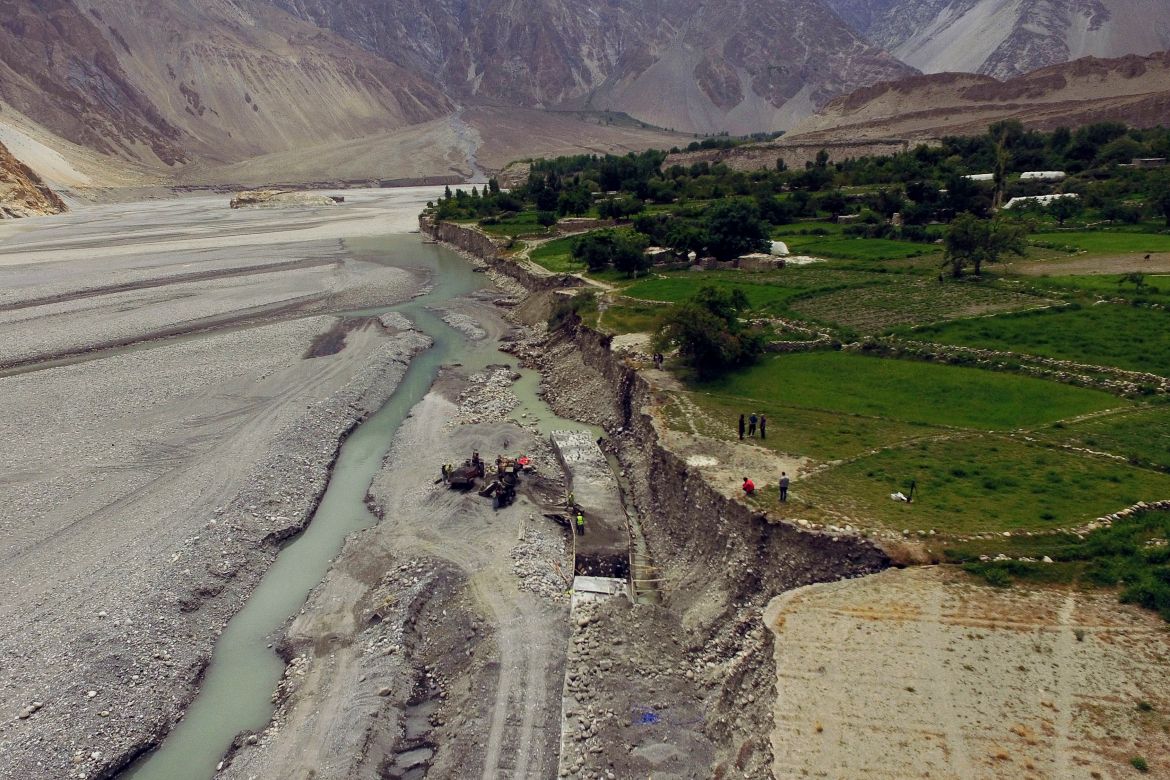
In this aerial picture taken on June 10, 2022, engineers and construction workers built a concrete wall to protect Passu village from land erosion
Engineers and construction workers built a concrete wall to protect Passu village from land erosion. [Abdul Majeed/AFP]
Advertisement
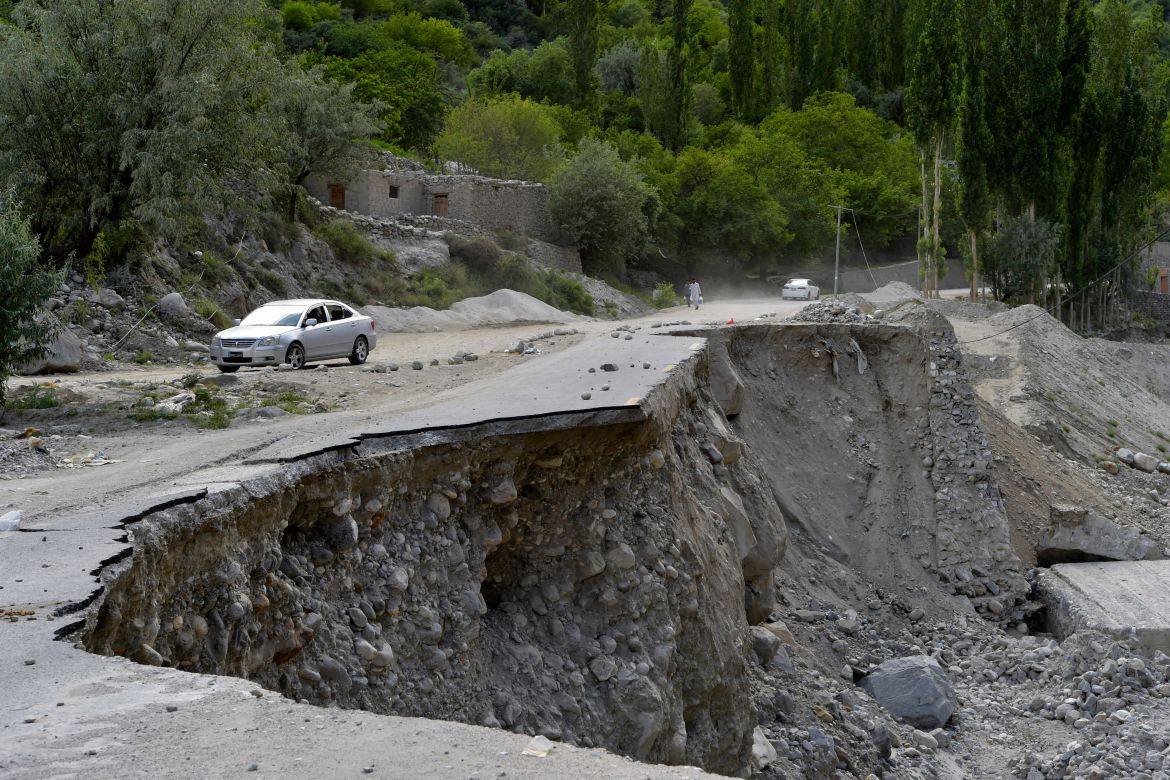
In this picture taken on June 9, 2022, a vehicle drives past a partially collapsed section of the Karakoram Highway damaged after a lake outburst because of a melting glacier, near Hassanabad village
A vehicle drives past a partially collapsed section of the Karakoram highway, damaged after a lake burst its banks after a glacier melted, near Hassanabad village. [Abdul Majeed/AFP]
In this picture taken on June 9, 2022, a resident clears debris from a damaged house after a lake outburst because of a melting glacier in Hassanabad village
A resident clears debris from a damaged house after a lake burst after a glacier melted in Hassanabad village. [Abdul Majeed/AFP]
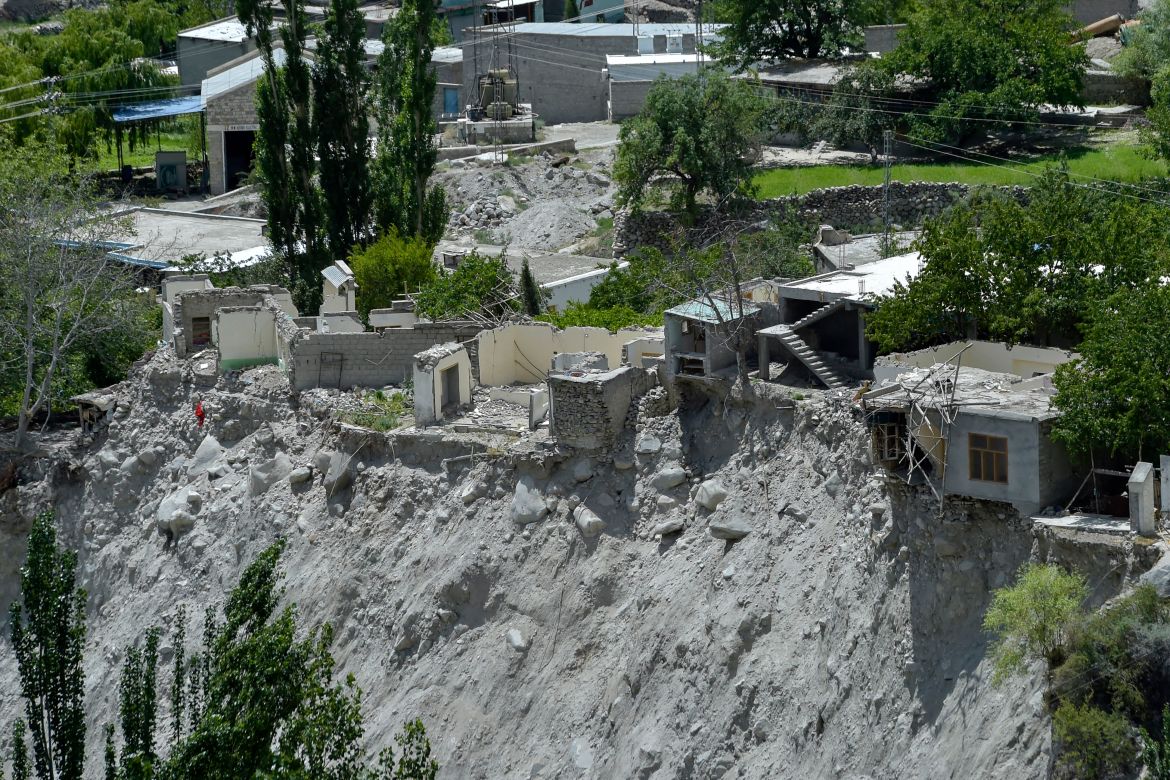
In this picture taken on June 9, 2022, a general view shows damaged houses after they were swept away by a lake outburst because of a melting glacier, in Hassanabad village
Houses were damaged and swept away by the lake after the glacier melted, in Hassanabad. [Abdul Majeed/AFP]
In this picture taken on June 9, 2022, construction workers build a temporary bridge after a lake outburst because of a melting glacier swept away the main bridge in Hassanabad village
Construction workers build a temporary bridge after the main bridge in Hassanabad was swept away. [Abdul Majeed/AFP]
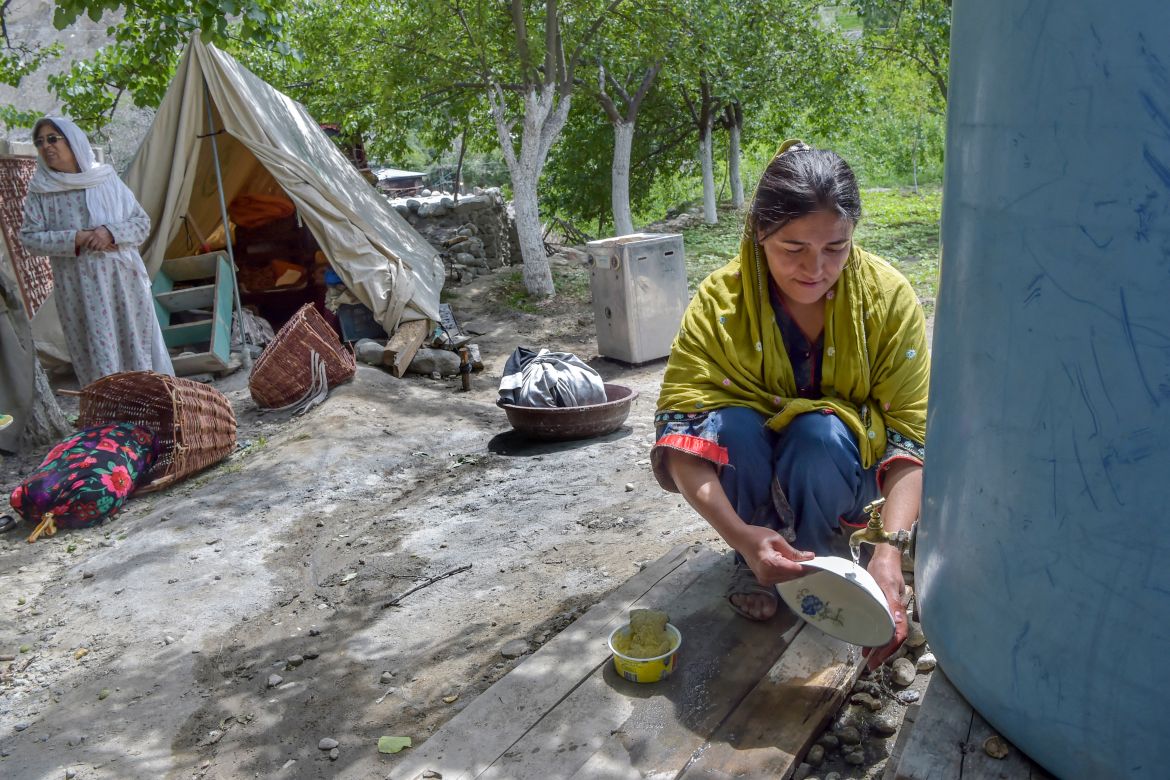
In this picture taken on June 9, 2022, a local resident washes dishes outside tents setup after their homes were swept by a lake outburst because of a melting glacier in Hassanabad
A resident washes dishes outside tents set up after their homes were swept away in Hassanabad. [Abdul Majeed/AFP]
Advertisement
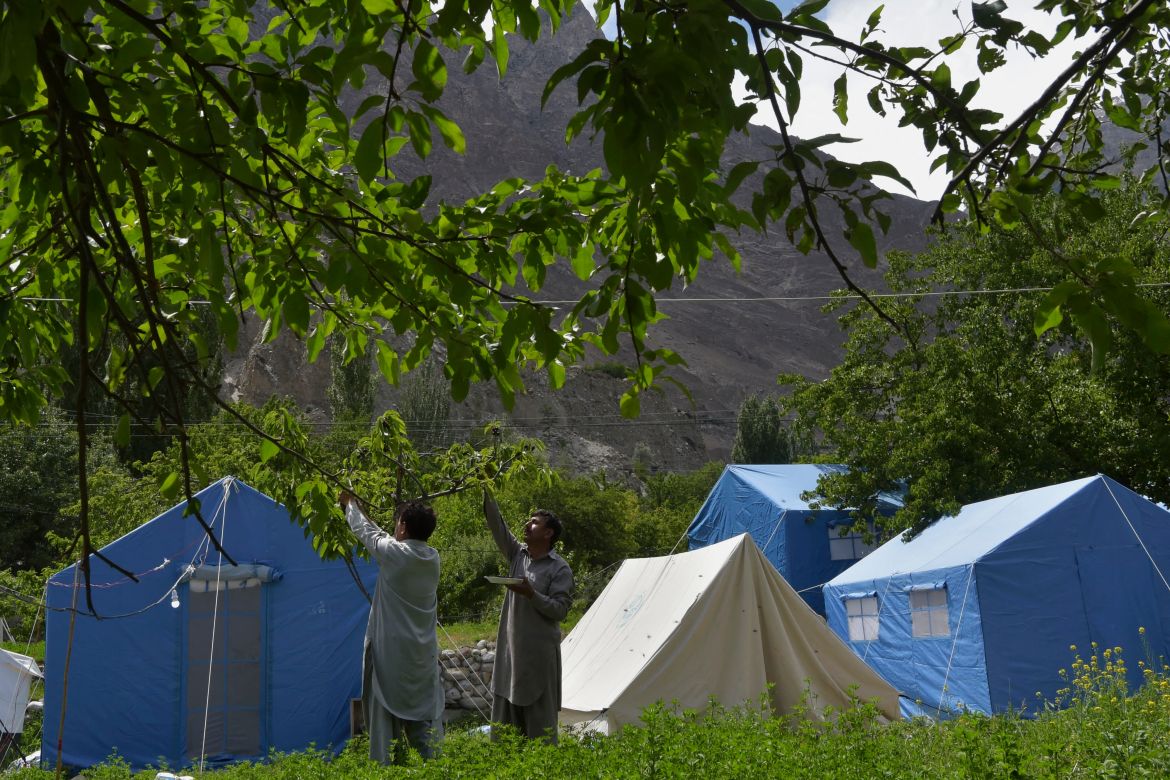
In this picture taken on June 9, 2022, local residents pick cherries from a tree beside tents setup after their homes were swept by a lake outburst because of a melting glacier, in Hassanabad village
Residents pick cherries from a tree beside tents set up after their homes were swept away in Hassanabad village. [Abdul Majeed/AFP]

Related

  • Pakistan’s tourism industry rocked by climate change

    With temperatures 9°C above normal, Lahore’s tourism industry has been shell-shocked in recent months.

    Published On 5 Jun 20225 Jun 2022
    A boy jumps into a canal to cool himself on a sweltering hot day in the eastern city of Lahore, Pakistan [File: Mohsin Raza/Reuters]
  • Climate crisis made South Asia heatwaves ’30 times more likely’

    Study says heatwaves in the region should be ‘rare’ but current level of global warming made them 30 times more likely.

    Published On 24 May 202224 May 2022
    India heatwave
  • ‘Perfect climate storm’: Pakistan reels from extreme heat

    ‘Torrid’ heatwave with temperatures reaching mid-40°s Celsius has renewed debate over the climate crisis.

    Published On 21 May 202221 May 2022
    Two young men next to a water canal
  • World’s glaciers hold less ice than thought: Study

    New study finds world’s glaciers contain far less ice than previously thought, raising concerns for some communities.

    Published On 7 Feb 20227 Feb 2022
    glacier

More from Gallery

  • Photos: Mughal-era pigeon training survives in heart of India’s capital

    Mughal-era pigeon training survives in heart of India's capital
    This gallery article has 11 imagescamera11
  • Photos: Displaced Lebanese families return home despite Israeli attacks

    Tens of thousands return to southern Lebanon despite warnings and risks
    This gallery article has 13 imagescamera13
  • Photos: Afghan villagers turn to gold-panning to sustain livelihoods

    Afghan villagers turn to gold panning to sustain livelihoods
    This gallery article has 9 imagescamera9
  • Photos: Families across Sudan endure years of displacement, hunger, loss

    Crowd of children sits under a tree and listens to a teacher.
    This gallery article has 17 imagescamera17

Most popular

  • Iran says no talks ‘under shadow of threats’; Trump says blockade to remain

    Relatives pray by the graves of Hussein Dbouk, 80, and his Son Rabih Dbouk, 32, victims retrieved from the rubble of a building hit by an Israeli strike just before the ceasefire, following a funeral ceremony, amid a 10-day ceasefire between Lebanon and Israel, in Tyre, southern Lebanon, April 20, 2026.
  • Iran war updates: Uncertainty over talks, Trump says deal to come ‘quickly’

    A view of Iranian-flagged cargo ship M/V Touska as the U.S. Navy Arleigh Burke-class Aegis guided missile destroyer USS Spruance conducts its interception in a location given as the north Arabian Sea, in this screen capture from a video released April 19, 2026.
  • Technofacism? Why Palantir’s pro-West ‘manifesto’ has critics alarmed

    Protesters hold up signs to "defund Palantir" and "free DC"
  • Japan lifts ban on lethal weapons exports in major shift of pacifist policy

    FILE PHOTO: FILE PHOTO: Sanae Takaichi, Japan’s prime minister, speaks during a press conference at the prime minister’s office in Tokyo, Japan, on Wednesday, Feb. 18, 2026. Kiyoshi Ota/Pool via REUTERS/File Photo/File Photo/File Photo

  • About

    • About Us
    • Code of Ethics
    • Terms and Conditions
    • EU/EEA Regulatory Notice
    • Privacy Policy
    • Cookie Policy
    • Cookie Preferences
    • Accessibility Statement
    • Sitemap
    • Work for us
  • Connect

    • Contact Us
    • User Accounts Help
    • Advertise with us
    • Stay Connected
    • Newsletters
    • Channel Finder
    • TV Schedule
    • Podcasts
    • Submit a Tip
    • Paid Partner Content
  • Our Channels

    • Al Jazeera Arabic
    • Al Jazeera English
    • Al Jazeera Investigative Unit
    • Al Jazeera Mubasher
    • Al Jazeera Documentary
    • Al Jazeera Balkans
    • AJ+
  • Our Network

    • Al Jazeera Centre for Studies
    • Al Jazeera Media Institute
    • Learn Arabic
    • Al Jazeera Centre for Public Liberties & Human Rights
    • Al Jazeera Forum
    • Al Jazeera Hotel Partners

Follow Al Jazeera English:

  • facebook
  • twitter
  • youtube
  • instagram-colored-outline
  • rss
Al Jazeera Media Network logo
© 2026 Al Jazeera Media Network