Skip linksSkip to Content
play
Live
Navigation menu
  • News
    • Africa
    • Asia
    • US & Canada
    • Latin America
    • Europe
    • Asia Pacific
  • Middle East
  • Explained
  • Opinion
  • Sport
  • Video
    • Features
    • Economy
    • Human Rights
    • Climate Crisis
    • Investigations
    • Interactives
    • In Pictures
    • Science & Technology
    • Podcasts
    • Travel
play
Live

In Pictures

Gallery|Climate Crisis

Iraq’s marshes are dying, and so is a civilization

The marshlands have shrunk from 20,000 square kilometres in the early 1990s to 4,000 by latest estimates.
Save

Share

facebookxwhatsapp-strokecopylink
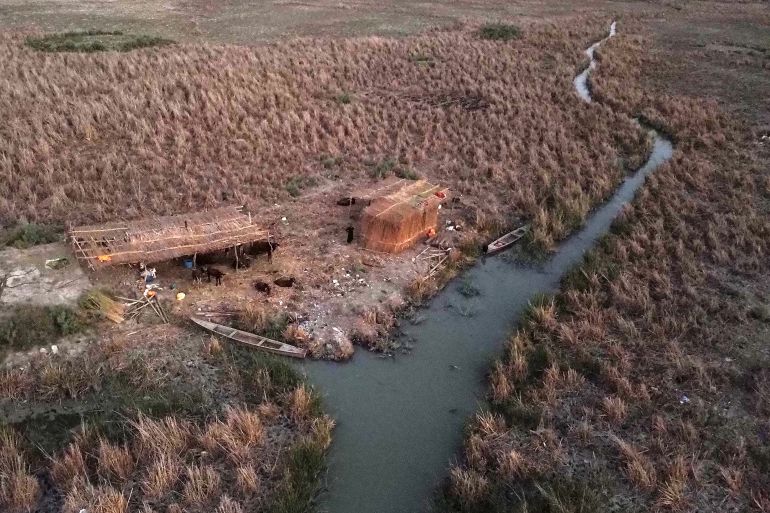
This aerial view shows a drying river in Chibayish in Iraq's southern Dhi Qar province.
This aerial view shows a drying river in Chibayish in Iraq's southern Dhi Qar province, home to fabled marshes in the floodplain of the Tigris River, already suffering from the effects of global warming. [Asaad Niazi/AFP]
By AFP
Published On 11 Dec 202311 Dec 2023

Mohammed Hamid Nour is only 23 but is already nostalgic for how Iraq’s Mesopotamian marshes once were before drought dried them up, decimating his herd of water buffaloes.

Even at their centre in Chibayish, only a few expanses of the ancient waterways – home to a Marsh Arab culture that goes back millennia – survive, linked by channels that snake through the reeds.

Pull back further and the water gives way to bare, cracked earth.

Mohammed has lost three-quarters of his herd to the drought that is now ravaging the marshes for a fourth consecutive year. The United Nations said it is the worst in 40 years, describing the situation as “alarming”, with “70 percent of the marshes devoid of water”.

“I beg you, Allah, have mercy!” Mohammed implored, keffiyeh on his head as he contemplated the disaster under the unforgiving blue of a cloudless sky.

As the marshes dry out, the water gets salty until it starts killing the buffaloes. Many of Mohammed’s herd died like this, others he was forced to sell before they too perished.

“If the drought continues and the government doesn’t help us, the others will also die,” said the young herder, who has no other income.

In the 1990s, Iraq’s former strongman President Saddam Hussein drained the marshes – which were 20,000sq km (7,700sq miles) – to punish the Marsh Arabs, diverting the flows of the Tigris and Euphrates rivers away from the land.

It was only after the invasion of Iraq in 2003 that people began to dismantle the Saddam-era infrastructure, allowing the marshes to refill slightly, but they are still only 4,000sq km (1,500sq miles) by the latest estimates – also choked by dams on the Tigris and Euphrates upstream in Turkey and Syria and soaring temperatures of climate change.

Advertisement

Iconic culture

Marsh buffalo milk is an iconic part of Iraqi cuisine, as is the thick, clotted “geymar” cream Iraqis love to have with honey for breakfast.

The buffaloes are tricky to raise and their milk cannot be mass-produced, and their rearing is tied to the marshes

Both the Mesopotamian marshes and the culture of the Ma’dan – Marsh Arabs – who live in them, have UNESCO World Heritage status. The Ma’dan have hunted and fished there for 5,000 years, building houses from woven reeds on floating reed islands where the Tigris and Euphrates rivers come together before pouring into the Gulf.

Even their beautifully intricate mosques were made of reeds.

Today, only a few thousand of the quarter million Ma’dan who lived in the marshes in the early 1990s remain.
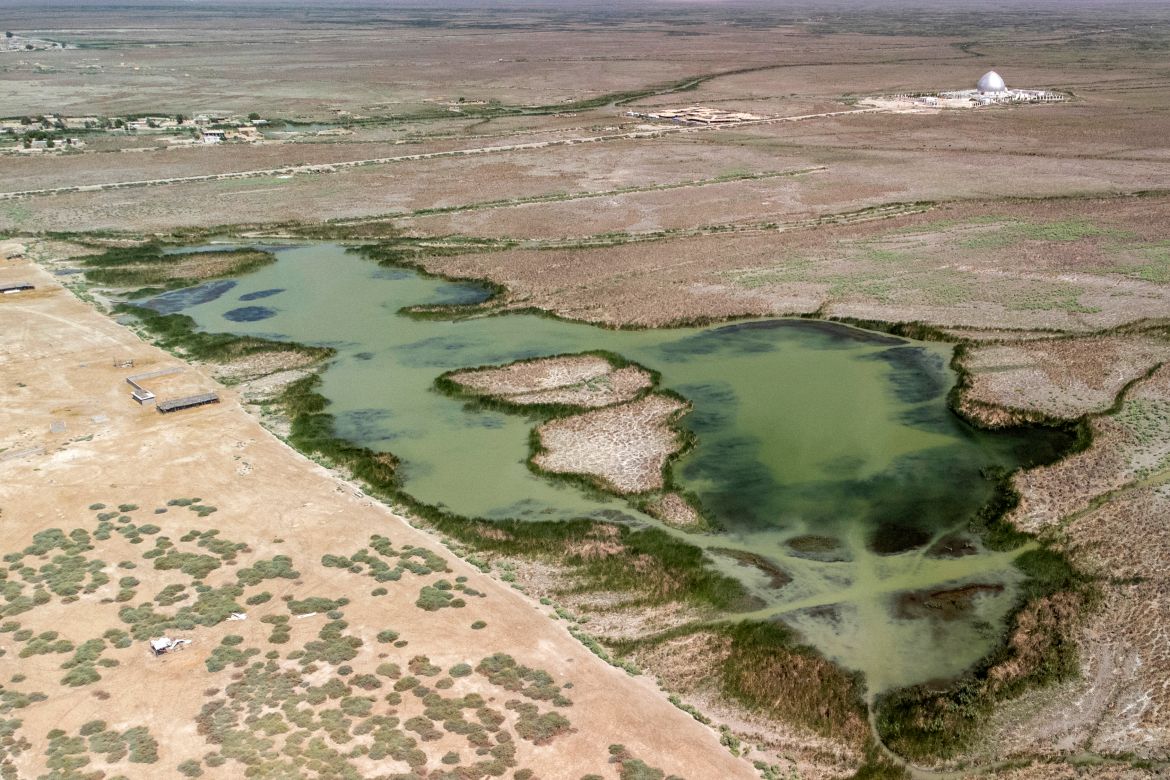
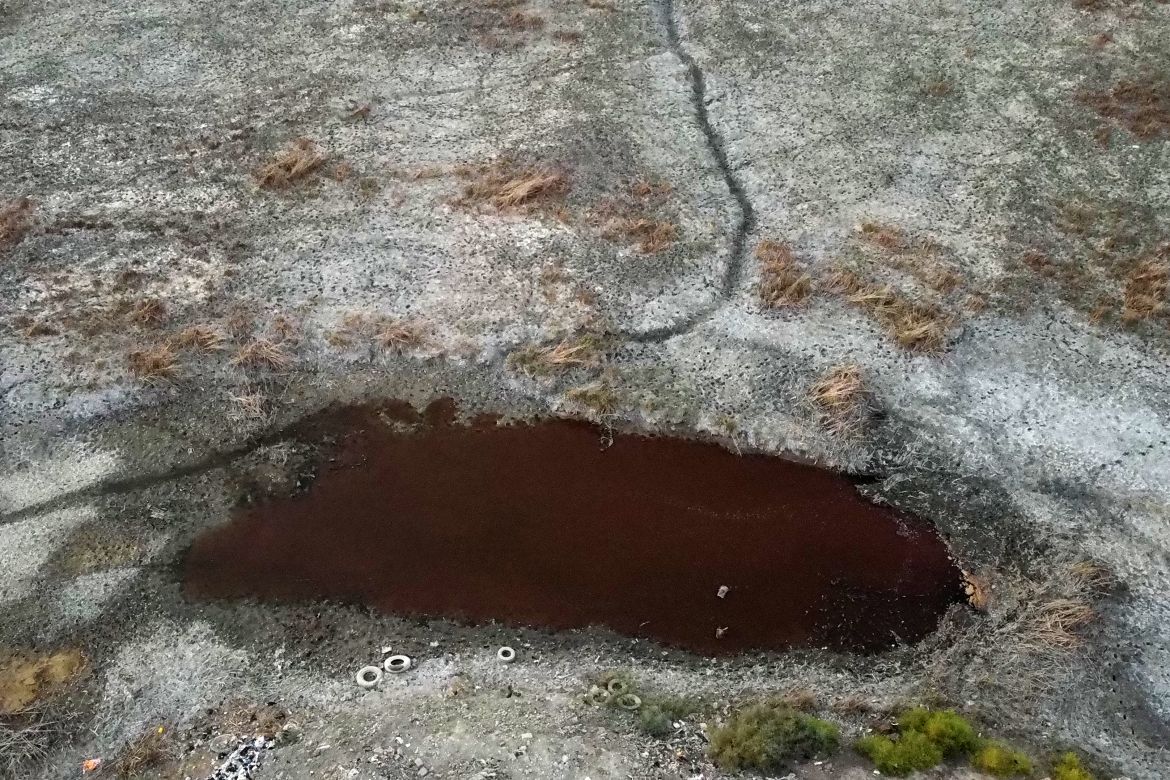
An aerial picture shows a the drying-up marshes of Chibayish in Iraq's southern Dhi Qar province.
Iraq is one of the five countries most touched by some effects of climate change, according to the UN. Rain is rarer and rarer and temperatures are expected to keep rising. [Asaad Niazi/AFP]
Advertisement
This aerial view shows a drying marsh in Chibayish in Iraq's southern Dhi Qar province.
Water levels in the central marshlands and the Euphrates which feeds it are 'dropping by half a centimetre a day', said engineer Jassim al-Assadi of Nature Iraq, the country's leading conservation group. That will get worse 'over the next two months as the temperatures rise and more and more water evaporates', he added. [Asaad Niazi/AFP]
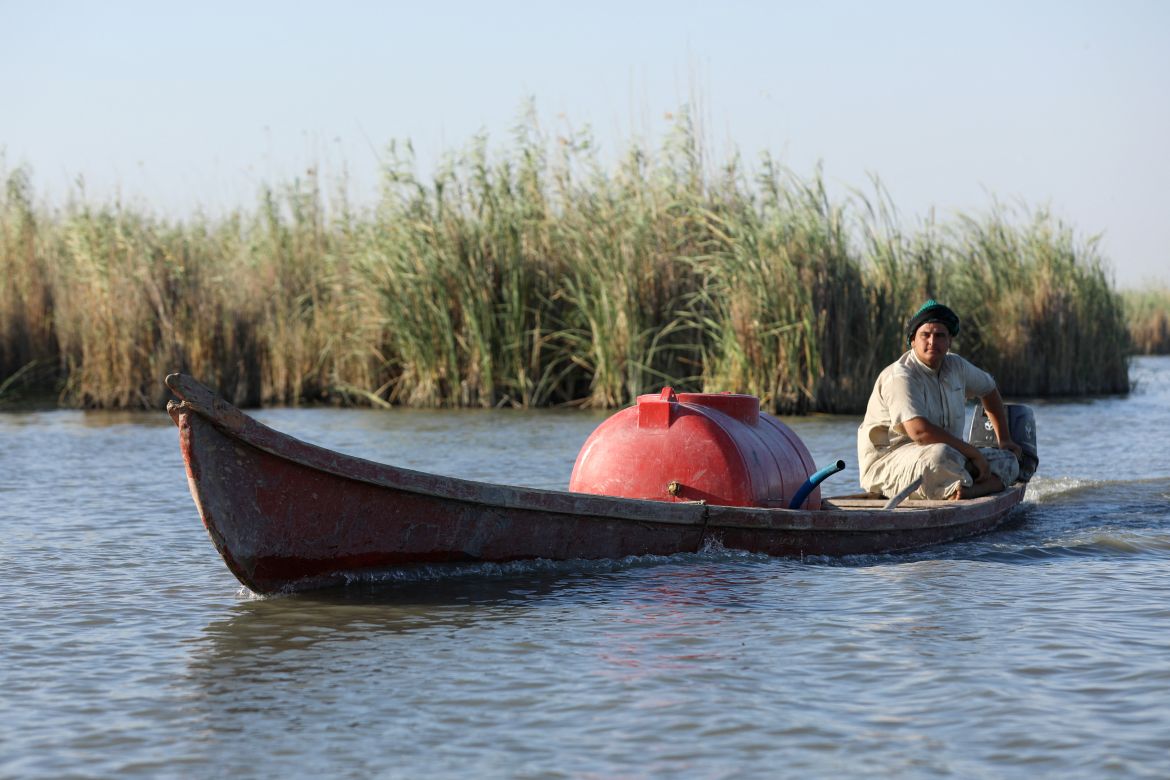
Mohammed Hamid Nour ferries a tank filled with less saline water than the water's edge, to give to his buffaloes in the Chibayish marshland in Iraq's southern Dhi Qar province.
To draw water for his remaining buffaloes, Mohammed Hamid Nour takes his canoe out into deeper water, where salt levels are lower. [Asaad Niazi/AFP]
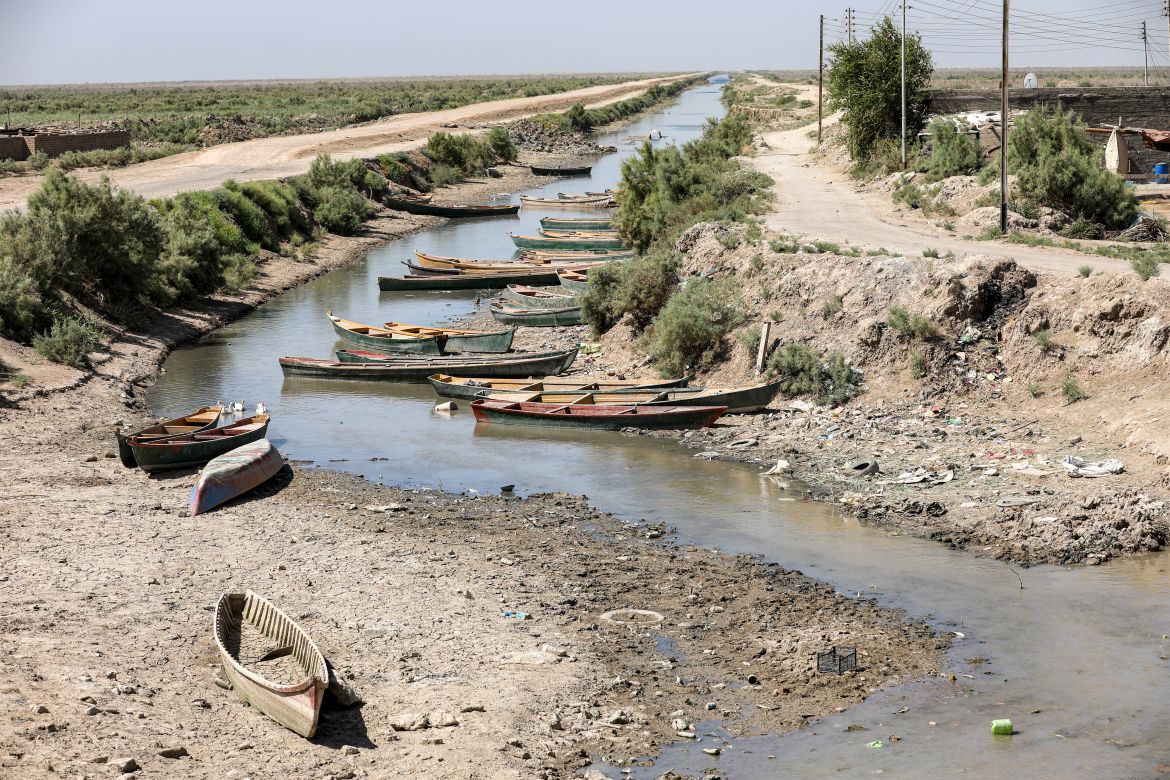
Fishermen's boats lie close to the drying riverbed of the Amshan river, which is fed by the Tigris, in al-Majar al-Kabir in Iraq's southeastern Maysan governorate.
'The level of the Euphrates in Iraq is around half of what it was in the 1970s,' said Ali al-Quraishi, of Baghdad's University of Technology. Dams upstream in Turkey, where the Tigris and the Euphrates have their sources, and others on their tributaries in Syria and Iran, are the 'principle' cause, he said. [Asaad Niazi/AFP]
An Iraqi man looks at a grounded boat along a dried-up bank in the Chibayish marshes in Iraq's southern Dhi Qar province.
Meanwhile, in the central marshes, there is so little water even canoes get stuck. Where there was water 'two months ago' is now a desert, said herder Youssef Mutlaq. [Asaad Niazi/AFP]
A local youth walks on parched soil in the Chibayish marshland in Iraq's southern Dhi Qar province.
Not long ago, a dozen or so mudhifs - traditional reed houses - were still occupied. 'There were lots of buffaloes, but when the water started to disappear, people left,' said the 20-year-old as his animals ate from their feedbags, which he has to use with less and less grass to be found. [Asaad Niazi/AFP]
Advertisement
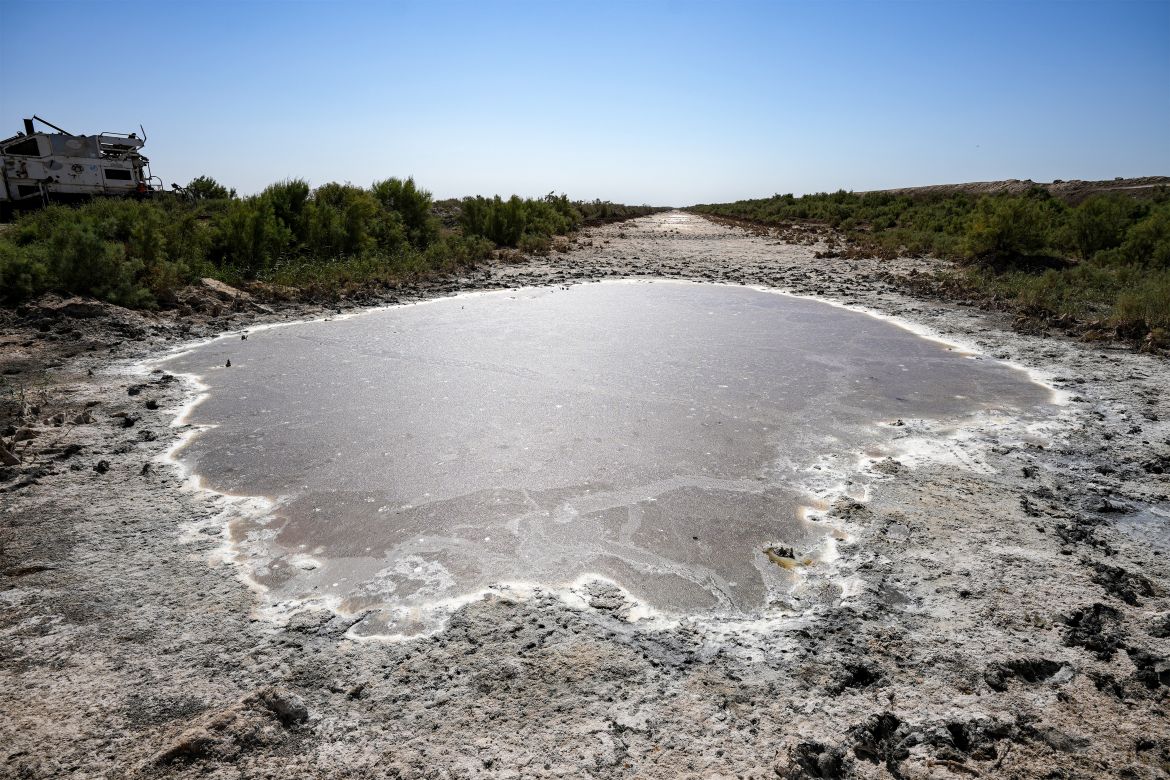
The drying riverbed of the Amshan river, which is fed by the Tigris, is pictured in al-Majar al-Kabir in Iraq's southeastern Maysan governorate.
Pollution is also rising alongside salination. Sewers, pesticides and waste from factories and hospitals are dumped directly into the Euphrates and much of it ends up in the marshes, said Nadheer Fazaa of Baghdad University, a specialist on climate change. 'We have analysed the water and found numerous pollutants like heavy metals' which cause illness, the scientist said. [Asaad Niazi/AFP]
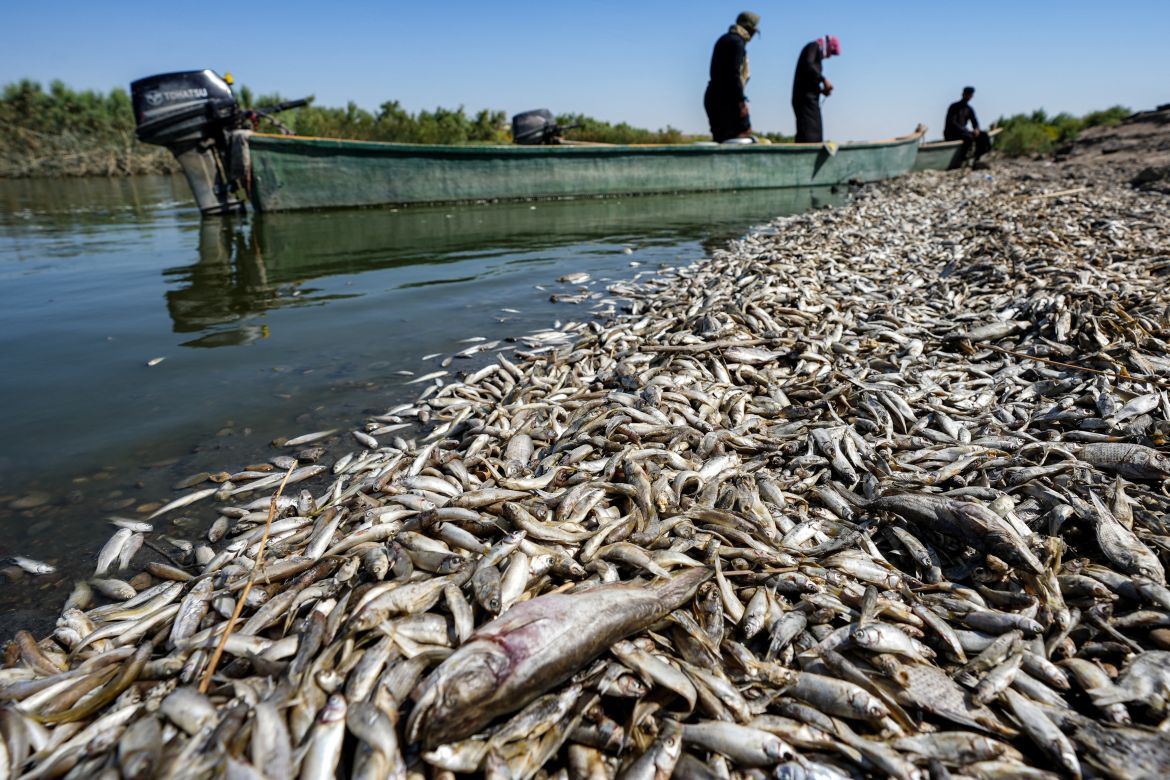
Fishermen stand in a boat as they inspect thousands of dead fish floating by the bank of the Amshan river, which draws its water from the Tigris, in Iraq's southeastern Maysan governorate.
And all the while, the fish are dying. Where the binni - the king of the Iraqi table - once swam, there are now only fish unfit for consumption. While the causes of the disaster are not being tackled, some are trying to limit the consequences of the drought. [Asaad Niazi/AFP]
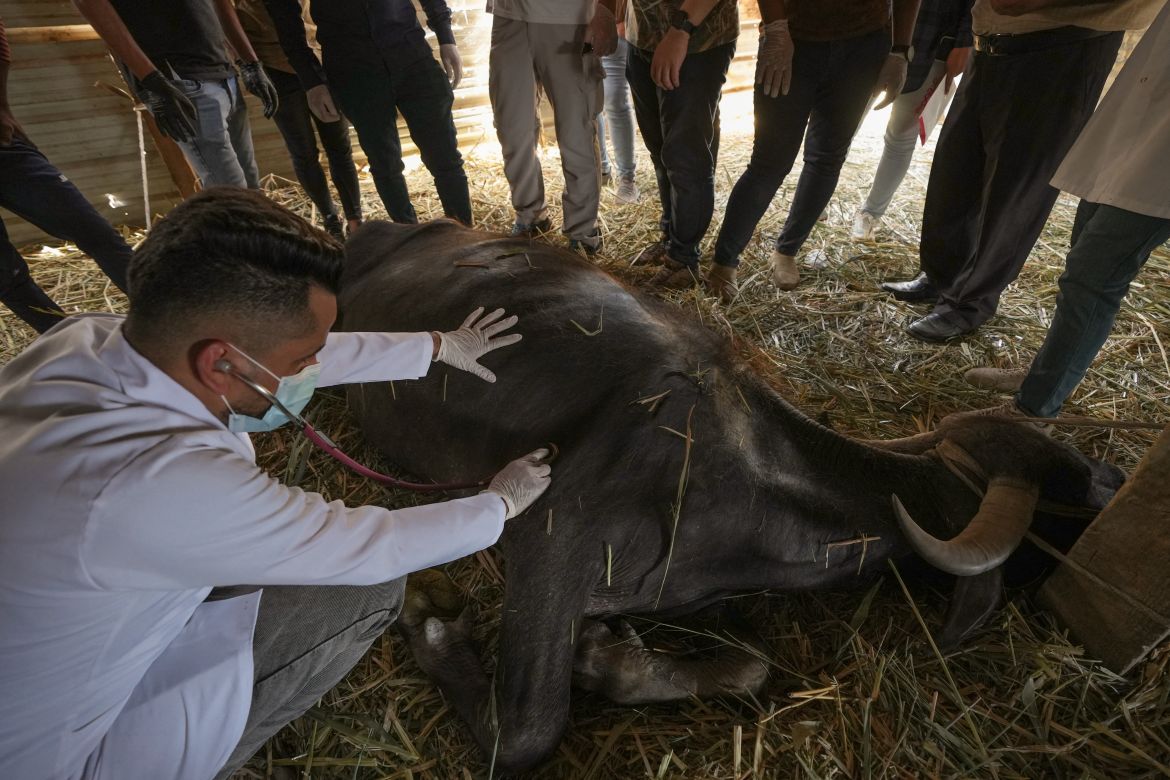
A veterinarian inspects a water buffalo with high fever at a barn in the Chibayish marshland area in Iraq's southern Dhi Qar province.
A veterinarian inspects a water buffalo with high fever at a barn in the Chibayish marshland area in Iraq's southern Dhi Qar province. [Asaad Niazi/AFP]
A dead fish lies on the cracking earth of a dry marsh in Chibayish in Iraq's southern Dhi Qar province.
Khaled Shemal, of the water resources ministry, said they were 'working hard' to restore the wetlands. But drinking water and supplies for homes and agriculture came first. [Asaad Niazi/AFP]
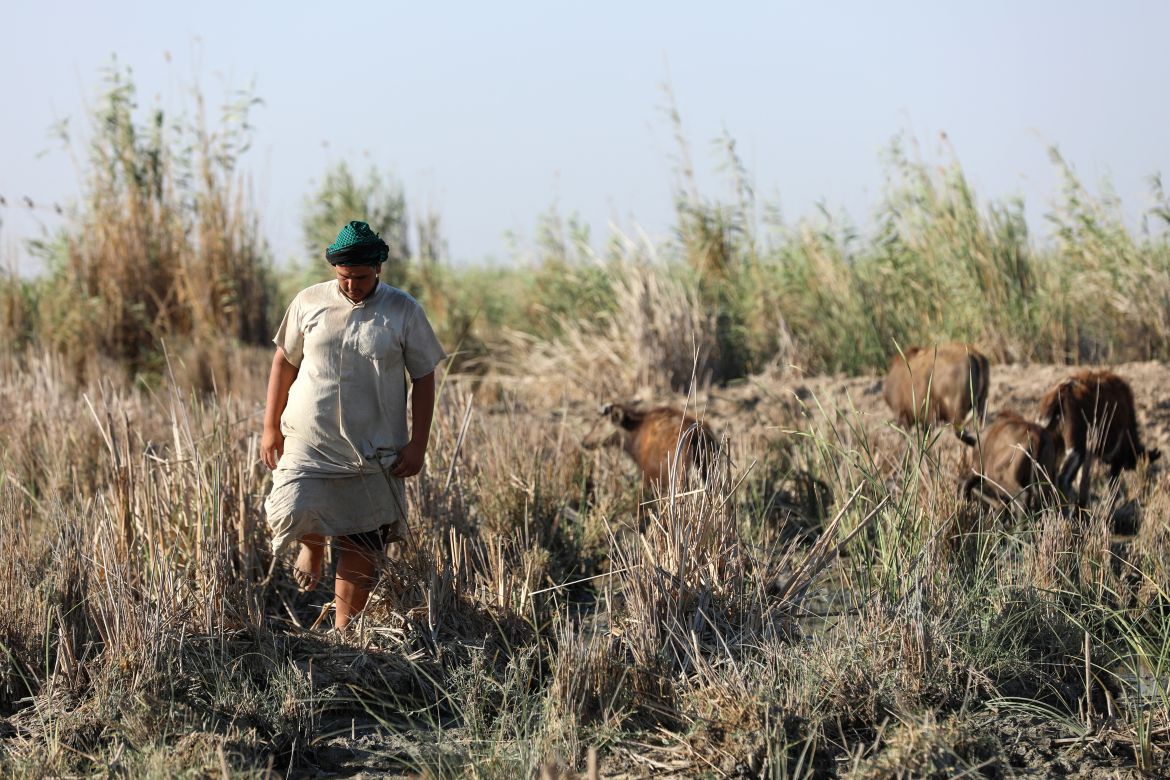
Mohammed Hamid Nour herds his buffaloes the Chibayish marshland in Iraq's southern Dhi Qar province.
In the meantime, many Marsh Arabs have left for the towns and cities, where they are often treated as pariahs. Last year, the UN's Food and Agriculture Organisation called it an 'exodus'. [Asaad Niazi/AFP]
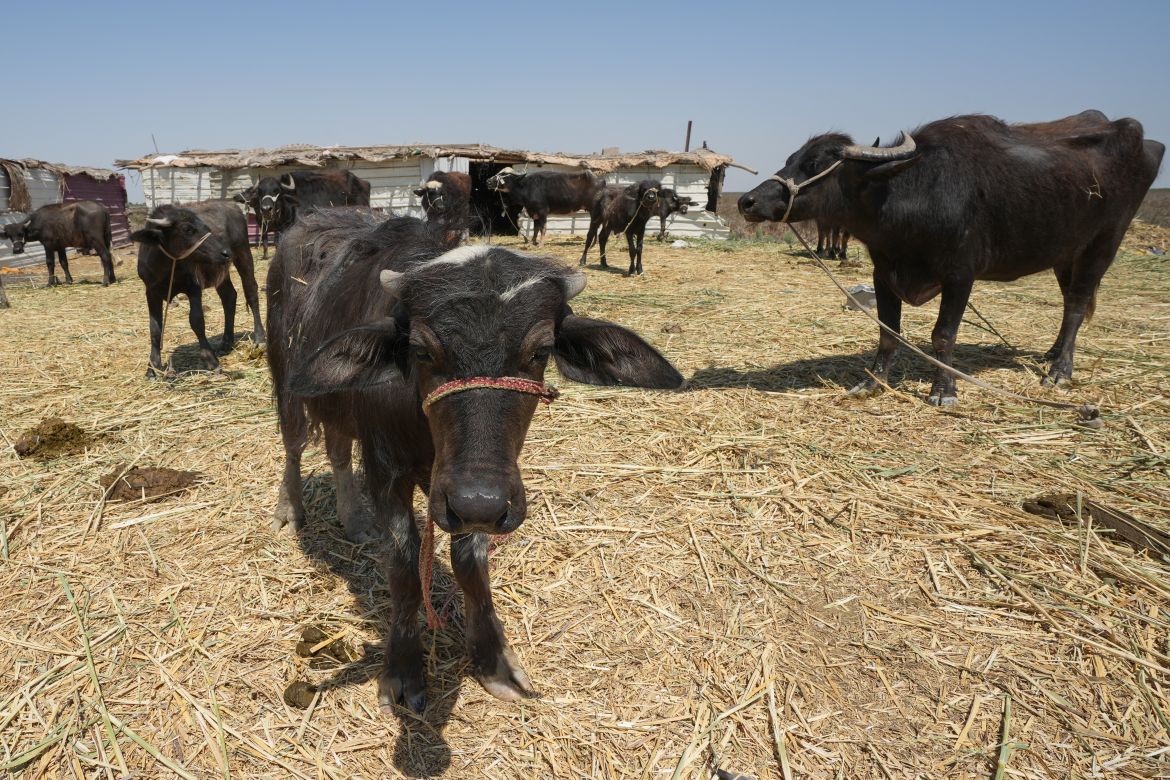
Water buffaloes feed near their sheds in the Chibayish marshes in Iraq's southern Dhi Qar province.
Walid Khdeir left the wetlands with his wife and six children 'four or five months ago' to live in the city of Chibayish. 'It was difficult, our lives were there like our grandparents' before us. But what can we do?' the 30-year-old said. Today, he is fattening buffaloes to resell but is obliged to buy fodder at exorbitant prices because there is hardly a blade of grass for them to eat. [Asaad Niazi/AFP]

Related

  • Why is the Shalamcheh-Basra railroad so important to Iran and Iraq?

    Tehran and Baghdad begin construction of rail link after decades of planning, but challenges remain.

    Published On 6 Sep 20236 Sep 2023
    Iranian Shi'ite pilgrims walk on a road after entering Iraq through the Zurbatia border crossing between Iran and Iraq, as they head towards Iraq's holy city of Kerbala to attend the holy Shi'ite ritual of Arbaeen, in Zurbatia, Iraq
  • OPINIONOPINION,

    As Iraq backslides on gender equality, where are its women MPs?

    The Iraqi parliament has the biggest number of women MPs since 2003 and yet this has not helped women’s rights at all.

    Opinion by Taif AlkhudaryTaif Alkhudary
    Published On 9 Sep 20239 Sep 2023
    Iraqi lawmakers attend a parliamentary session to vote on the federal budget at the parliament headquarters in Baghdad, Iraq, June 11, 2023. Iraqi Parliament Media Office/Handout via REUTERS ATTENTION EDITORS - THIS IMAGE HAS BEEN SUPPLIED BY A THIRD PARTY
    quotes
  • Iraq increases financial support for Kurdish autonomous region

    Decision announced after thousands of people protest over unpaid salaries.

    Published On 18 Sep 202318 Sep 2023
    Iraqi lawmakers attend a parliamentary session to vote on the federal budget at the parliament headquarters in Baghdad, Iraq, June 11, 2023. Iraqi Parliament Media Office/Handout via REUTERS ATTENTION EDITORS - THIS IMAGE HAS BEEN SUPPLIED BY A THIRD PARTY
  • Photos: Arbaeen, one of the world’s largest annual pilgrimages in Iraq

    The annual event sees millions of pilgrims from around the world gather in Karbala for the Arbaeen commemoration.

    Published On 7 Sep 20237 Sep 2023
    Arbaeen : world’s largest annual pilgrimage in Iraq
    This gallery article has 17 imagescamera17

More from Gallery

  • Photos: Cuba holds May Day celebrations amid US threats

    People hold banners of Che Guevara at a march in Havana
    This gallery article has 8 imagescamera8
  • Photos: Rains revive Iraq’s wetlands after years of drought

    Iraq's marshes revived: long-awaited rains bring life back to wetlands
    This gallery article has 8 imagescamera8
  • Photos: Somalia hunger crisis worsens as drought displaces more than 500,000

    Hawa Moalim, 33, fled Wajid in the Bakool region after the drought destroyed her livelihood. She began the journey to Baidoa with her six children and the few goats that had survived, determined to give her family a chance. One by one, the animals died on the road. By the time the family arrived at Wayamo displacement camp two weeks ago, they had nothing left. "We arrived here hoping for help," she says. "But since we came, we have received nothing. There is no food, no water, and no proper shelter." Wayamo displacement camp, Baidoa, Southwest State, Somalia. [Abdulkadir Mohamed/NRC]
    This gallery article has 14 imagescamera14
  • Photos: North Korea opens museum for troops killed fighting for Russia

    North Korea opens museum for troops killed fighting for Russia
    This gallery article has 9 imagescamera9

Most popular

  • US says offensive phase of war over, but Tehran won’t control Hormuz

    Vessels in the Strait of Hormuz near Bandar Abbas, Iran, May 4, 2026. Amirhosein Khorgooi/ISNA/WANA (West Asia News Agency) via REUTERS ATTENTION EDITORS - THIS PICTURE WAS PROVIDED BY A THIRD PARTY TPX IMAGES OF THE DAY
  • US Army says ‘Project Freedom’ in blockaded Hormuz has ‘just begun’

    TOPSHOT - A photo illustration taken in Nicosia on May 4, 2026, shows a person in front of a large screen displaying vessel movements in the Strait of Hormuz on a ship-tracking website.
  • What Modi’s big win in Indian state elections could mean for its democracy

    India election
  • Russian attacks kill 26 in Ukraine before Kyiv-announced ceasefire

    In this photo, provided by the Ukrainian Emergency Service, emergency services personnel work to extinguish a fire a vehicle following a Russian drone attack in Kyiv region, Ukraine, Tuesday, May 5, 2026. (Ukrainian Emergency Service via AP)

  • About

    • About Us
    • Code of Ethics
    • Terms and Conditions
    • EU/EEA Regulatory Notice
    • Privacy Policy
    • Cookie Policy
    • Cookie Preferences
    • Accessibility Statement
    • Sitemap
    • Work for us
  • Connect

    • Contact Us
    • User Accounts Help
    • Advertise with us
    • Stay Connected
    • Newsletters
    • Channel Finder
    • TV Schedule
    • Podcasts
    • Submit a Tip
    • Paid Partner Content
  • Our Channels

    • Al Jazeera Arabic
    • Al Jazeera English
    • Al Jazeera Investigative Unit
    • Al Jazeera Mubasher
    • Al Jazeera Documentary
    • Al Jazeera Balkans
    • AJ+
  • Our Network

    • Al Jazeera Centre for Studies
    • Al Jazeera Media Institute
    • Learn Arabic
    • Al Jazeera Centre for Public Liberties & Human Rights
    • Al Jazeera Forum
    • Al Jazeera Hotel Partners

Follow Al Jazeera English:

  • facebook
  • twitter
  • youtube
  • instagram-colored-outline
  • rss
Al Jazeera Media Network logo
© 2026 Al Jazeera Media Network