Skip linksSkip to Content
play
Live
Navigation menu
  • News
    • Africa
    • Asia
    • US & Canada
    • Latin America
    • Europe
    • Asia Pacific
  • Middle East
  • Explained
  • Opinion
  • Sport
  • Video
    • Features
    • Economy
    • Human Rights
    • Climate Crisis
    • Investigations
    • Interactives
    • In Pictures
    • Science & Technology
    • Podcasts
    • Travel
play
Live
Navigation menu
  • Israel-Palestine conflict
  • Gaza six months into ‘ceasefire’
  • ‘This is an apartheid regime’
  • Could the EU’s alliance with Israel change?
  • History of flotilla campaigns
  • ‘Tears and grief’: Mother’s Day in Gaza

In Pictures

Gallery|Israel-Palestine conflict

Photos: Memories of Nakba inspire Palestinian artist’s work

Abed Abdi, 81, is a Palestinian visual artist who was expelled from Haifa in 1948 and returned three years later.
Save

Share

facebookxwhatsapp-strokecopylink
Abed Abdi, Haifa artist
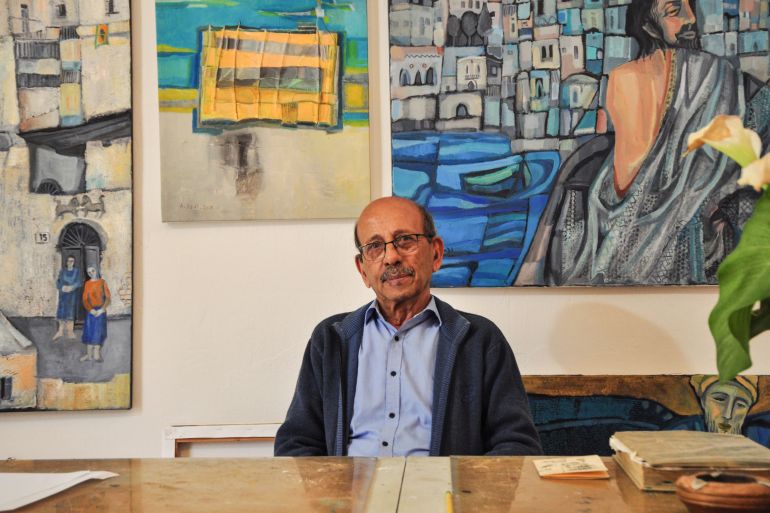
Artist Abed Abdi sits in his studio in the neighborhood of Wadi Nisnas in the northern city of Haifa [Zena Al Tahhan/Al Jazeera]
By Zena Al Tahhan
Published On 29 May 202329 May 2023

Wadi Nisnas, Haifa – Visual artist Abed Abdi was expelled from Haifa – a major port city on the Mediterranean Sea – along with tens of thousands of fellow Palestinians by Zionist militias in 1948.

Memories of displacement and dispossession that started at age six inspire the art Abdi produces even today, at 81 years of age.

“Those scenes are very painful,” Abdi tells Al Jazeera from his art studio, located at the edge of the neighbourhood of Wadi Nisnas on the northern outskirts of Haifa.

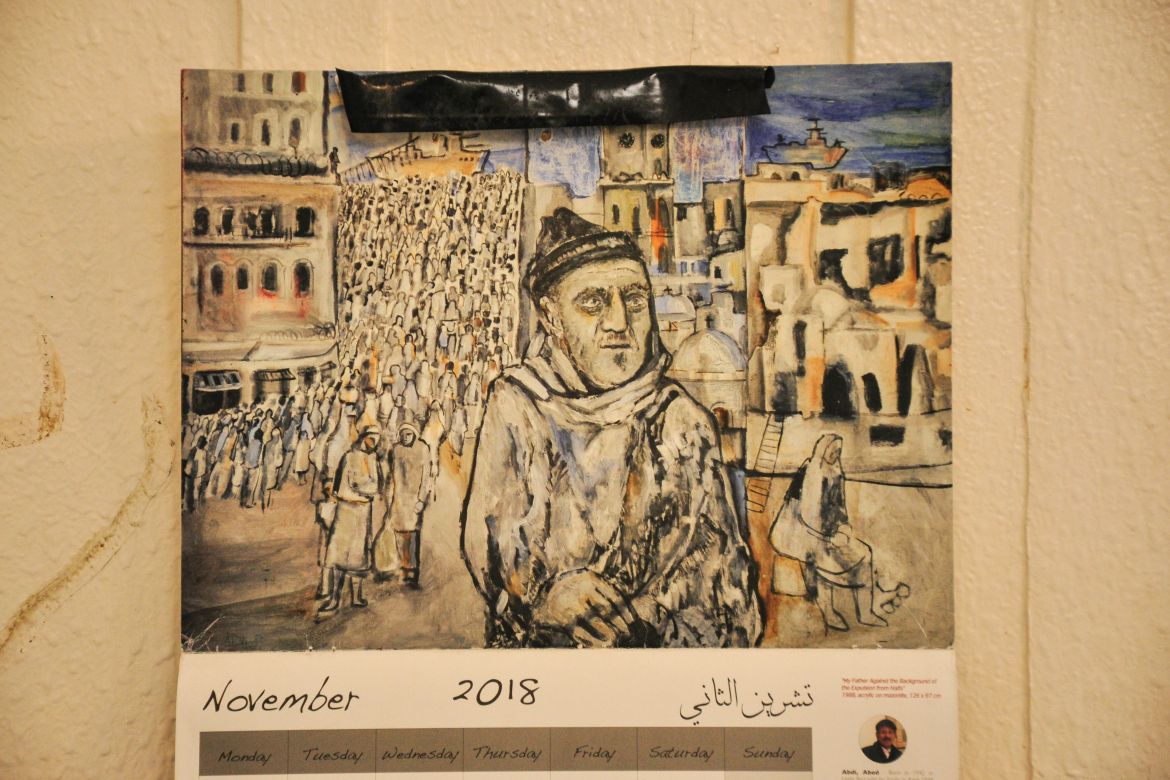
“My memory of those moments is like a treasure to me,” added Abdi – a soft-spoken, meticulous man. “I remember the masses of people at the Haifa port. I remember the suffering of the people.”

On April 22, 1948, three weeks before Israel was declared a state, Abdi was forced to flee from the neighbourhood of Wadi Salib in Haifa with his mother and four siblings due to intense shelling by Zionist militias and attacks on residents.

More than 750,000 Palestinians were forcefully displaced from their homelands as Zionist militias went on a rampage, killing Palestinians and destroying their society and homelands in 1948.

At least 110 Palestinian men, women and children were slaughtered in the Palestinian village of Deir Yassin on April 9, 1948, and Zionist militias killed 60 to 70 Palestinians in the Balad al-Shaykh village, 7km (4 miles) east of Haifa city months prior.

Palestinians observed the 75th anniversary of the organised and violent ethnic cleansing of Palestine – which is marked as Nakba, or catastrophe – on May 15, 2023.

Advertisement

“Most of Haifa’s residents took to the port for shelter, thinking that it could save them. Even if they would be away for a week or two, they would be back,” says Abdi, who returned to his homeland three years later.

“Some people carried their mattresses with them. My mother took cooking tools such as her mortar, even though it was heavy. We took it and came back with it. She also asked someone to carve her name into one of her pots that she took with her,” Abdi continues.

His father managed to remain in Haifa during the cataclysmic events. After three years in refugee camps across neighbouring Lebanon and Syria, Abdi, his mother and three of his siblings became one of the few Palestinians allowed to return to their city for family unification in 1951.

Between December 1947 and April 1948, the Zionist forces expelled more than 95 percent of Haifa’s Palestinian residents. Originally a city of some 75,000 Palestinians, only 3,000 to 4,000 of them remained after the Nakba. The rest became refugees, mainly in neighbouring Lebanon and Syria, and they are barred from returning to this day.

Those who remained were concentrated in the neighbourhood of Wadi Nisnas and prevented from returning to their homes or retrieving their property.

“Our suffering continued – we returned to hardship and a hostile environment. The homes and properties of the Abdi family owned were all confiscated. My father moved into his aunt’s house, the ownership of which also went to the state,” he says.

“I was in a situation where I realised it was critical for me to activate my visual memory,” says Abdi. During his time in refugee camps, he recalled one attempt to displace his family again.

“I remember, and my sister Zahra remembers, there was an attempt to evict us or displace us once again, in a truck, to Baghdad. We escaped from the camp and we went to my sister Lutfiyeh’s house in Damascus.”

At 22, Abdi moved from Haifa to Germany, where he was accepted into a visual arts school. Upon his return in 1972, he found that “there were few Palestinian artists”, he says. “I was in an environment where people were struggling for bread, not for creativity and nonessentials.”

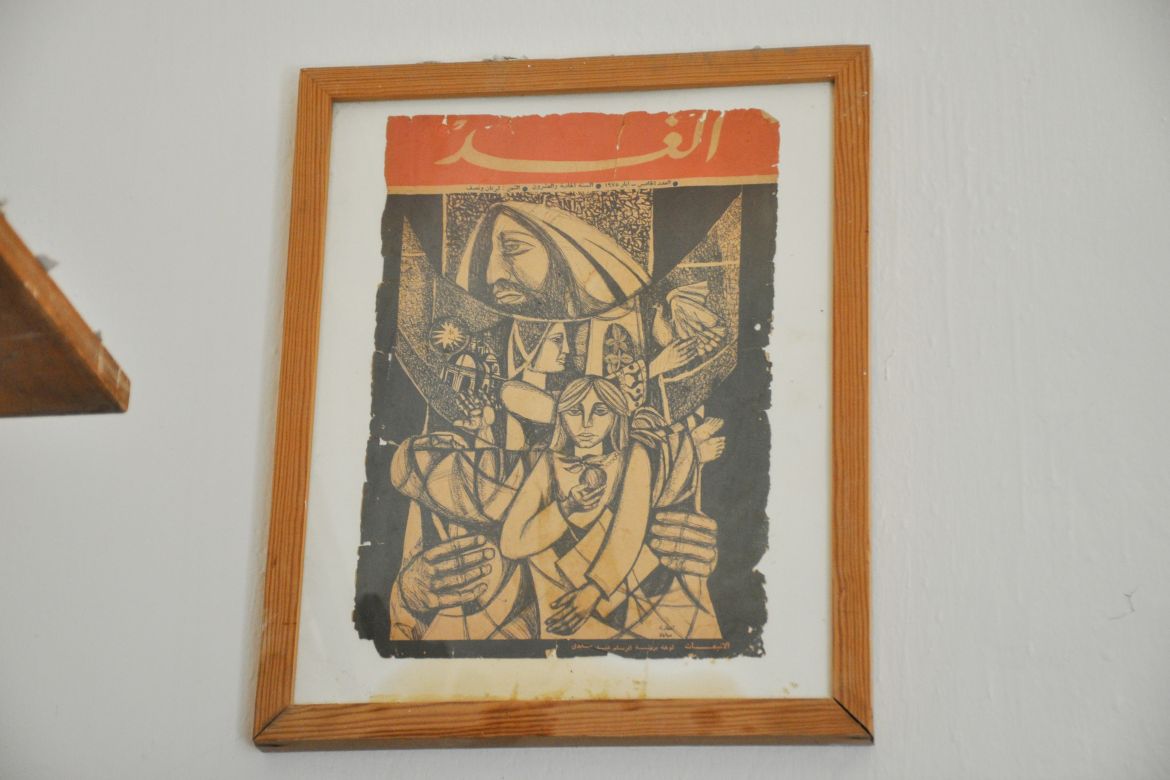
Abdi worked as the chief graphic designer and illustrator of Al-Ittihad newspaper based in Haifa and Al Jadid literary journal – two key publications in Palestinian society at the time – for more than a decade, starting in 1972.

He drew illustrations and prints for notable names in the Palestinian literary scene at the time, including Emile Habibi, Toufiq Zayyad, Samih al-Qassim, Mahmoud Darwish and Salman Natour.

Advertisement

Besides producing countless pieces of art exhibited around the world, Abdi also gave art courses and workshops in Palestinian towns across Israel including Shefa-Amr, Kufr Yasif and Daliyat al-Carmel.

“I work towards creating a new cadre of Palestinian artists,” says Abdi, explaining, “It is important the new generations understand fully the truth of our expulsion from our city Haifa in 1948.”
Abed Abdi, Haifa artist
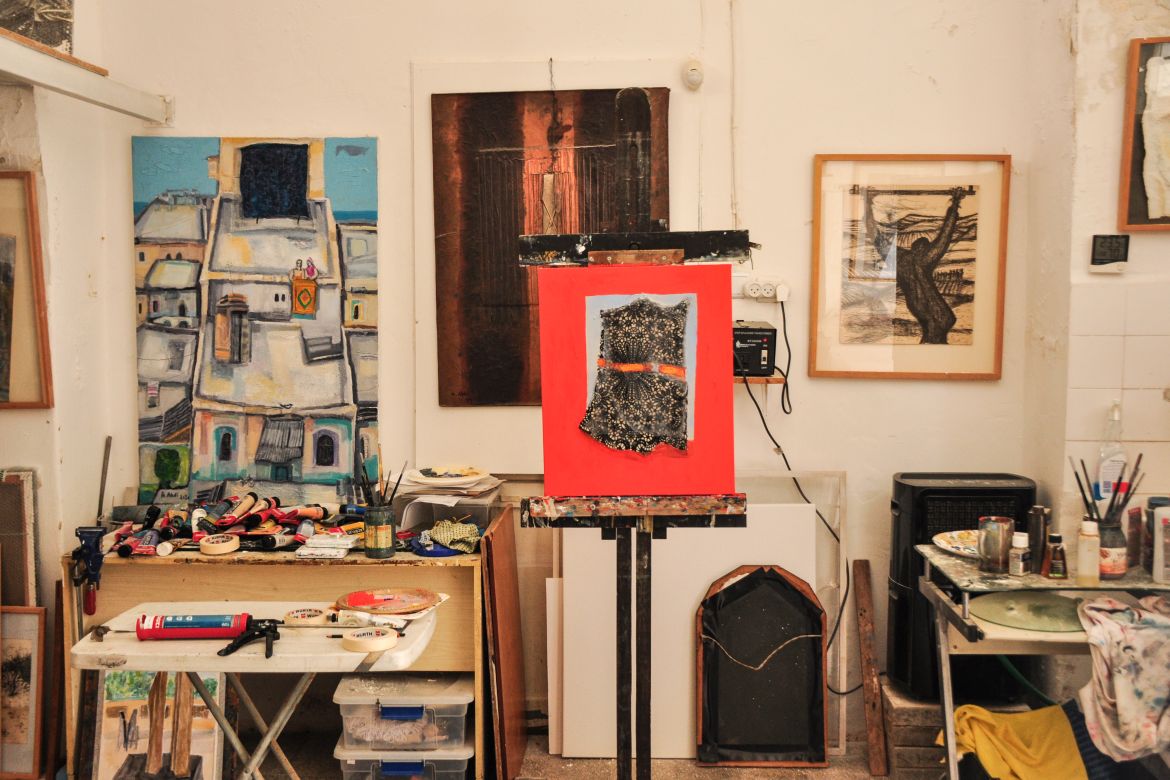
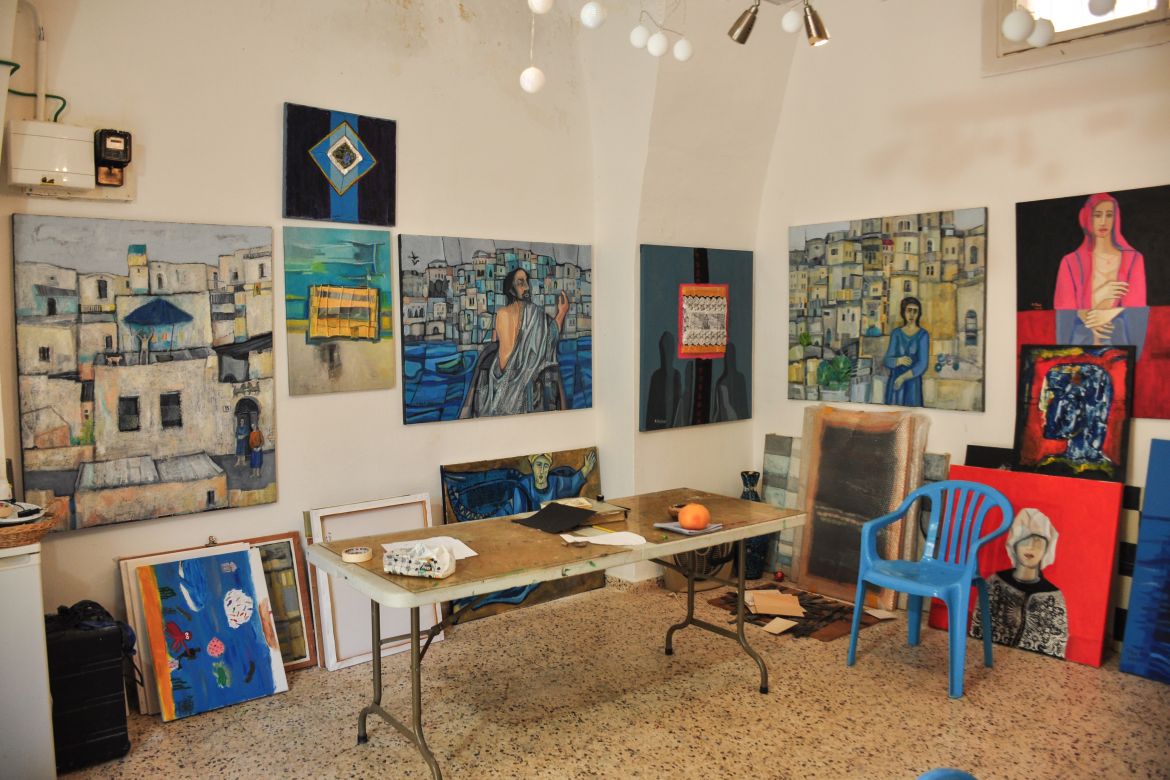
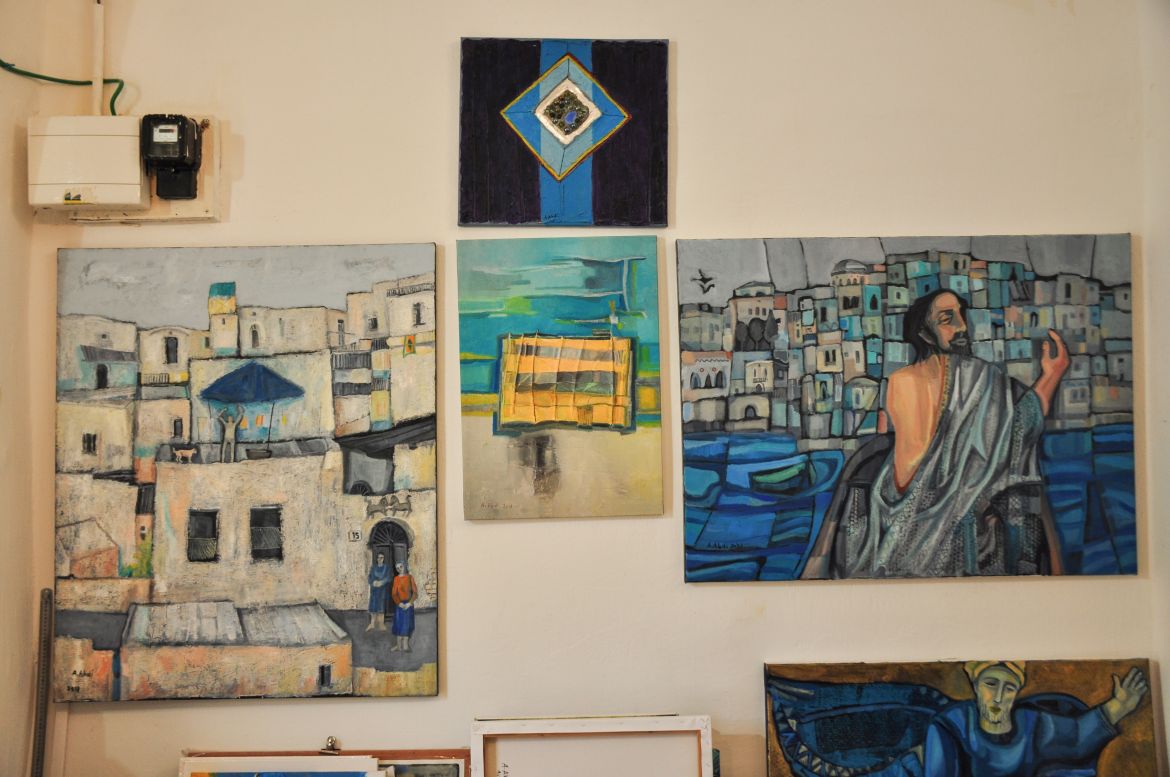
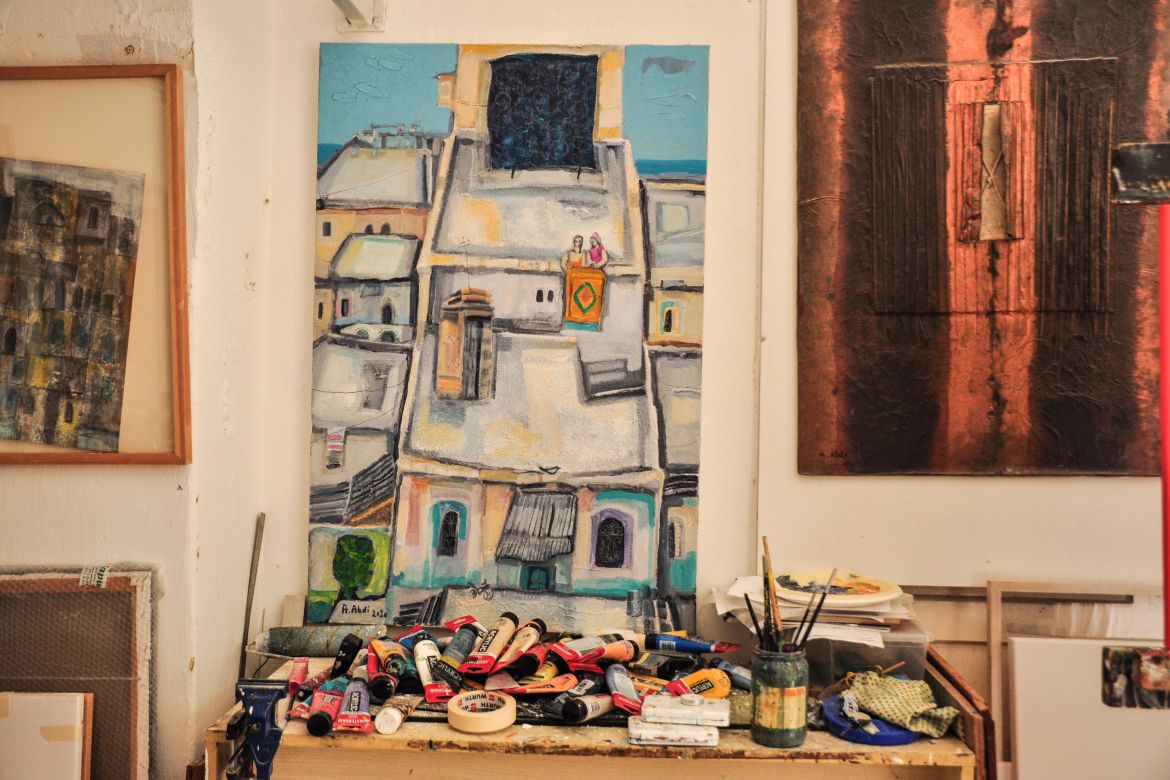
Many of Abdi's paintings depict Haifa's neighbourhoods before, during and after the Nakba. Abdi told Al Jazeera he practices visual art 'both as a participation of existence and to improve our cultural production'. [Zena Al Tahhan/Al Jazeera]
Advertisement
Abed Abdi, Haifa artist
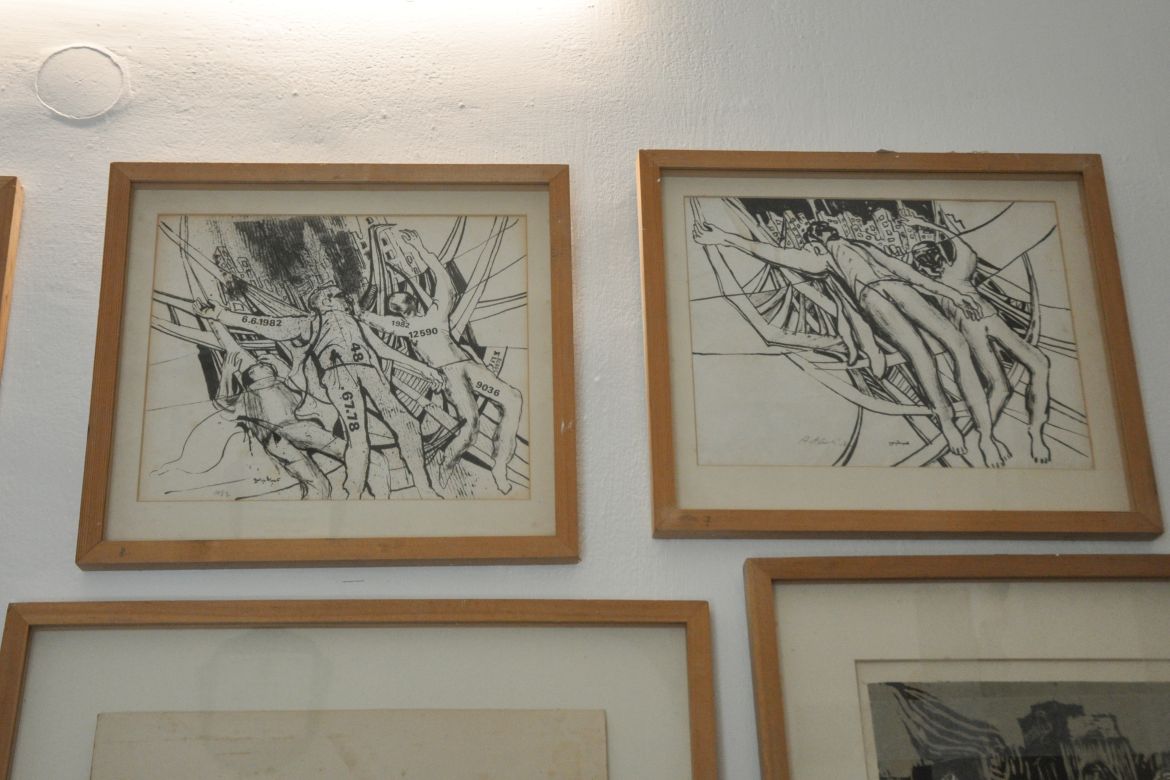
The painting by Abdi shows the masses of Palestinians pushed to Haifa port before becoming refugees during the Nakba. The violent campaign by Zionist militias to capture Haifa and its surrounding villages began in December 1947, days after the United Nations announced a plan to partition Palestine between Palestinians and Jews on November 29, 1947. [Zena Al Tahhan/Al Jazeera]
Abed Abdi, Haifa artist
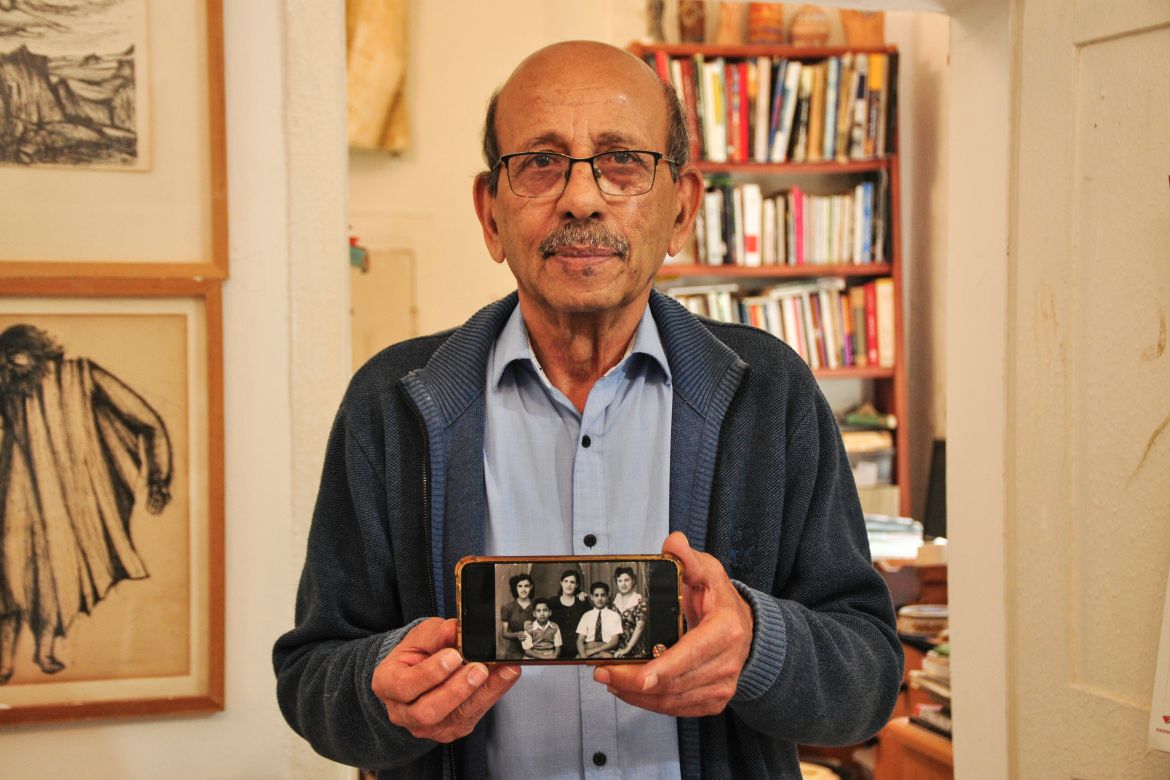
Abdi holds up a family portrait of himself, second from left, and his siblings with their mother, taken one year after their return to Haifa in 1952. [Zena Al Tahhan/Al Jazeera]
Abed Abdi, Haifa artist
Abdi's memories of displacement inspire his art. He told Al Jazeera he recalls that the separators between the families at the Mieh Mieh refugee camp in Lebanon were made out of sackcloth, a fabric he has incorporated into his art pieces. [Zena Al Tahhan/Al Jazeera]
Abed Abdi, Haifa artist
During the Nakba, Zionist militias carried out dozens of massacres and destroyed more than 500 Palestinian villages, while three-quarters of the Palestinian population was expelled from their homes, the vast majority made refugees outside of Palestine. [Zena Al Tahhan/Al Jazeera]
Abed Abdi, Haifa artist
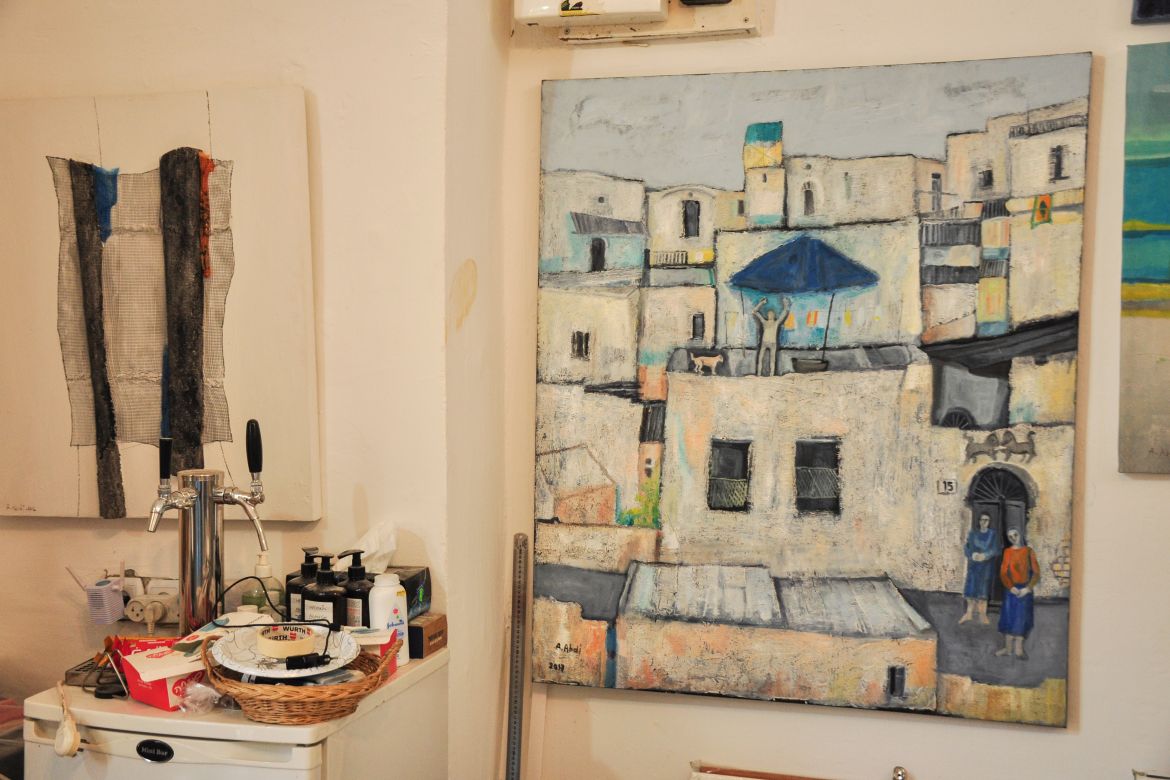
A painting by Abdi showing his father’s aunt’s house in the neighbourhood of Wadi Nisnas, where the family lived for 10 years in a single bedroom upon their return in 1951. The home they lived in before the Nakba in nearby Wadi Salib was destroyed by Zionist militia. [Zena Al Tahhan/Al Jazeera]
Advertisement
Abed Abdi, Haifa artist
Upon his return to Haifa in 1972 after studying art in Germany, Abdi worked as an illustrator for Palestinian and other Arab newspapers and journals for more than a decade. [Zena Al Tahhan/Al Jazeera]
Abed Abdi, Haifa artist
Israel forced all the Palestinians remaining in Haifa into Wadi Nisnas after the Nakba and barred them from returning to their homes in the city. 'Before 1948, Wadi Nisnas was a beautiful, elegant neighbourhood. It was turned into a refugee camp for shelter with high density,' he says. [Zena Al Tahhan/Al Jazeera]
Abed Abdi, Haifa artist
Today, Abdi says, 'he is proud that there is a number of valuable Palestinian artists within the Arab [Palestinian] masses.' [Zena Al Tahhan/Al Jazeera]

Related

  • Ethnic cleansing in Palestine

    The eviction of 750,000 Palestinians in 1948, the Nakba, is a crime that Israel and the world have yet to atone for.

    Published On 15 May 202315 May 2023
    Ethnic cleansing in Palestine
    This gallery article has 9 imagescamera9
  • OPINIONOPINION,

    The Arab world has forsaken the Palestine cause

    The Palestinians have lost their Arab allies amid Arab regimes’ increasing authoritarianism and dependence on the US.

    Opinion by Imad K HarbImad K Harb
    Published On 14 May 202314 May 2023
    Palestinian demonstrators carry a symbolic coffin reading: "the resolutions of the Arab League" during a protest against Bahrain's workshop for U.S. peace plan, in Ramallah, in the Israeli-occupied West Bank June 24, 2019. REUTERS/Mohamad Torokman
    quotes
  • EU’s ‘Israeli independence’ message rebuked in Palestine

    Palestinian leaders, social media users criticise EU commission president for saying Israel makes ‘the desert bloom’.

    Published On 27 Apr 202327 Apr 2023
    Ursula von der Leyen

More from Gallery

  • Photos: Chornobyl’s ‘liquidators’ return 40 years after nuclear disaster

    Survivors return to Chernobyl, 40 years after devastating explosion
    This gallery article has 15 imagescamera15
  • Photos: Mughal-era pigeon training survives in heart of India’s capital

    Mughal-era pigeon training survives in heart of India's capital
    This gallery article has 11 imagescamera11
  • Photos: Displaced Lebanese families return home despite Israeli attacks

    Tens of thousands return to southern Lebanon despite warnings and risks
    This gallery article has 13 imagescamera13
  • Photos: Afghan villagers turn to gold-panning to sustain livelihoods

    Afghan villagers turn to gold panning to sustain livelihoods
    This gallery article has 9 imagescamera9

Most popular

  • Iran says no talks under siege; Trump cancels envoys’ trip to Pakistan

    A woman walks past images of Iran's late supreme leaders Ayatollah Ruhollah Khomeini (above L) and Ayatollah Ali Khamenei (Above C) next to newly elected supreme leader Mojtaba Khamenei (above R), and photos strung along the wall of children killed on the first day of the war in an alleged US-Israeli missile strike on a school in the southern Iranian city of Minab, outside a mosque in the capital Tehran on April 25, 2026. On February 28, Israel and the United States launched strikes on Iran, killing its supreme leader and triggering a war that spread across the Middle East.
  • Trump unhurt after shots fired at White House correspondents’ dinner

    Trump
  • Trump updates: Suspect arrested after shooting at correspondents’ dinner

    Secret service agents respond during the White House Correspondents Dinner, Saturday, April 25, 2026, in Washington.
  • World reacts to shooting at White House correspondents’ dinner

    U.S. President Donald Trump holds a press briefing at the White House, following a shooting incident during the annual White House Correspondents’ Association dinner, in Washington, D.C., U.S., April 25, 2026 REUTERS/Jonathan Ernst

  • About

    • About Us
    • Code of Ethics
    • Terms and Conditions
    • EU/EEA Regulatory Notice
    • Privacy Policy
    • Cookie Policy
    • Cookie Preferences
    • Accessibility Statement
    • Sitemap
    • Work for us
  • Connect

    • Contact Us
    • User Accounts Help
    • Advertise with us
    • Stay Connected
    • Newsletters
    • Channel Finder
    • TV Schedule
    • Podcasts
    • Submit a Tip
    • Paid Partner Content
  • Our Channels

    • Al Jazeera Arabic
    • Al Jazeera English
    • Al Jazeera Investigative Unit
    • Al Jazeera Mubasher
    • Al Jazeera Documentary
    • Al Jazeera Balkans
    • AJ+
  • Our Network

    • Al Jazeera Centre for Studies
    • Al Jazeera Media Institute
    • Learn Arabic
    • Al Jazeera Centre for Public Liberties & Human Rights
    • Al Jazeera Forum
    • Al Jazeera Hotel Partners

Follow Al Jazeera English:

  • facebook
  • twitter
  • youtube
  • instagram-colored-outline
  • rss
Al Jazeera Media Network logo
© 2026 Al Jazeera Media Network