Skip linksSkip to Content
play
Live
Navigation menu
  • News
    • Africa
    • Asia
    • US & Canada
    • Latin America
    • Europe
    • Asia Pacific
  • Middle East
  • Explained
  • Opinion
  • Sport
  • Video
    • Features
    • Economy
    • Human Rights
    • Climate Crisis
    • Investigations
    • Interactives
    • In Pictures
    • Science & Technology
    • Podcasts
    • Travel
play
Live

In Pictures

Gallery|Science and Technology

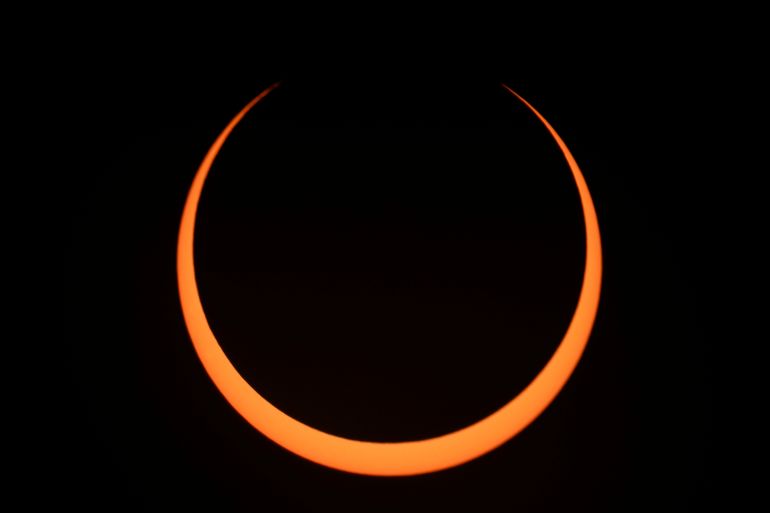
South America witnesses a ‘ring of fire’, the final solar eclipse of 2024

A full eclipse was visible from Chile and Argentina, with other parts of the world seeing a partial ‘crescent’ eclipse.
Save

Share

facebookxwhatsapp-strokecopylink
Solar eclipse
A solar eclipse is seen from Tahai in Rapa Nui, Chile, on October 2 [Esteban Felix/AP Photo]
Published On 3 Oct 20243 Oct 2024

Stargazers in Chile and Argentina turned their eyes to the horizon on Wednesday to catch the final solar eclipse of 2024: a “ring of fire” that blazed across the sky.

Also known as an annular eclipse, the celestial phenomenon occurs when the moon passes in front of the sun, darkening the centre of the orb.

Solar eclipses are not uncommon: NASA, the United States space agency, estimates that two to four happen each year. But they are not visible from every angle on the globe.

Only those within the “path of totality” can view the full eclipse, when the moon blots out the sun, leaving only a ring of light. Experts say that the path of totality this year was only between 265 to 331 kilometres wide (165 to 206 miles wide).

Still, those outside the path of totality could enjoy a partial eclipse, with the sun appearing to be a crescent shape — or looking as though a bite had been taken out of it.

Stretches of Chile and Argentina were directly in the path of totality. A partial eclipse, meanwhile, was visible in Antarctica, Hawaii, Mexico, New Zealand and other parts of South America, including Brazil and Uruguay.

While the “ring of fire” was the last solar eclipse of 2024, the following year will bring two partial eclipses. The first, on March 29, will be visible in stretches of Europe, Asia, Africa and North and South America.

The second, on September 21, will be seen in Australia and Antarctica.

For another full solar eclipse, however, stargazers will have to endure a wait: The next “ring of fire” arrives on February 17, 2026.

Advertisement
A poodle dog watches the eclipse through glasses.
Dana the dog wears glasses as people watch an annular solar eclipse in Las Horquetas in the Santa Cruz province of Argentina. [Agustin Marcarian/Reuters]
Advertisement
A person watches the eclipse through boxy glasses.
Experts warn against gazing at even partial solar eclipses without protective eyewear. [Natacha Pisarenko/AP Photo]
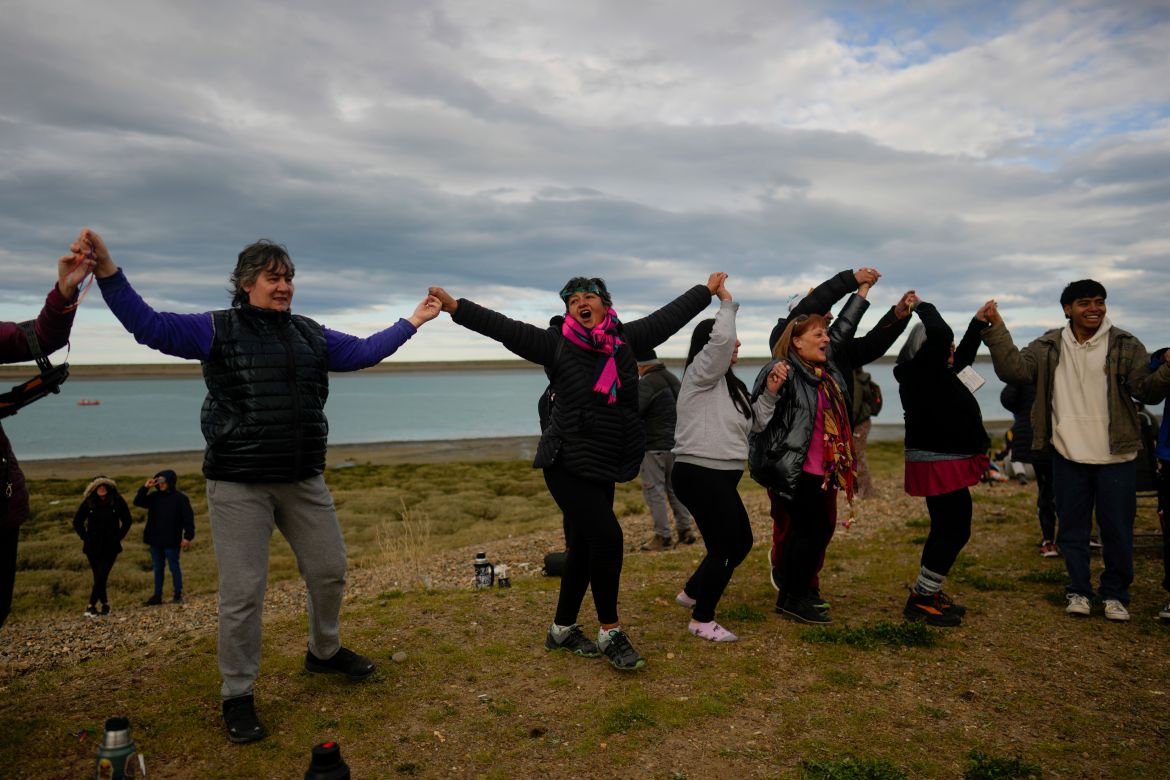
People dance and hold hands in a line as the eclipse unfolds.
People join hands and dance during the annular solar eclipse in Puerto San Julian, Argentina, on October 2. [Natacha Pisarenko/AP Photo]
A view of the eclipse through the clouds.
Eclipses occur when the moon passes in front of of the sun, creating a rim of light called the antumbra. [Natacha Pisarenko/AP Photo]
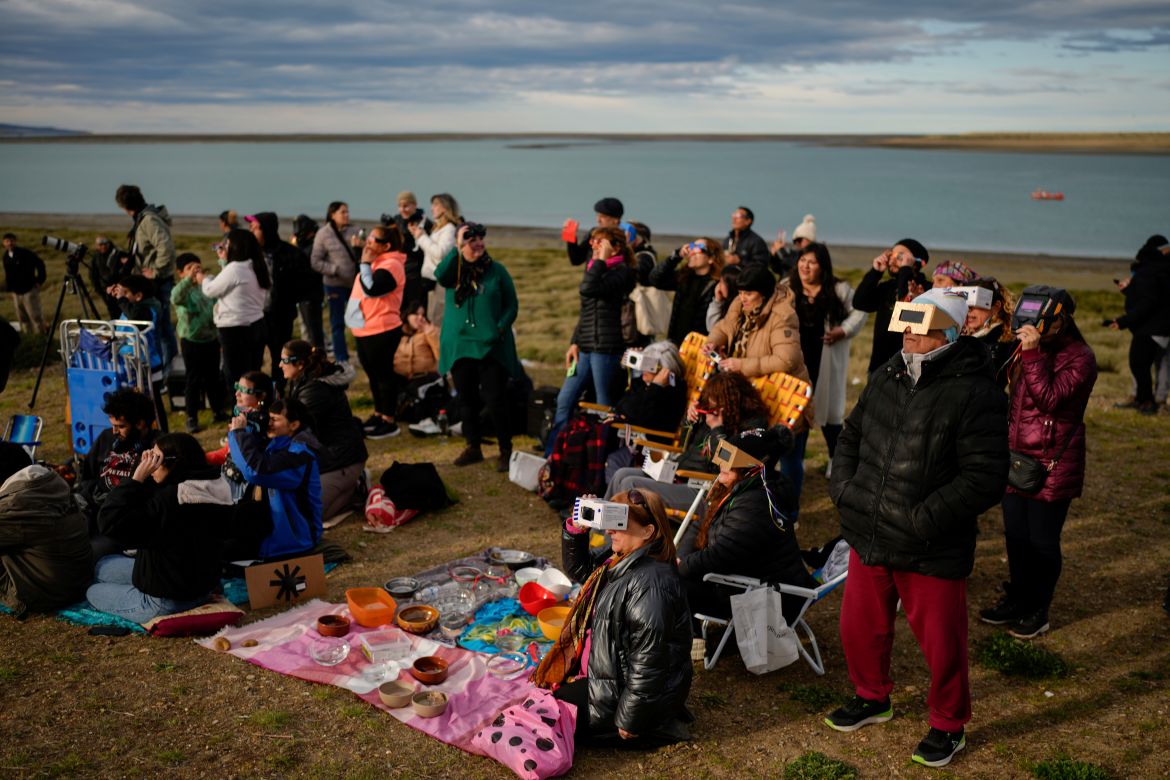
People watch the eclipse through protective glasses.
The next annular solar eclipse will not be visible until 2026. [Natacha Pisarenko/AP Photo]
A group of people on a beach watch the eclipse.
The path of totality for Wednesday's solar eclipse passed from southern Argentina across to Chile and onward to the southern Pacific Ocean, where it was visible from the island of Rapa Nui. [Natacha Pisarenko/AP Photo]
Advertisement
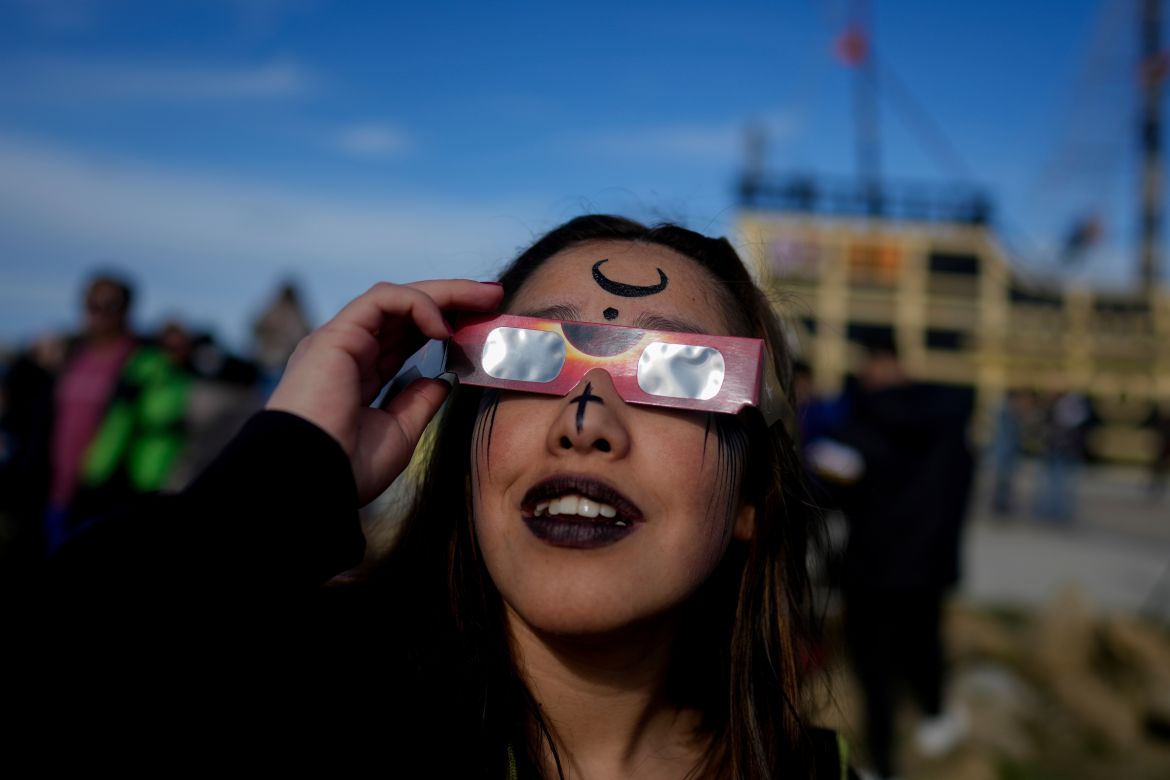
A person wears protective glasses to watch the eclipse and has a crescent drawn on her forehead.
A stargazer in Puerto San Julian, Argentina, decorates her forehead with an image of the crescent sun. [Natacha Pisarenko/AP Photo]
An antique wooden boat and a crowd watching the solar eclipse
People hug and celebrate as the solar eclipse passes over Puerto San Julian, Argentina. [Natacha Pisarenko/AP Photo]
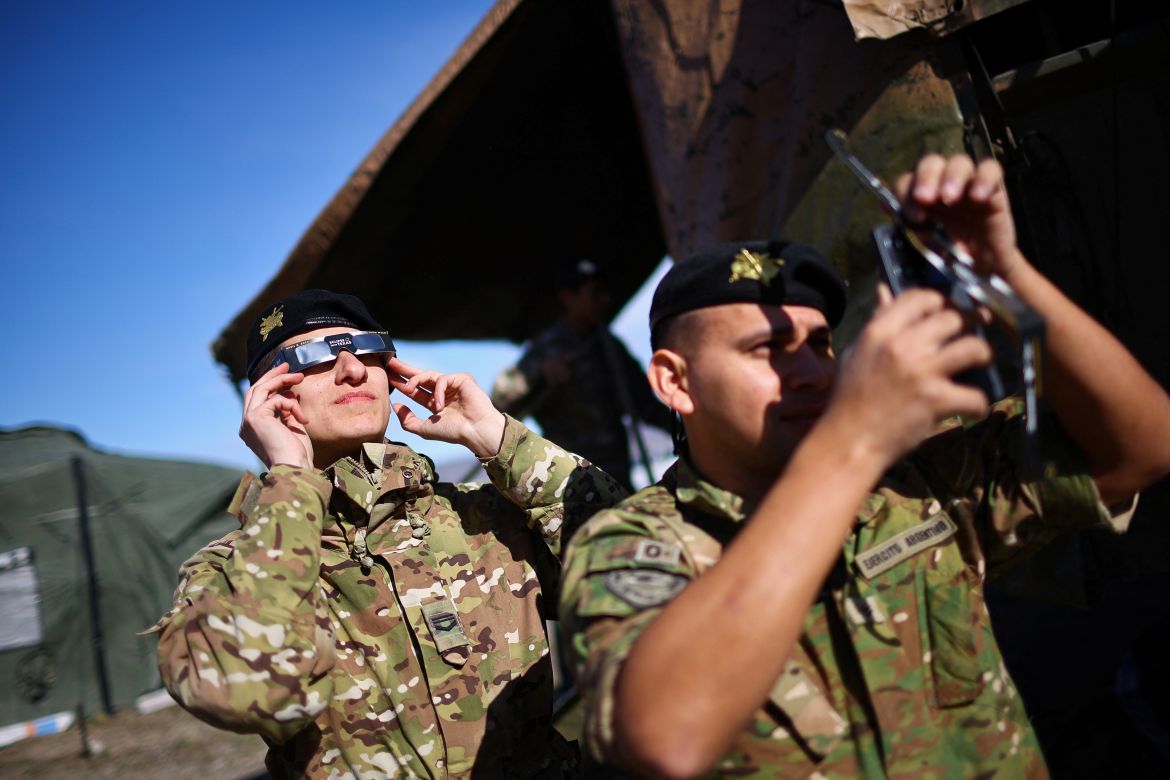
Soldiers watch the eclipse through protective glasses.
Soldiers pause to watch the annular solar eclipse in Las Horquetas, Argentina. [Agustin Marcarian/Reuters]
People wear a full-face mask to watch the eclipse.
Sebastian Caceres and Guadalupe Caceres, right, were among those to enjoy the celestial event. [Natacha Pisarenko/AP Photo]

Related

  • Photos: Mexico, US, Canada mesmerised by rare total solar eclipse

    The moon fully blocked the sun in parts of Canada, Mexico and US, drawing the attention of star-gazers and scientists.

    Published On 8 Apr 20248 Apr 2024
    A bearded man stares upwards to watch the solar eclipse.
    This gallery article has 12 imagescamera12
  • Total solar eclipse sweeps across North America: Eight highlights

    The path of totality crossed several major cities including Dallas, Indianapolis, Cleveland, Buffalo and Montreal.

    Published On 9 Apr 20249 Apr 2024
    Hundreds of people at Shawnee National Forest erupted into cheers as darkness fell over a campground. Temperatures dropped several degrees. Birds chirped and frogs croaked. And planets including Jupiter and Venus were visible during the more than 3 minutes of totality.
  • Week in pictures: War in Sudan, a solar eclipse, and Iran attacks Israel

    A roundup of some of the week’s key events.

    Published On 14 Apr 202414 Apr 2024
    Participants prepare to fly hot air balloons during the traditional hot air balloon festival, an annual event since 1950, during the Eid al-Fitr holiday celebrating the end of the Muslim holy fasting month of Ramadan, in Wonosobo, Central Java on April 11
    This gallery article has 9 imagescamera9

More from Gallery

  • Photos: Cuba holds May Day celebrations amid US threats

    People hold banners of Che Guevara at a march in Havana
    This gallery article has 8 imagescamera8
  • Photos: Rains revive Iraq’s wetlands after years of drought

    Iraq's marshes revived: long-awaited rains bring life back to wetlands
    This gallery article has 8 imagescamera8
  • Photos: Somalia hunger crisis worsens as drought displaces more than 500,000

    Hawa Moalim, 33, fled Wajid in the Bakool region after the drought destroyed her livelihood. She began the journey to Baidoa with her six children and the few goats that had survived, determined to give her family a chance. One by one, the animals died on the road. By the time the family arrived at Wayamo displacement camp two weeks ago, they had nothing left. "We arrived here hoping for help," she says. "But since we came, we have received nothing. There is no food, no water, and no proper shelter." Wayamo displacement camp, Baidoa, Southwest State, Somalia. [Abdulkadir Mohamed/NRC]
    This gallery article has 14 imagescamera14
  • Photos: North Korea opens museum for troops killed fighting for Russia

    North Korea opens museum for troops killed fighting for Russia
    This gallery article has 9 imagescamera9

Most popular

  • Trump announces plan to escort ships stuck in Strait of Hormuz

    Vehicles drive past a billboard with graphic showing Strait of Hormuz and sewn lips of U.S. President Donald Trump in a square in downtown Tehran, Iran, Saturday, May 2, 2026.
  • What’s Iran’s 14-point proposal to end the war? And will Trump accept it?

    People chant slogans during a rally in Tehran, Iran
  • Trump says US will ‘help free up’ ships stuck in Hormuz Strait

    Hormuz
  • Ukraine drone attacks hit nuclear power plant, Baltic port

    This handout satellite image taken on March 23, 2026 by Planet Labs PBC shows smoke rising from the Russian oil terminal at Primorsk, the most important Russian loading port in the Baltic Sea, following a drone attack claimed by Ukraine. The Russian port of Primorsk, near the Finnish border, suffered damage in the latest round of drone attacks, the region's governor announced on March 23, 2026, with Ukraine claiming responsibility.

  • About

    • About Us
    • Code of Ethics
    • Terms and Conditions
    • EU/EEA Regulatory Notice
    • Privacy Policy
    • Cookie Policy
    • Cookie Preferences
    • Accessibility Statement
    • Sitemap
    • Work for us
  • Connect

    • Contact Us
    • User Accounts Help
    • Advertise with us
    • Stay Connected
    • Newsletters
    • Channel Finder
    • TV Schedule
    • Podcasts
    • Submit a Tip
    • Paid Partner Content
  • Our Channels

    • Al Jazeera Arabic
    • Al Jazeera English
    • Al Jazeera Investigative Unit
    • Al Jazeera Mubasher
    • Al Jazeera Documentary
    • Al Jazeera Balkans
    • AJ+
  • Our Network

    • Al Jazeera Centre for Studies
    • Al Jazeera Media Institute
    • Learn Arabic
    • Al Jazeera Centre for Public Liberties & Human Rights
    • Al Jazeera Forum
    • Al Jazeera Hotel Partners

Follow Al Jazeera English:

  • facebook
  • twitter
  • youtube
  • instagram-colored-outline
  • rss
Al Jazeera Media Network logo
© 2026 Al Jazeera Media Network