Skip linksSkip to Content
play
Live
Navigation menu
  • News
    • Africa
    • Asia
    • US & Canada
    • Latin America
    • Europe
    • Asia Pacific
  • Middle East
  • Explained
  • Opinion
  • Sport
  • Video
    • Features
    • Economy
    • Human Rights
    • Climate Crisis
    • Investigations
    • Interactives
    • In Pictures
    • Science & Technology
    • Podcasts
    • Travel
play
Live

In Pictures

Gallery|Climate Crisis

Photos: Once fruitful, Libyan village suffers amid climate crisis

Pounded by sun and dry winds, trees struggle to bear fruit as Kabaw in the Nafusa Mountains faces a lack of rainfall.

Save

Share

facebookxwhatsapp-strokecopylink
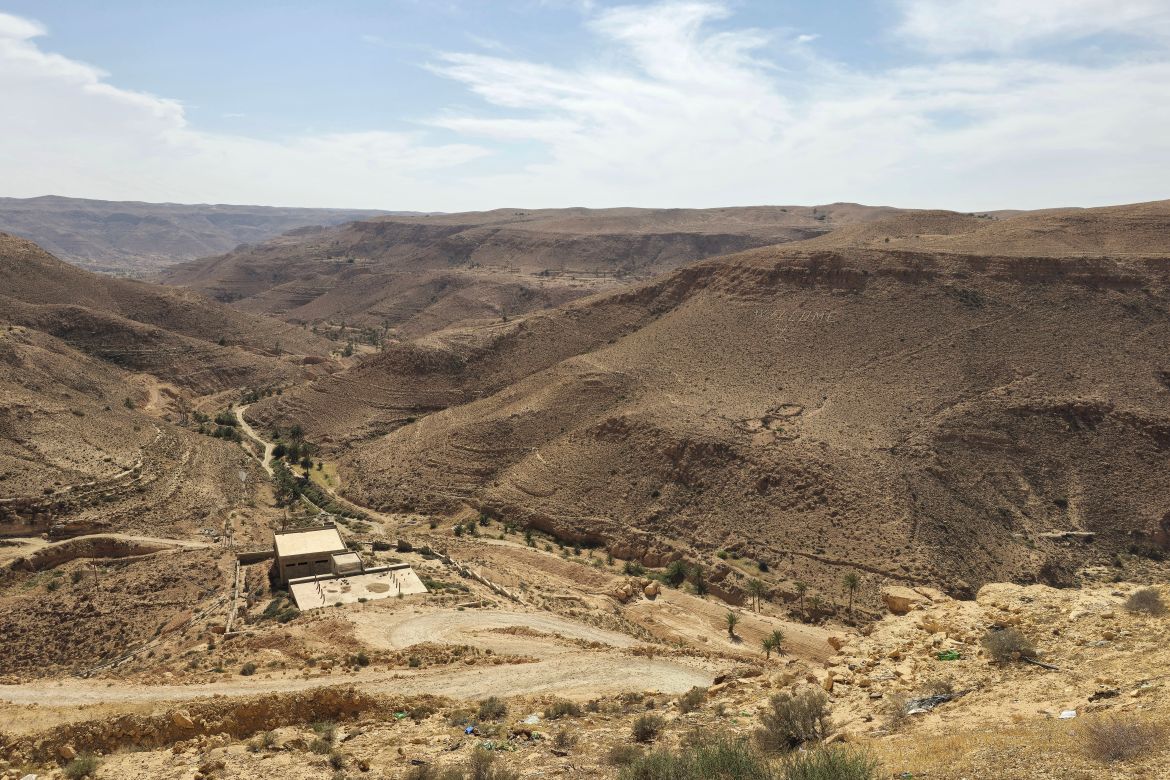
The old and abandoned village of Kabao stands on arid land not far from the newer constructions in the Nafusa mountains
The abandoned village of Kabao stands on arid land not far from newer construction in Libya's Nafusa Mountains. [Mahmud Turkia/AFP]
By AFP
Published On 17 Jun 202417 Jun 2024

In the Libyan village of Kabaw in the Nafusa Mountains, Mohamed Maakaf waters an ailing fig tree as climate change pushes villagers to forsake lands and livestock.

Kabaw was once flourishing and known for its figs, olives and almonds. Now its fields are mostly barren and battered by climate change-induced drought.

The area about 200km (125 miles) southwest of Tripoli was once “green and prosperous until the beginning of the millennium”, Maakaf recalled. “People loved to come here and take walks, but today it has become so dry that it’s unbearable.”

“We no longer see the green meadows we knew in the 1960s and ’70s,” added the 65-year-old, wearing a traditional white tunic and sirwal trousers.

Kabaw, like many villages in the Nafusa Mountains, is primarily inhabited by Amazigh people, a non-Arab minority.

Libya, which is about 95 percent desert, is one of the world’s most water-scarce countries, according to the United Nations.

Its annual precipitation in coastal areas has fallen from 400mm (16 inches) in 2019 to 200mm (8 inches) today, and water demand is higher than what is available.

Mourad Makhlouf, mayor of Kabaw, says drought in the last decade has pushed hundreds of families to leave for the capital, Tripoli, and other coastal cities, where water is easier to access.

“It’s not just about water scarcity or crops dying due to drought,” Makhlouf said. “There is a demographic and human dimension with the exodus of hundreds of families towards the capital and coastal towns.”

Suleiman Mohammed, a local farmer, fears that climate change will soon cause everyone to leave because “living without water is certain death.”

Advertisement

“How can we be patient?” he said. “It has gotten to the point where breeders sell their livestock because keeping them costs twice their value.”

Standing by a cluster of dead tree trunks, Maakaf decried the loss of “thousands of olive trees”.

“Some were 200 years old and inherited from our grandfathers,” he said.

Hoping to alleviate the burden, local authorities began selling subsidised water for 25 Libyan dinars (about $5) per 12,000 litres (3,170 gallons).

“We manage to water our fields two to three times a week, but water is expensive,” Maakaf said, adding that they also rely on private tanker trucks selling the same amount for up to 160 dinars ($33).

M'hamed Maakaf waters a fig tree with water drawn from a well in his field in the libyan village of Kabao in the Nafusa mountains
Mohamed Maakaf waters a fig tree with water drawn from a well in his field. [Mahmud Turkia/AFP]
Advertisement
Sheep graze in an arid field in the Libyan village of Kabao in the Nafusa mountains
Driven out by increasing water stress, local villagers and their livestock have been gradually moving out of the Nafusa Mountains and surrounding plains. [Mahmud Turkia/AFP]
A tanker delivers water drawn from a well, to an inhabitant of the libyan village of Kabao in the Nafusa mountains
A tanker delivers water drawn from a well to a resident in the Libyan village of Kabao in the Nafusa Mountains. [Mahmud Turkia/AFP]
M'hamed Maakaf stands near trunks and branches of trees dried out from drought in his field in the libyan village of Kabao in the Nafusa mountains
Maakaf stands near trunks and branches of trees dried out and dead from drought. [Mahmud Turkia/AFP]
Sheep and goats gather in the shade under trees in an arid field in the Libyan village of Kabao in the Nafusa mountains
The Nafusa Mountains, sitting at an altitude of almost 1,000 metres (3,280ft) in western Libya, are home to about half a million people out of Libya's population of seven million. [Mahmud Turkia/AFP]
A road leading to the Libyan village of Kabao in the Nafusa mountains, winds between arid hills
A road leads to the Libyan village of Kabao in the Nafusa Mountains. [Mahmud Turkia/AFP]
Advertisement
Bare trees stand near palms in a field in the Libyan village of Kabao in the Nafusa mountains
Bare trees stand near palms in a field in an area once known for its olives, figs and almonds. [Mahmud Turkia/AFP]
A tanker truck make the trip between the water stations and the Libyan village of Kabao in the Nafusa mountains
Tanker trucks make the trip between a water station and the mountain villages, travelling up to 50km (30 miles) and allowing residents to hold on after so many have left for the Mediterranean coast. [Mahmud Turkia/AFP]

Related

  • Australia scrambles to secure energy as war on Iran fuels uncertainty

    Heavily dependent on imported oil, Australia looks for quick fixes from regional diplomacy to free train rides.

    Published On 17 Apr 202617 Apr 2026
    epa12891375 Australian Prime Minister Anthony Albanese disembarks from a plane upon arrival in Kuala Lumpur, Malaysia, 15 April 2026. Prime Minister Albanese is on an official visit to Malaysia from 15 to 17 April 2026 as part of the Australian government’s efforts to work with regional partners to maintain the two-way flow of energy supplies, fertiliser and other critical goods. EPA/BIANCA DE MARCHI AUSTRALIA AND NEW ZEALAND OUT
  • Super Typhoon Sinlaku bears down on Northern Mariana Islands, Guam

    Slow-moving Sinlaku is weakening as it heads towards Guam, but it will still bring dangerous conditions to the region.

    Published On 14 Apr 202614 Apr 2026
    A satellite image of Super Typhoon Sinlaku approaching the Mariana Islands and Guam over the Pacific Ocean, in this handout picture taken from a video and released April 13, 2026. CSU/CIRA & JMA/JAXA/Handout via REUTERS THIS IMAGE HAS BEEN SUPPLIED BY A THIRD PARTY. MUST ON-SCREEN COURTESY. MANDATORY CREDIT. OVERLAY FROM SOURCE.
  • From: NewsFeed

    Musician performs inside melting glacier to highlight climate crisis

    Swiss musician To Athena has performed inside a cave in a melting glacier to highlight ice loss in the Alps.

    Published On 12 Apr 202612 Apr 2026
    .
    Video Duration 01 minutes 38 seconds play-arrow01:38
  • Argentina MPs approve bill allowing mining in glaciers

    Thousands of people have demonstrated against the bill, which scientists and activists say threatens water resources.

    Published On 9 Apr 20269 Apr 2026
    Demonstrators pose during a protest against the modifications of the Glaciers Law in front of the Congress building in Buenos Aires, on April 8, 2026.

More from Gallery

  • Photos: Displaced Lebanese families return home despite Israeli attacks

    Tens of thousands return to southern Lebanon despite warnings and risks
    This gallery article has 13 imagescamera13
  • Photos: Afghan villagers turn to gold-panning to sustain livelihoods

    Afghan villagers turn to gold panning to sustain livelihoods
    This gallery article has 9 imagescamera9
  • Photos: Families across Sudan endure years of displacement, hunger, loss

    Crowd of children sits under a tree and listens to a teacher.
    This gallery article has 17 imagescamera17
  • Photos: Maradona’s childhood home becomes soup kitchen for those in need

    A woman rides a bicycle past murals depicting the late football star Diego Maradona.
    This gallery article has 11 imagescamera11

Most popular

  • Iran may skip Islamabad talks amid tensions over US seizure of cargo ship

    A view of Iranian-flagged cargo ship M/V Touska as the U.S. Navy Arleigh Burke-class Aegis guided missile destroyer USS Spruance conducts its interception in a location given as the north Arabian Sea, in this screen capture from a video released April 19, 2026.
  • Iran war updates: Tehran vows response after Trump says US seized ship

    A tanker sits anchored in the Strait of Hormuz
  • Trump says US seized Iranian ship trying to get past blockade near Hormuz

    U.S. President Donald Trump
  • What’s behind the US army’s decision to raise enlistment age to 42?

    Soldiers wait to board a plane with a US flag in the background

  • About

    • About Us
    • Code of Ethics
    • Terms and Conditions
    • EU/EEA Regulatory Notice
    • Privacy Policy
    • Cookie Policy
    • Cookie Preferences
    • Accessibility Statement
    • Sitemap
    • Work for us
  • Connect

    • Contact Us
    • User Accounts Help
    • Advertise with us
    • Stay Connected
    • Newsletters
    • Channel Finder
    • TV Schedule
    • Podcasts
    • Submit a Tip
    • Paid Partner Content
  • Our Channels

    • Al Jazeera Arabic
    • Al Jazeera English
    • Al Jazeera Investigative Unit
    • Al Jazeera Mubasher
    • Al Jazeera Documentary
    • Al Jazeera Balkans
    • AJ+
  • Our Network

    • Al Jazeera Centre for Studies
    • Al Jazeera Media Institute
    • Learn Arabic
    • Al Jazeera Centre for Public Liberties & Human Rights
    • Al Jazeera Forum
    • Al Jazeera Hotel Partners

Follow Al Jazeera English:

  • facebook
  • twitter
  • youtube
  • instagram-colored-outline
  • rss
Al Jazeera Media Network logo
© 2026 Al Jazeera Media Network