Iraqi president names Shia bloc candidate Ali al-Zaidi as PM-designate
Choice of al-Zaidi breaks a months-long deadlock after Trump opposed appointment of pro-Iran former PM al-Maliki.
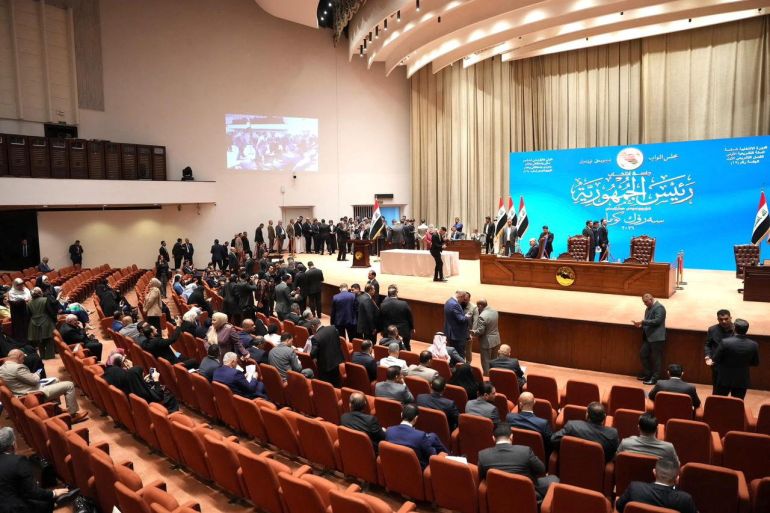

The Iraqi President Nizar Amedi has named Ali al-Zaidi as prime minister-designate, and tasked him with forming a government, Al Jazeera’s correspondent in Iraq has reported.
Al-Zaidi was named earlier on Monday as the candidate of the Coordination Framework, a coalition of Shia parties that has a majority in parliament. His nomination sees him promoted over a pro-Iranian rival.
Recommended Stories
list of 3 items- list 1 of 3‘Clearly stronger’: Germany’s Merz says Iran ‘humiliated’ US in its war
- list 2 of 3Timeline: The highs and lows of the US-UK ‘special relationship’
- list 3 of 3NPT summit: Can nuclear pact survive US-Israel war on Iran?
“After considering the names of the candidates, Ali al-Zaidi was chosen to be the candidate of the Coordination Framework bloc, as the largest bloc in the House of Representatives, to occupy the position of prime minister and form the next government,” a Coordination Framework statement read after a meeting in Baghdad.
The selection of al-Zaidi breaks a months-long deadlock in which United States President Donald Trump had intervened, after former two-time Prime Minister Nouri al-Maliki had emerged as the coalition’s initial candidate.
Al-Maliki, who is close to Iran, was fiercely opposed by Trump. The US president warned that all support to Iraq would stop if he became prime minister.
However, the Coordination Framework said that al-Maliki and outgoing Prime Minister Mohammed Shia al-Sudani had withdrawn their candidacies.
In a statement announcing al-Zaidi’s nomination, the coalition thanked al-Maliki and al-Sudani for their “historic and responsible positions” in withdrawing their candidacies to help overcome the political deadlock. Al-Sudani issued a statement congratulating al-Zaidi.
Al-Zaidi, who is chairman of Al-Janoob Islamic Bank, emerged in the final stages of discussions as a leading candidate, bolstered by his economic background and connections in the business and investment sectors. He has not previously held political office.
al-Zaidi promised to focus on making Iraq “a balanced country, regionally and internationally” following his nomination.
“This appointment comes at a sensitive time that requires concerted efforts from all political and social forces,” he said.
Under the constitution, the designated prime minister has 30 days to present a cabinet to parliament, with 167 votes required to secure a vote of confidence.
In the country’s power-sharing system, in place since 2003 following the US-led coalition’s invasion, the presidency goes to the Kurds, the premiership to Shia Arabs and the post of parliament speaker to the Sunnis.
The next Iraqi government will have to deal with the political and economic fallout of the US-Israeli war against Iran, while the closure of the Strait of Hormuz has disrupted the oil exports on which the country’s economy depends.
The new government will also face challenges in dealing with corruption, uncontrolled weapons, and the future of the Popular Mobilisation Forces, a coalition of Shiite militias that are nominally under the Iraqi military but in practice largely outside of its control.