‘Anything but normal’: Uncertainty as Iranians try to get by amid US war
War damage and blockade have worsened economic conditions for many struggling Iranians.
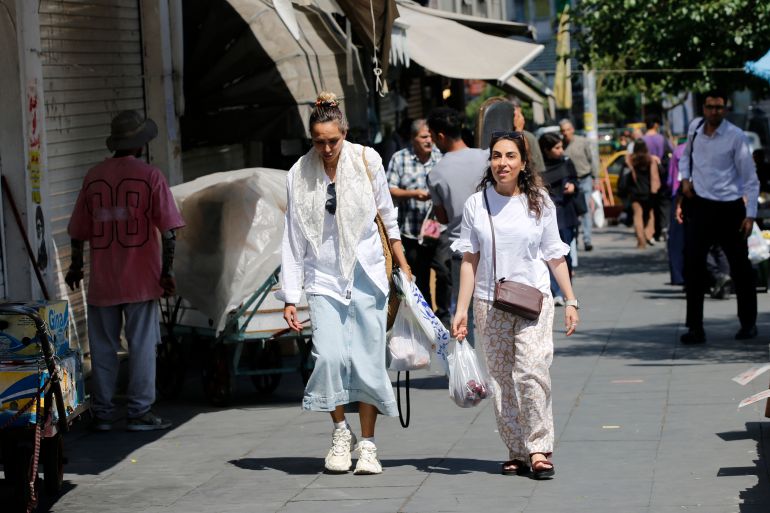

Tehran, Iran – Months into a war with the United States and after another flareup of fighting with Israel, daily conversations in Iran have been dominated by conflict and economic survival.
Many residents of the capital, Tehran, went to work over the past two days with war and peace on their minds, as US President Donald Trump continued to portray an understanding as being within reach despite an exchange of fire between Iran and Israel.
A 33-year-old man who works at an office in western Tehran said people were alert and checking their phones but did not all rush out after hearing a loud bang in the distance before noon on Monday, which was followed by at least two more in the early hours of the morning.
“You get used to it at some level and eventually keep going about work and conversations like everything is normal, but the truth is that this is anything but normal,” he told Al Jazeera, asking to remain anonymous.
The Israeli military struck Tehran and other cities, as well as a petrochemical complex in the western city of Bandar-e Mahshahr, after the Islamic Revolutionary Guard Corps (IRGC) launched missiles at Israel overnight in retaliation for an attack on the southern suburbs of Lebanon’s capital, Beirut, known as Dahiyeh.
Israeli leaders said they were paving the way for future strikes, and Iran warned of harsher attacks if Lebanon is not spared, but the missile launches have stopped for now. This is while Iran and the US exchanged night-time fire for more than a week before the strikes, and Washington continues to impose a blockade that has further squeezed Iran’s embattled economy.
Late on Tuesday, Trump accused Iran of shooting down a US military helicopter over the Strait of Hormuz, saying that his country “must respond” to the alleged attack.
In a small cafe in central Tehran, a young woman who works as a digital marketer said she does not believe that the Islamic Republic and the US could reach a long-term resolution, which means more uncertainty about the future.
“The two of them don’t go with each other,” she said. “How could they reach a deal when one of them says something and the other says something completely different?”
A man who works as a gym instructor said the two sides might announce an interim agreement, but he believes even that would not be welcome news for many Iranians.
“At best, that can postpone everything until after the end of the World Cup, or a few more months more, which will be a few more months of everything getting harder for us trying to live a normal life,” he told Al Jazeera, adding that he believed the conflict would continue after that.
‘Getting pummelled’
In the meantime, keeping up with the same life standards or just staying afloat in the fast-declining economy gets harder and more unpredictable for all.
The owner of the cafe said he has taken some items off the menu due to price fluctuations and lower demand.
He is now paying roughly 2.5 times more for a kilogramme of the same coffee compared with just three weeks ago, without being able to tell what will happen in another three weeks. Less than four years ago, he was paying 20 times less.
“I get a headache looking at the news and Trump saying they might get a deal in two days or two weeks. I just know that I’m getting pummelled here,” he said.
“Everyone I speak to regularly for my work – from the local butcher to the baker, grocery shop owner and the customer – is complaining. A lot of vendors say the price they’ve been selling at keeps falling behind the price of their next purchase very fast.”
The Iranian economy has long faced chronic inflation, rooted in corruption, mismanagement and the cumulative effect of US sanctions that isolated the country from many international markets.
But war damage and the blockade have quickly exacerbated conditions, with year-on-year inflation pushing past 83 percent by late May. Food inflation was at 130 percent by the same time, according to the Statistical Center of Iran, with many staples such as cooking oil and eggs more than quadrupling compared with last year.
When footage of Iranian missiles flying from Kermanshah and other places towards Israel began flooding social media on Sunday night, many were concerned that authorities would once again cut internet connectivity in the country.
“I bought 10-gig [configuration] and had another two in reserve,” a young man living in western Tehran told Al Jazeera about his preparation for a potential shutdown on Monday, in reference to a virtual private network connection that can circumvent state filtering. The shutdown did not happen, but the internet remains heavily throttled.
Partial internet traffic and access were only restored in late May, after three months of near-total state-imposed shutdown based on vague security considerations. A number of officials and state supporters have attacked the government of President Masoud Pezeshkian for not maintaining the full blackout until the end of the war.
At night on the streets, pro-state demonstrators still gather under security protection to wave flags and chant slogans against the US and Israel, although at smaller numbers compared with the start of the war.