

- 6 Oct 2023 - 12:50(12:50 GMT)
Thank you for joining us
That’s it from our Live team today.
You can check out our explainer on who has so far won the 2023 Nobel Prize here.
Thank you for joining us.
- 6 Oct 2023 - 12:40(12:40 GMT)
Our live coverage is coming to an end
We are about to wrap up our coverage, so here’s a reminder of what happened today:
- Iranian women’s rights campaigner Narges Mohammadi won the Nobel Peace Prize.
- Mohammadi was honoured “for her fight against the oppression of women in Iran and her fight to promote human rights and freedom for all”, according to Berit Reiss-Andersen, head of the Norwegian Nobel Committee in Oslo.
- Mohammadi said in a statement to the New York Times that global support and recognition of her human rights advocacy makes her “more resolved, more responsible, more passionate and more hopeful”, according to a post on the X platform.
- This was the fifth Nobel Prize to be awarded this week; on Monday the final Nobel Prize for economic sciences will be announced.
- 6 Oct 2023 - 12:34(12:34 GMT)
Mohammadi’s brother: ‘They will just crush people’
Mohammadi’s brother Hamidreza says he has not been in touch with his sister but the Nobel Peace Prize “means a lot to her”. He added, however, it is unlikely to make a difference in Iran.
“The prize means that the world has seen this movement, [but] the award will not affect the situation in Iran,” he said. “The regime will double down on the opposition, and it will have no effect on the regime. They will just crush people.”
Waiting for the announcement “was nerve-racking”, he added. But he knew immediately his sister won when he heard the committee’s chair Berit Reiss-Andersen saying three words in Farsi: “woman, life and freedom” – the slogan of recent demonstrations.
“I felt very great,” said Hamidreza Mohammadi, who lives in Norway.
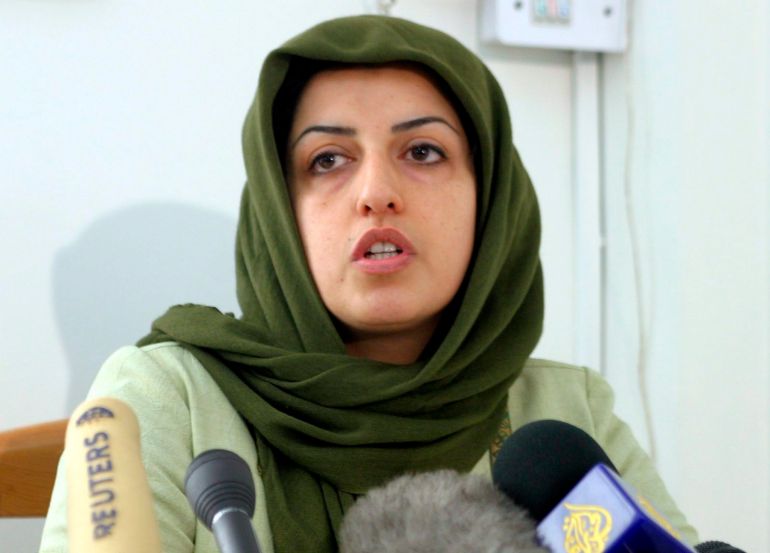
Iranian activist Narges Mohammadi speaks in 2005 [File: Abedin Taherkenareh/EPA-EFE] Advertisement - 6 Oct 2023 - 12:19(12:19 GMT)
Iran’s ‘hijab and chastity’ laws
For nearly all of Mohammadi’s life, Iran has been governed by a theocracy headed by the country’s supreme leader. While women hold jobs, academic positions and even government appointments, their lives can be tightly controlled.
Laws require all women to at least wear a headscarf, or hijab, to cover their hair as a sign of piety. Iran and neighbouring Afghanistan remain the only countries that mandate it.
Iran’s parliament last month passed a new “hijab and chastity” bill that lays out punishment for people who violate the country’s mandatory dress code rules.
For women, unacceptable covering has been defined as “revealing or tight clothing, or clothing that shows parts of the body lower than the neck or above the ankles or above the forearms”.
- 6 Oct 2023 - 12:09(12:09 GMT)
‘It is time to free Narges Mohammadi’: Human rights organisation
Front Line Defenders, a human rights organisation that has closely worked on amplifying Mohammadi’s imprisonment, shared their congratulations on her Nobel Peace Prize.
Olive Moore, interim director at Front Line Defenders, said, “This Nobel Peace Prize is a resounding recognition of Narges Mohammadi and other women human rights defenders who – at great cost to personal liberty – have courageously advocated for Iranian women to enjoy the full range of human rights and freedoms.”
“Front Line Defenders has spent years advocating for an end to the Iranian authorities’ persecution and imprisonment of Narges Mohammadi. This Nobel Prize is a clear signal that the international community agrees – it is time to free Narges Mohammadi and all unjustly imprisoned human rights defenders.”
- 6 Oct 2023 - 12:01(12:01 GMT)
White Torture: ‘I will not stop campaigning’
Partly from her own experience and after interviewing 12 other female prisoners, Mohammadi wrote the book White Torture. Published in 2022, it examines psychological torture such as sleep deprivation and solitary confinement that Iranian prisoners endure.
She also describes inmates suffering harassment, beatings by guards, blindfolding and denial of medical treatment.
“They will put me in jail again, but I will not stop campaigning until human rights and justice prevail in my country,” Mohammadi wrote.
As a journalist, she has also penned many articles arguing for social reform in Iran and published an essay collection, The Reforms, the Strategy, and the Tactics.

Narges Mohammadi is seen at her home in Tehran in 2001 [File: Behrouz Mehri/AFP] - 6 Oct 2023 - 11:59(11:59 GMT)
Who are the other women that won the Nobel Peace Prize?
Mohammadi became the 19th woman to win the Nobel Peace Prize on Friday, but who are the others:
- 1905 – Bertha von Suttner: “For her audacity to oppose the horrors of war.”
- 1931 – Jane Addams: “For their assiduous effort to revive the ideal of peace and to rekindle the spirit of peace in their own nation and in the whole of mankind.”
- 1946 – Emily Greene Balch: “For her lifelong work for the cause of peace.”
- 1976 – (joint) Betty Williams and Mairead Corrigan: “For the courageous efforts in founding a movement to put an end to the violent conflict in Northern Ireland.”
- 1979 – Mother Teresa: “For her work for bringing help to suffering humanity.”
- 1982 – Alva Myrdal: “For their work for disarmament and nuclear and weapon-free zones.”
- 1991 – Aung San Suu Kyi: “For her non-violent struggle for democracy and human rights.”
- 1992 – Rigoberta Menchu Tum: “In recognition of her work for social justice and ethno-cultural reconciliation based on respect for the rights of Indigenous peoples.”
- 1997 – Jody Williams: “For their work for the banning and clearing of anti-personnel mines”.
- 2003 – Shirin Ebadi: “For her efforts for democracy and human rights. She has focused especially on the struggle for the rights of women and children.”
- 2004 – Wangari Muta Maathai: “For her contribution to sustainable development, democracy and peace.”
- 2011 – (joint) Ellen Johnson Sirleaf, Leymah Gbowee, Tawakkol Karman: “For their non-violent struggle for the safety of women and for women’s rights to full participation in peace-building work.”
- 2014 – Malala Yousafzai: “For their struggle against the suppression of children and young people and for the right of all children to education.”
- 2018 – Nadia Murad: “For their efforts to end the use of sexual violence as a weapon of war and armed conflict.”
- 2021 – Maria Ressa: “For their efforts to safeguard freedom of expression, which is a precondition for democracy and lasting peace.”
- 6 Oct 2023 - 11:48(11:48 GMT)
‘Victory is near’: Mohammadi says global support makes her ‘more hopeful’
Mohammadi has said in a statement to the New York Times that global support and recognition of her human rights advocacy makes her “more resolved, more responsible, more passionate and more hopeful”, according to a posting on the X platform.
She said she would never stop striving for democracy and equality, even if that meant staying in prison.
“I will continue to fight against the relentless discrimination, tyranny and gender-based oppression by the oppressive religious government until the liberation of women,” the newspaper quoted her as saying in a statement.
“I also hope this recognition makes Iranians protesting for change stronger and more organised. Victory is near.”
- 6 Oct 2023 - 11:34(11:34 GMT)
Locked up: Four other jailed Nobel Peace Prize winners
Four other Nobel Peace Prize laureates were imprisoned when they won the award:
- 1935: Carl Von Ossietzky, Germany. Journalist and pacifist Carl von Ossietzky was imprisoned in a Nazi concentration camp when he won the 1935 Nobel Peace Prize and was unable to make the trip to Oslo to collect the award. Von Ossietzky was arrested three years earlier in a raid on opponents of Adolf Hitler following the Reichstag fire.
- 1991: Aung San Suu Kyi, Myanmar. The deposed leader and democracy champion won the 1991 Nobel Peace Prize at a time when she was under house arrest as part of a crackdown by the country’s military leadership on the pro-democracy opposition. She was honoured “for her non-violent struggle for democracy and human rights”.
- 2010: Liu Xiaobo, China. The jailed dissident was serving an 11-year jail sentence for subversion at the time. Liu’s chair was symbolically left empty and no award was handed out. He died in July 2017 of liver cancer in hospital at the age of 61, becoming the second Nobel laureate to die in captivity.
- 2022: Ales Bialiatski, Belarus. Rights campaigner Ales Bialiatski shared the award with Russia’s Memorial group and Ukraine’s Center for Civil Liberties for their work to document war crimes and rights abuse. The head of Belarus’s most prominent rights group, Viasna, has been at the forefront of attempts to chart the abuses of the regime of Belarusian strongman Alexander Lukashenko.

Suu Kyi has been detained since the army removed her elected government in February 2021, and has not been seen or allowed to speak in public since then [AP]
Advertisement - 6 Oct 2023 - 11:07(11:07 GMT)
Iran ally Russia says ‘no comment’ on Nobel Peace award
Russia, allied to Iran, declined to react to the decision by the Nobel Committee to award Mohammadi the Peace Prize.
“No, we have no comment,” Kremlin spokesman Dmitry Peskov told reporters when asked.
With Friday’s announcement, 63 women have won Nobel Prizes, including 27 in scientific categories. Only five women have won the physics award and just two have won the economics prize.
- 6 Oct 2023 - 10:58(10:58 GMT)
Recap of events
Let’s bring you up to speed with today’s developments:
- Iran’s jailed women’s rights advocate Narges Mohammadi won the Nobel Peace Prize in a boost for anti-government protesters.
- The prize honoured all those behind recent unprecedented demonstrations in Iran and the award-making committee called for the release of Mohammadi, 51, who has campaigned for women’s rights and the abolition of the death penalty.
- Dan Smith, head of the Stockholm International Peace Research Institute think tank, said while the prize could help ease pressure on Iranian dissidents, it would be unlikely to lead to her release.
- Mohammadi is the 19th woman to win the 122-year-old prize and the first one since Maria Ressa of the Philippines won the award in 2021 jointly with Russia’s Dmitry Muratov.
- 6 Oct 2023 - 10:51(10:51 GMT)
Who is Mahsa Amini?
“Women, life, freedom” is the protest slogan that has become ingrained in women’s rights demonstrations across Iran and the world following the death of Mahsa Amini.
In September 2022, morality police in Tehran arrested Amini, who was 22 years old at the time, for not wearing a “proper” hijab. Police reportedly took Amini to Vozara Police Station, where she was beaten and later transferred to a hospital after suffering a stroke.
On September 16, 2022, Amini died in hospital, and what followed was some of the biggest protests for women’s rights and against clerical rule that Iran has ever experienced.
During the protests, more than 500 people were killed, including 70 minors, in government crackdowns, according to foreign human rights organisations.
The protests have reverberated across the globe with demonstrations in support of women’s freedoms in Iran held from Brussels to New York.
- 6 Oct 2023 - 10:46(10:46 GMT)
Iran government the ‘true defender’ of human rights in the country: FM
Iran’s government has defended itself against accusations of human rights abuses, blaming recent demonstrations on foreign enemies who are “inciting terror and riots” across the country.
“[It’s] not about the Islamic Republic of Iran, which is a true defender of human rights and has shown deep restraint during recent riots,” Iran’s Foreign Minister Hossein Amirabdollahian has said previously of the unrest.
Protests began in September 2022 after the death in police custody of Mahsa Amini, 21. She was arrested by the country’s “morality police” for allegedly wearing her hijab improperly.
- 6 Oct 2023 - 10:16(10:16 GMT)
Iran’s Fars agency: Mohammadi given Nobel for acts against ‘national security’
A semi-official Iranian news agency says Mohammadi has been awarded the Nobel Peace Prize for “her actions against Iran’s national security”.
“Narges Mohammadi received her prize from the Westerners,” the Fars news agency reported, adding that she “had made headlines multiple times due to her acts against the national security”.
Iranian authorities have yet to comment on the award.
- 6 Oct 2023 - 10:12(10:12 GMT)
Prize will embolden Mohammadi’s fight, husband says
Mohammadi’s award will further encourage her struggle and the movement she leads, her husband has told Reuters.
“This Nobel Prize will embolden Narges’ fight for human rights, but more importantly, this is in fact a prize for the woman, life and freedom (movement),” Mohammadi’s husband Taghi Ramahi said in an interview at his home in Paris.

Taghi Ramahi, husband of Narges Mohammadi with an undated photo of himself and his wife, at his home in Paris [Christian Hartmann/Reuters] - 6 Oct 2023 - 10:09(10:09 GMT)
Mohammadi’s prize highlights courage of Iranian women, UN rights office says
The Office of the United Nations High Commissioner for Human Rights says the Nobel Peace Prize awarded to Mohammadi highlights the courage and determination of Iranian women.
“We’ve seen their courage and determination in the face of reprisals, intimidation, violence and detention,” agency spokesperson Elizabeth Throssell said.
“They’ve been harassed for what they do or don’t wear. There are increasingly stringent legal, social and economic measures against them. This really is something that highlights the courage and determination of the women of Iran and how they are an inspiration to the world.”
- 6 Oct 2023 - 10:07(10:07 GMT)
Prize committee hopes Iran will free Mohammadi
The Norwegian Nobel Committee says it hopes Iran will release Mohammadi so she can attend the prize ceremony in December.
“If the Iranian authorities make the right decision, they will release her, so she can be present to receive this honour, which is what we primarily hope for,” Reiss-Andersen said at a press conference.
Advertisement - 6 Oct 2023 - 10:05(10:05 GMT)
‘A heart that breaks’
Mohammadi has not seen her children for eight years, and restrictions placed by the prison on her telephone calls means she has not even heard their voices for more than a year and a half.
“My most incurable and indescribable suffering is the longing to be with my children, from whose lives I departed when they were eight,” she told the Agence France-Presse news agency in September.
“The price of the struggle is not only torture and prison. It is a heart that breaks with every regret and a pain that strikes to the marrow of your bones.”
But she added: “I believe that as long as democracy, equality and freedom have not been achieved, we must continue to fight and sacrifice.”
- 6 Oct 2023 - 10:02(10:02 GMT)
‘The future of Iran is its women’, says German minister
German Foreign Minister Annalena Baerbock praised Mohammadi’s Nobel Prize win and says her “fearless voice cannot be locked away”.
On X, Baerbock wrote, “Women. Life. Freedom. The [Nobel Peace Prize] to Narges Mohammadi and thus the women of Iran shows the power of women for freedom. Mohammadi’s fearless voice cannot be locked away, the future of Iran is its women.”
Women. Life. Freedom.
زن، زندگی، آزادی
ژن، ژیان، ئازادیDer #Friedensnobelpreis an #NargesMohammadi und damit die Frauen Irans zeigt die Kraft von Frauen für #Freiheit. Mohammadis furchtlose Stimme lässt sich nicht wegsperren, die Zukunft des Irans sind seine Frauen.
— Außenministerin Annalena Baerbock (@ABaerbock) October 6, 2023
- 6 Oct 2023 - 10:00(10:00 GMT)
A history of arrests
The Nobel Prize has written a brief bio on Mohammadi on Twitter:
“As a young physics student Mohammadi distinguished herself as an advocate for equality and women’s rights. In 2011 she was arrested for the first time and sentenced to many years of imprisonment for her efforts to assist incarcerated activists and their families.
“After her release on bail, this year’s peace laureate Mohammadi immersed herself in a campaign against use of the death penalty. Her activism against the death penalty led to her re-arrest in 2015, and to a sentence of additional years behind walls.
“Last year’s wave of protests became known to the political prisoners held inside the notorious Evin prison in Tehran. From captivity, 2023 #NobelPeacePrize laureate Mohammadi has helped to ensure that the protests have not ebbed out.”
Nobel Peace Prize 2023 updates: Winner is Iran’s Narges Mohammadi
These were the updates from the Nobel Peace Prize announcement on October 6, 2023.
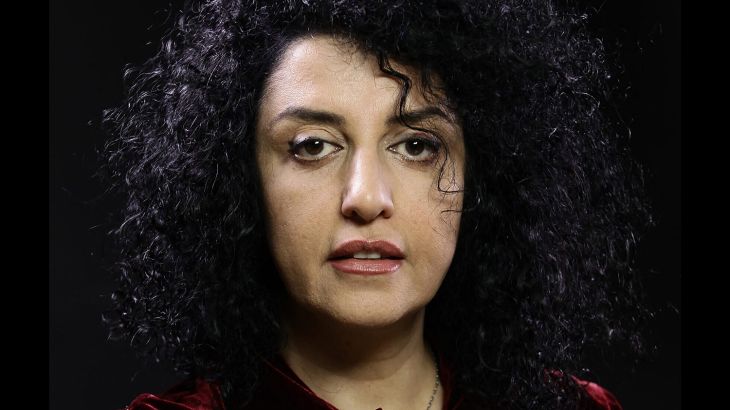
Iran’s Narges Mohammadi wins Nobel Peace Prize for rights fight
Published On 6 Oct 2023
This live page has now been closed.
- Iranian women’s rights campaigner Narges Mohammadi wins the Nobel Peace Prize.
- Mohammadi was honoured “for her fight against the oppression of women in Iran and her fight to promote human rights and freedom for all”, said Berit Reiss-Andersen, head of the Norwegian Nobel Committee in Oslo.
- Authorities arrested Mohammadi in November after she attended a memorial for a victim of violent 2019 protests. Mohammadi has a long history of imprisonment, harsh sentences and international calls for reviews of her case.
- After Friday’s announcement, a ceremony will take place at the Oslo City Hall on December 10, the anniversary of founder Alfred Nobel’s death.