A visual guide to redistricting
The United States is heading into one of its most consequential midterm elections in decades.



The United States is heading into one of its most consequential midterm elections in decades.
On November 3, every seat in the House of Representatives and a third of the Senate will be up for grabs in what amounts to the country's first major verdict on Donald Trump's second term as president.
It was a year and a half ago that Trump pulled off a sweeping victory against Democrat Kamala Harris.
His fellow Republicans also achieved narrow majorities in the Senate and House, giving Trump the power to push through legislation and cabinet appointments with minimal Democratic interference. With his approval numbers declining, Trump is pushing hard to retain Republican control of Congress.
Now with that power on the line, both parties are fighting not just for votes but also over the very maps where those votes will count. In this visual explainer, Al Jazeera unpacks what happens during the midterms, how the primaries work and how the shape of electoral district maps can favour one political party over another.

What happens during the midterms?
On November 3, nearly 244 million voters are eligible to cast ballots in the US midterms.
These elections are not to elect a new president but rather to vote for 35 US Senate seats and all 435 House seats. Voters will also elect 39 state governors and state legislators.
The Senate, or upper house of Congress, has 100 seats in total with each of the 50 states represented by two senators regardless of their population size. In the national elections held in November every two years, roughly one-third of the Senate's seats are up for grabs as senators serve six-year terms and elections are staggered.
The House of Representatives, or lower house, allocates seats to each state according to population for a total of 435 members, all of whom serve two-year terms and are up for election every cycle.
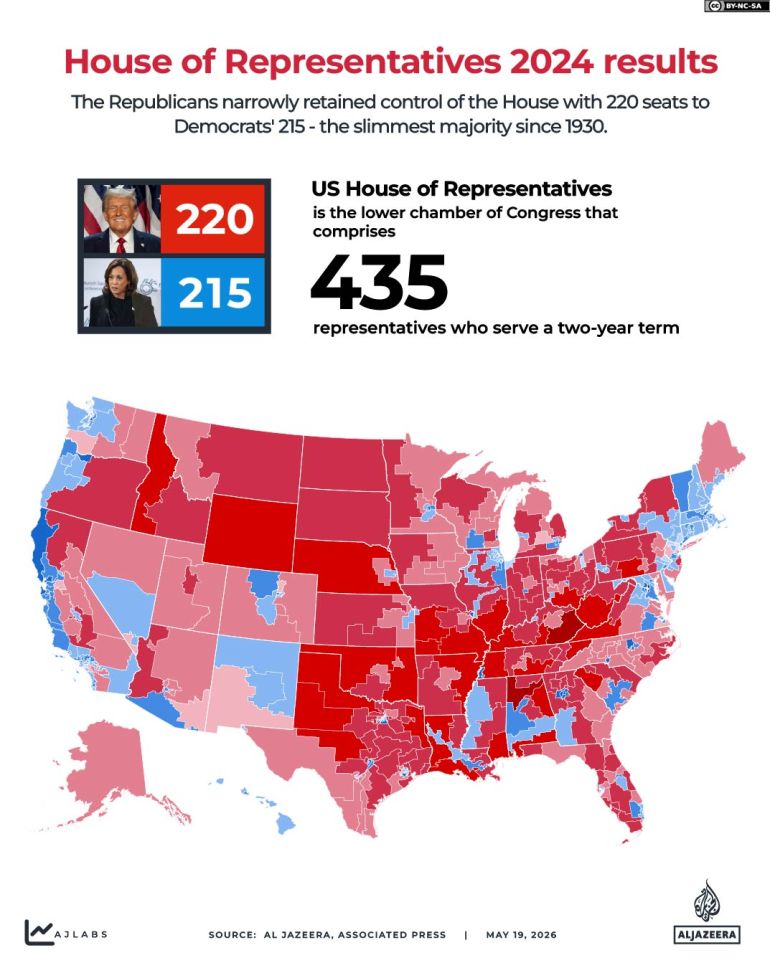
In 2024, the Republicans narrowly retained control of the House with 220 seats to the Democrats' 215, the slimmest majority since 1930. That razor-thin margin is why the redistricting battle matters so much.
What happens during the primaries?
Before November's midterm elections, each party must decide which candidates it will field. These internal contests, known as primaries, begin as early as March and run through the summer, state by state.
Primaries are especially important in heavily Democratic or Republican districts, where the winning candidates of the majority party rarely face serious competition in November. In most states, primary turnout can shape the ideological direction of both major parties long before November voters cast their ballots.
On Tuesday, six states held primary elections: Alabama, Georgia, Idaho, Kentucky, Oregon and Pennsylvania.
The graphic below shows the calendar of primaries leading up to the November 3 elections.


How are the 435 House districts drawn up?
Before any primary takes place, each state must draw its congressional district maps to determine which voters are grouped together and will vote for a single person to represent them in the House.
These maps determine:
- Which voters are in each district
- Whether a district leans Democratic, Republican or is competitive
- How “safe” or “fragile” a seat is
This process is called redistricting. Every 10 years after the US census, the country’s 435 House seats are reapportioned based on population shifts, triggering a nationwide redrawing of congressional districts. The number of seats in the House has been 435 since 1912, and the only exception was made in 1929 to allow the admission of Alaska and Hawaii into the US.
The most recent census was in 2020, and states completed their redistricting by 2022. Since 2024, however, several states have redrawn their congressional maps again - some successfully, some blocked by the courts - with accusations of gerrymandering.
What is gerrymandering?
Gerrymandering is the practice of drawing electoral district boundaries to favour one political party over another. The tactic exists in many countries with district-based voting systems but is most closely associated with the US.
The term itself originates in the US, coined in 1812 after Massachusetts Governor Elbridge Gerry signed a bill creating a strangely shaped district that a newspaper likened to a salamander, combining it with his name to get "gerrymander".

There are two main forms of gerrymandering in the US:
- Packing: District lines concentrate voters from one party or identity group into a small number of seats, limiting their influence elsewhere.
- Cracking: District lines split those same voters across multiple districts, diluting their voting power and preventing them from forming a majority.

Have a try for yourself to see how reorganising districts works and what seems fair and what doesn’t.


Which states have redrawn their maps before the midterms?
Before the 2026 midterms, at least eight states - California, Florida, Missouri, North Carolina, Ohio, Tennessee, Texas and Utah - passed new congressional maps, according to the National Conference of State Legislatures.
On May 13, the National Association for the Advancement of Colored People (NAACP) along with a coalition of civil rights and community organisations filed a lawsuit In Tennessee against the lawmakers who split the state’s only majority-Black district centred on Memphis.
Legal battles over redistricting also escalated in Texas, Louisiana, Virginia, Alabama and South Carolina over racial gerrymandering and voting rights before the midterms.
The map below shows redistricting activity between the 2024 and 2026 elections.
Florida
Florida’s new congressional map is expected to strengthen Republican control of the state’s 28 House seats and could help the party gain up to four additional Republican-leaning districts before the midterms.
The previous map already favoured Republicans with Democratic voters concentrated around Orlando, Tampa and South Florida, including Miami. The redraw further clusters Democratic voters into fewer districts while expanding Republican-leaning areas across central and southern Florida.
Governor Ron DeSantis pushed the new district map into law. Voting rights groups and Democratic organisations filed lawsuits within days, arguing it violates Florida's "Fair Districts" antigerrymandering amendment and was designed to benefit Republicans.

Texas
Texas remains a major redistricting battleground before the midterms. Republicans hold the majority of the state's House seats at 25 to the Democrats' 13.
On April 27, the US Supreme Court reinstated the post-2020 congressional map drawn by Texas Republicans, which was challenged under the Voting Rights Act in a lower court that had blocked the map over allegations of racial gerrymandering.
Civil rights organisations - including the American Civil Liberties Union, the League of United Latin American Citizens and the Mexican American Legal Defense and Educational Fund - have challenged the map in federal court, arguing it violates the Voting Rights Act by diluting minority representation.

Missouri
Missouri Republicans redrew congressional maps before 2026, aiming to gain one extra House seat for their party.
In September, a new map was approved by Republicans to reinforce the party's already strong advantage in the state's US House representation. Heading into the redistricting effort, Republicans represented six of Missouri's eight congressional districts.
Governor Mike Kehoe, a Republican who is closely aligned with the party’s conservative wing, signed the map into law in the same month for use in the 2026 elections.
The new lines generally make most Republican-leaning districts in the rest of Missouri even harder for Democrats to win. The map faced legal challenges, but the Missouri Supreme Court upheld it, clearing the way for its use in the 2026 midterm elections.

North Carolina
In October, the North Carolina Senate approved a new congressional map that is expected to make one more US House seat Republican-leaning by reshaping several previously competitive or Democratic-leaning districts.
Under the old map, Democratic support was mostly concentrated in a handful of urban and suburban districts anchored in cities such as Charlotte, Raleigh, Durham and Greensboro while Republicans held most of the rest of the state.
The revised map redraws boundaries in eastern and suburban North Carolina to make key swing districts more reliably Republican while leaving only a few urban-centred districts largely unchanged.
The move comes after years of intense legal and political battles over redistricting in the state and could further solidify Republican control of North Carolina’s US House delegation.

California
California has the country's largest congressional delegation with 52 House seats and has become the ground for a key Democratic counterattack in the national redistricting battle before the midterms.
California voters approved a new Democratic-backed map under Proposition 50, known as the Election Rigging Response Act, in a 2025 special election.
The new boundaries are designed to help Democrats protect and potentially expand their existing 43-seat majority in the state.
Democrats already dominate coastal urban regions, including Los Angeles, San Francisco and San Diego, while Republicans remain stronger in inland rural areas.

Ohio
Ohio approved a new congressional map before this year's midterms after a 2018 constitutional amendment forced another redraw of the state’s Republican-leaning districts.
The new plan, unanimously approved by the Ohio Redistricting Commission in October, retains Republican dominance across most of the state while making several suburban and rural districts even safer for the party.
Democratic support remains concentrated in cities, including Cleveland, Columbus and Cincinnati.
Ohio was once considered a major presidential swing state, but Republicans now hold 10 of its 15 House seats, and the redraw is expected to further strengthen the party’s advantage.
