Skip linksSkip to Content
play
Live
Navigation menu
  • News
    • Africa
    • Asia
    • US & Canada
    • Latin America
    • Europe
    • Asia Pacific
  • Middle East
  • Explained
  • Opinion
  • Sport
  • Video
    • Features
    • Economy
    • Human Rights
    • Climate Crisis
    • Investigations
    • Interactives
    • In Pictures
    • Science & Technology
    • Podcasts
    • Travel
play
Live

In Pictures

Gallery|Coronavirus pandemic

In Pictures: Indian man cremates COVID-19 victims despite stigma

Facing infection and stigma, Ramananda Sarkar lights funeral pyres at crematorium in Assam dedicated to the virus dead.
Save

Share

facebookxwhatsapp-strokecopylink
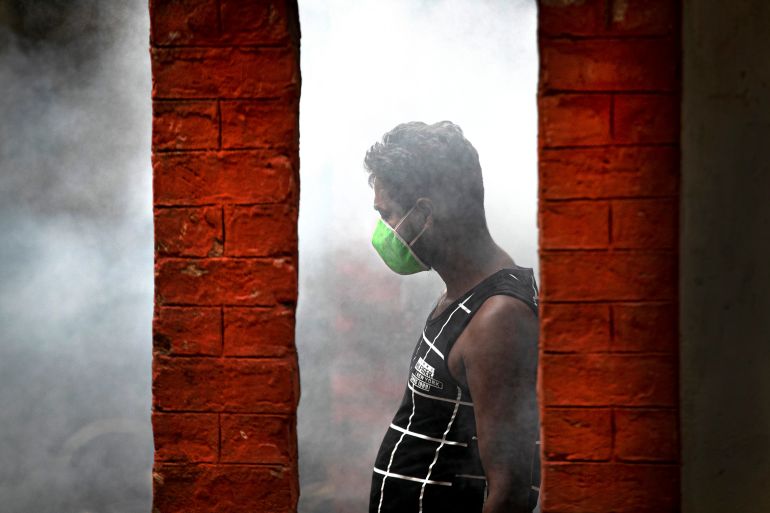
Smoke envelops Ramananda Sarkar, 43, as he cremates bodies of COVID-19 victims in Assam state. [Anupam Nath/AP Photo]
By AP
Published On 5 Oct 20205 Oct 2020

Ramananda Sarkar never wanted to burn bodies for a living, but he was deep in debt and desperate for money.

The 43-year-old had fled his remote village in India’s northeastern Assam state after failing to pay back a loan he had taken to start selling sugarcane juice on a wooden cart. But even in the state’s main city of Guwahati, Sarkar had trouble finding work.

Two years ago, he walked onto a cremation ground in the city and took up the job of lighting the funeral pyres.

While Hindus believe cremation rites are sacred and release the dead person’s soul from the cycle of rebirth, those who actually deal with corpses are looked down upon since the work has historically been carried out by the less privileged castes.

That has given the job a stigma only made worse by the coronavirus, which has killed more than 100,000 people out of 6.6 million reported infections in India.

Sarkar thought he had come to terms with his reputation, finally telling his wife what his job was after hiding it for some time. But in early May, he took part in what he thought was a routine cremation, not knowing that the woman had died of COVID-19.

When people learned the woman had been a victim of the disease, Sarkar’s acquaintances started shunning him and the state authorities put him under quarantine for a few days. But they let him out as there was no one available to do his job at the cremation ground.

“I don’t understand why people hate me. Only because I burn the dead bodies?” Sarkar asked. “If I don’t do this, then who will?”

Advertisement

Sarkar now works at a special cremation ground that local authorities designated just for victims of the pandemic.

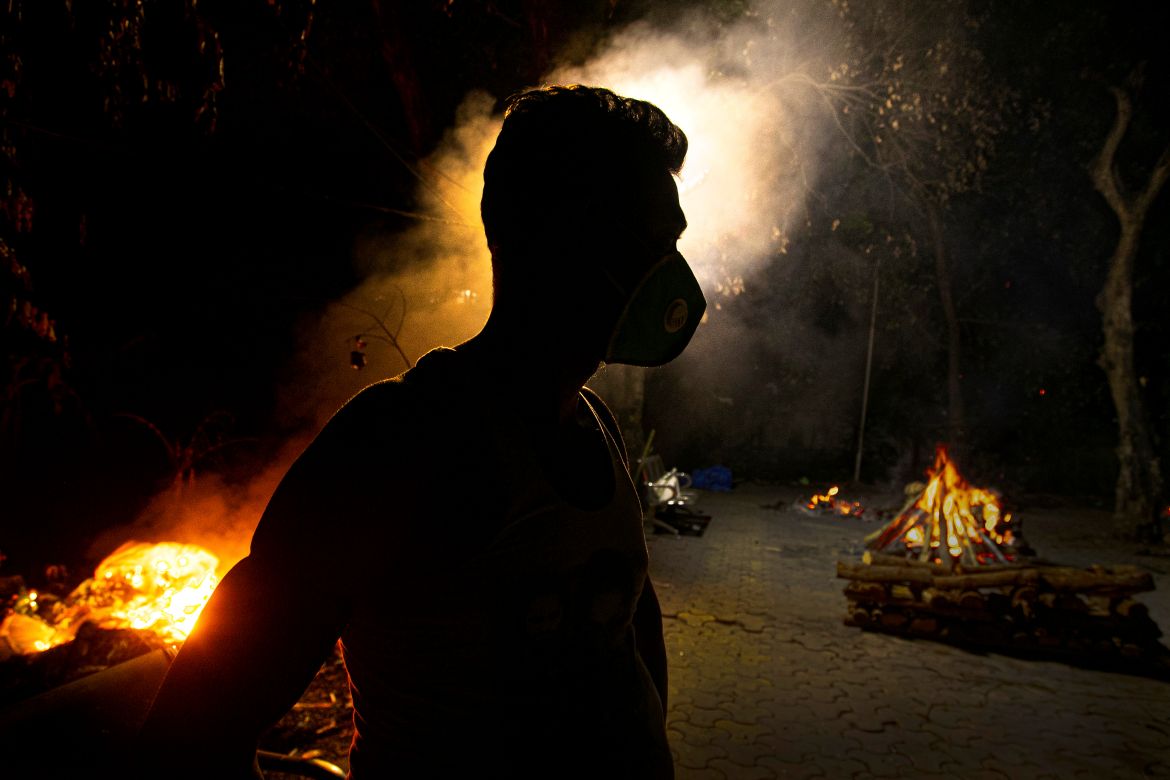
With a mask on his face and a prayer on his lips, he cremates bodies brought in by a handful of relatives in protective suits – hurried affairs conducted with minimal rituals under the state government’s guidelines.

Assam state has reported more than 181,600 confirmed cases of the virus since the pandemic began, and 711 deaths. Sarkar said he alone has cremated more than 450 COVID-19 victims.

Despite his vital community service, Sarkar’s own life continues to worsen. When his landlord heard what he did for work, he asked him to move out. A district official arranged a hotel room for him.

Sarkar was also stopped from returning to his village to visit his family, first by the village head and then, after local authorities intervened on his behalf, by the villagers themselves.

After more than a month of not seeing his wife and three sons, Sarkar recently snuck into his village in the middle of a rainy night. He called out to his family from the road outside his house and was able to spend 15 minutes with them and leave them some money.

“I don’t want my sons to become cremators like me,” Sarkar said. “I want them to go to school and become good human beings and earn respect from the society, not like me who has to meet his family in the dark.”

On his way back to the city, Sarkar says he decided to stop at a nearby temple to rest, but was told to leave by the temple officials.

He made it back to the cremation grounds and said despite the personal cost – which includes the risk of infection – he will continue to light the funeral pyres of those who have lost their lives to the virus and he will honour them as best as he can.

“I may die of COVID-19, but I don’t care,” he said. “I will do my work sincerely till the end.”

Sarkar makes an offering to Hindu goddess Kali before cremating the body of a COVID-19 victim. [Anupam Nath/AP Photo]
Advertisement
Two years ago, Sarkar walked into a cremation ground in Guwahati and took up the job of lighting the funeral pyres. [Anupam Nath/AP Photo]
While Hindus believe cremation rites are sacred and release the dead person's soul from the cycle of rebirth, those who actually deal with corpses are looked down upon. [Anupam Nath/AP Photo]
The stigma around the men lighting funeral pyres has been made worse by the coronavirus. [Anupam Nath/AP Photo]
Sarkar works at a special cremation ground that local authorities designated just for victims of the pandemic. [Anupam Nath/AP Photo]
Sarkar's wife and children stand by the door of their house in a remote village in Assam. [Anupam Nath/AP Photo]
Advertisement
Sarkar says he was stopped from returning to his village to visit his family by the villagers. [Anupam Nath/AP Photo]
After a month of not seeing his family, Sarkar snuck into his village in the middle of a rainy night. [Anupam Nath/AP Photo]

Related

  • In Pictures: Kashmir’s elaborate weddings muted by COVID-19

    The pandemic has dampened the traditional wedding rituals and cutdown in week-long feasting.

    Published On 22 Sep 202022 Sep 2020
    A Kashmiri man sprays sanitizer on the hand of Haseeb Mushtaq, a Kashmiri groom as he arrives at brides home during his wedding ceremony on the outskirts of Srinagar, Indian controlled Kashmir, Monday
    This gallery article has 12 imagescamera12
  • In Pictures: Remembering China’s coronavirus dead

    Taoist priest honours China’s coronavirus dead with memorial tablets.

    Published On 10 Sep 202010 Sep 2020
    Taoist temple Jiuyang Palace and Jiuyang Pagoda stand in Laiwu of Jinan city, Shandong province, China, September 1, 2020. The monastery complex, where a small community of priests lives, sleeps, eats
    This gallery article has 9 imagescamera9
  • In Pictures: Peru’s Indigenous fight virus using ancestral wisdom

    Peru has world’s highest per-population confirmed COVID-19 mortality rate, forcing the Indigenous to find own remedies.

    Published On 14 Sep 202014 Sep 2020
    Passengers arrive in a public taxi boat to the Shipibo Indigenous community of Pucallpa, located along the Ucayali River in the Amazonian rainforest of eastern Peru, Thursday, Sept. 3, 2020, amid the
    This gallery article has 9 imagescamera9

More from Gallery

  • Photos: Mughal-era pigeon training survives in heart of India’s capital

    Mughal-era pigeon training survives in heart of India's capital
    This gallery article has 11 imagescamera11
  • Photos: Displaced Lebanese families return home despite Israeli attacks

    Tens of thousands return to southern Lebanon despite warnings and risks
    This gallery article has 13 imagescamera13
  • Photos: Afghan villagers turn to gold-panning to sustain livelihoods

    Afghan villagers turn to gold panning to sustain livelihoods
    This gallery article has 9 imagescamera9
  • Photos: Families across Sudan endure years of displacement, hunger, loss

    Crowd of children sits under a tree and listens to a teacher.
    This gallery article has 17 imagescamera17

Most popular

  • Iran’s Araghchi to travel to Islamabad amid US-Tehran talks deadlock

    Smoke rises from a village in southern Lebanon as the Israeli army operates in it as seen from the Israeli side of the border, April 23, 2026 REUTERS/Gil Eliyahu ISRAEL OUT. NO COMMERCIAL OR EDITORIAL SALES IN ISRAEL TPX IMAGES OF THE DAY
  • How long can Iran survive the US’s Hormuz blockade?

    A navy vessel is seen sailing in the Strait of Hormuz
  • US considers suspending Spain from NATO, reported internal email suggests

    British Prime Minister Keir Starmer gestures next to U.S. President Donald Trump during their meeting at Chequers, near Aylesbury, Britain, September 18, 2025. REUTERS/Kevin Lamarque
  • Chornobyl at 40: Settlers and horses survive Russian drones, contamination

    An aerial view of the Chornobyl nuclear power plant.

  • About

    • About Us
    • Code of Ethics
    • Terms and Conditions
    • EU/EEA Regulatory Notice
    • Privacy Policy
    • Cookie Policy
    • Cookie Preferences
    • Accessibility Statement
    • Sitemap
    • Work for us
  • Connect

    • Contact Us
    • User Accounts Help
    • Advertise with us
    • Stay Connected
    • Newsletters
    • Channel Finder
    • TV Schedule
    • Podcasts
    • Submit a Tip
    • Paid Partner Content
  • Our Channels

    • Al Jazeera Arabic
    • Al Jazeera English
    • Al Jazeera Investigative Unit
    • Al Jazeera Mubasher
    • Al Jazeera Documentary
    • Al Jazeera Balkans
    • AJ+
  • Our Network

    • Al Jazeera Centre for Studies
    • Al Jazeera Media Institute
    • Learn Arabic
    • Al Jazeera Centre for Public Liberties & Human Rights
    • Al Jazeera Forum
    • Al Jazeera Hotel Partners

Follow Al Jazeera English:

  • facebook
  • twitter
  • youtube
  • instagram-colored-outline
  • rss
Al Jazeera Media Network logo
© 2026 Al Jazeera Media Network