Skip linksSkip to Content
play
Live
Navigation menu
  • News
    • Africa
    • Asia
    • US & Canada
    • Latin America
    • Europe
    • Asia Pacific
  • Middle East
  • Explained
  • Opinion
  • Sport
  • Video
    • Features
    • Economy
    • Human Rights
    • Climate Crisis
    • Investigations
    • Interactives
    • In Pictures
    • Science & Technology
    • Podcasts
    • Travel
play
Live
Navigation menu
  • Syria's War
  • Live: A year since fall of al-Assad
  • Hope and celebration in Syria
  • How many Syrians have returned?
  • Watch: The Road to Damascus
  • The fight for justice in Syria
  • Watch: One year after al-Assad

In Pictures

Gallery|Turkey-Syria Border

In Pictures: Displaced Syrians fear spread of COVID-19

With social distancing ‘near impossible’ in the overcrowded internally displaced people’s camps, coronavirus cases are still on the rise.

Save

Share

facebookxwhatsapp-strokecopylink
Ghatwa al-Mohommad, 80, is pictured in her makeshift home in an overcrowded internally displaced people's camp in Qah near the Turkish border in Syria's northwestern Idlib province. Humanitarian workers fear a rise in coronavirus cases would be disastrous in northwest Syria, where almost 1.5 million people live in overcrowded camps or shelters, after escaping the fighting during Syria's nine-year civil war. [Ahmad al-Atrash/AFP]
By AFP
Published On 2 Nov 20202 Nov 2020

Humanitarian workers fear a further rise in novel coronavirus cases would be disastrous in northwest Syria, where almost 1.5 million people live in overcrowded camps or shelters, often with poor access to running water.

Health authorities in northwest Syria announced 5,075 cases of COVID-19 so far, including 42 deaths.

Of those, more than 860 cases have been recorded among healthcare staff and almost 330 people in the camps.

Of the three million people living in Idlib, nearly half live in makeshift homes and tents after escaping the fighting during Syria’s nine-year civil war.

In an informal settlement in Idlib, the country’s last major rebel stronghold, Hassan Sweidan, who fled his home seven years ago, said he and other displaced Syrians did not stand much chance against the disease.

“We live in a camp all crammed in together. If someone talks to his family, all the neighbours can hear it,” said Sweidan, who is in his 40s and has an existing health condition.

If someone gets sick “it’s hardly the disease’s fault”, the father-of-six added.

Sweidan said he hopes he does not have to take anyone in his family to the local hospital.

“Hospitals are overcrowded. People are now scared of doctors and nurses, who they think might be infected with all the sick people going to them.”

Sweidan especially fears catching coronavirus as he suffers from a chronic liver condition.

“One of my relatives got it a while back, and I’m really scared because I have no immunity,” he said.

Local and international humanitarian workers are working to contain the virus, but cases are still on the rise.

Advertisement

“In the northwest, confirmed cases have increased sixfold over the last month, with cases also rising in displacement camps and settlements,” Mark Lowcock, United Nations under-secretary-general for humanitarian affairs, told the UN Security Council on Tuesday.

At the Idlib health directorate, Dr Yahya Nehmeh said they had asked residents to observe social distancing.

But he admitted that was “near impossible” in the hundreds of informal settlements dotting the region.

Few in the camps wear masks. Many cannot afford to buy face coverings, or to change them regularly, let alone disinfectant hand gels.

For most, food, water, medicine and school supplies are far more important.

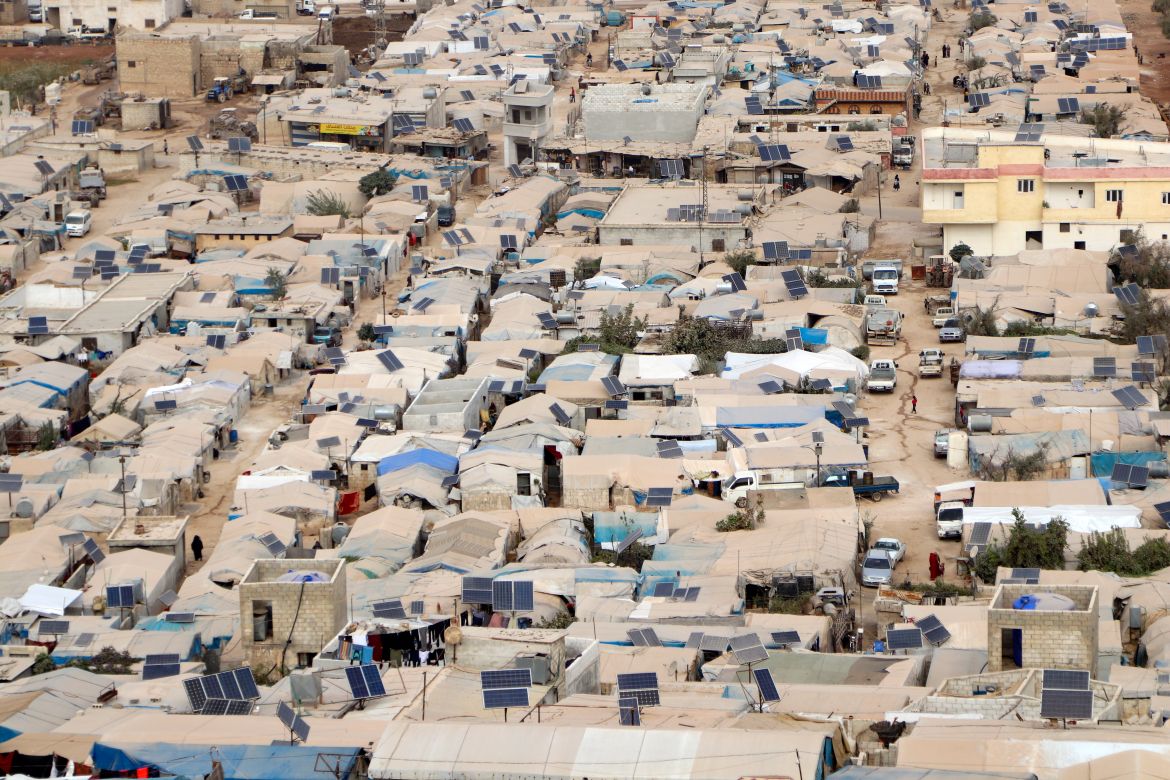
An overcrowded internally displaced people's camp near the village of Qah, close to the Turkish border in the northwestern Idlib province. [Ahmad al-Atrash/AFP]
Advertisement
Displaced children gather on one of the streets of an internally displaced people's camp near Qah. [Ahmad al-Atrash/AFP]
Hassan Sweidan walks with children in a camp near Qah. Sweidan, who fled home seven years ago, fears catching coronavirus as he suffers from a chronic liver condition. [Ahmad al-Atrash/AFP]
Humanitarian workers fear a rise in cases would be disastrous in northwest Syria. [Ahmad al-Atrash/AFP]
Humanitarian workers are working to contain the virus, but cases are still on the rise. [Ahmad al-Atrash/AFP]
Elderly displaced Syrian men sit in front of a tent. Few in the camps wear masks. Many cannot afford to buy face coverings or to change them regularly. [Ahmad al-Atrash/AFP]
Advertisement
A man sells vegetables in the camp near Qah. [Ahmad al-Atrash/AFP]
Idlib health directorate's Dr Yahya Nehmeh said they had asked residents to observe social distancing. But he admitted that was 'near impossible' in the hundreds of informal settlements dotting the region. [Ahmad al-Atrash/AFP]
Almost 1.5 million people live in overcrowded camps or shelters in northwest Syria, often with poor access to running water. [Ahmad al-Atrash/AFP]

Related

  • From: Talk to Al Jazeera

    Hakan Fidan on Iran and Turkiye’s role in global security

    Turkish foreign minister warns against escalation with Iran, explaining how Ankara sees the future of regional security.

    Published On 29 Jan 202629 Jan 2026
    Video Duration 27 minutes 40 seconds play-arrow27:40
  • Syrian army offensive overjoys some, leaves others with ‘existential’ fear

    Many Syrians feel liberated by the army pushing out the Kurdish-led SDF. But others fear government troops.

    Published On 27 Jan 202627 Jan 2026
    Kurdish fighters with the Syrian Democratic Forces (SDF) prepare to head towards the front line before the end of a four-day truce with the Syrian government in Hasakah, northeastern Syria, Saturday, January 24, 2026 [Baderkhan Ahmad/AP]
  • Clashes in Aleppo highlight challenge of SDF integration for Syria

    Analysts say a temporary ceasefire may bring relief, but the complex issues behind the violence must be addressed.

    Published On 9 Jan 20269 Jan 2026
    Buses stand by close to the Lairamoun roundabout as they wait to enter the Sheikh Maqsud neighbourhood to evacuate US-backed Kurdish-led Syrian Democratic Forces (SDF) fighters from two districts of the city of Aleppo, northern Syria, on January 9, 2026.
  • Hundreds of thousands march in Istanbul in solidarity with Gaza

    Demonstrators in Turkiye demand global pressure on Israel, calling the so-called ceasefire ‘a slow-motion genocide’.

    Published On 1 Jan 20261 Jan 2026
    A young girl holds Turkish and Palestinian flags as people demonstrate.

More from Gallery

  • Photos: Mughal-era pigeon training survives in heart of India’s capital

    Mughal-era pigeon training survives in heart of India's capital
    This gallery article has 11 imagescamera11
  • Photos: Displaced Lebanese families return home despite Israeli attacks

    Tens of thousands return to southern Lebanon despite warnings and risks
    This gallery article has 13 imagescamera13
  • Photos: Afghan villagers turn to gold-panning to sustain livelihoods

    Afghan villagers turn to gold panning to sustain livelihoods
    This gallery article has 9 imagescamera9
  • Photos: Families across Sudan endure years of displacement, hunger, loss

    Crowd of children sits under a tree and listens to a teacher.
    This gallery article has 17 imagescamera17

Most popular

  • US envoys to fly to Pakistan as Iran’s top diplomat to arrive for talks

    Smoke rises from a village in southern Lebanon as the Israeli army operates in it as seen from the Israeli side of the border, April 23, 2026 REUTERS/Gil Eliyahu ISRAEL OUT. NO COMMERCIAL OR EDITORIAL SALES IN ISRAEL TPX IMAGES OF THE DAY
  • How long can Iran survive the US’s Hormuz blockade?

    A navy vessel is seen sailing in the Strait of Hormuz
  • US considers suspending Spain from NATO, reported internal email suggests

    British Prime Minister Keir Starmer gestures next to U.S. President Donald Trump during their meeting at Chequers, near Aylesbury, Britain, September 18, 2025. REUTERS/Kevin Lamarque
  • Chornobyl at 40: Settlers and horses survive Russian drones, contamination

    An aerial view of the Chornobyl nuclear power plant.

  • About

    • About Us
    • Code of Ethics
    • Terms and Conditions
    • EU/EEA Regulatory Notice
    • Privacy Policy
    • Cookie Policy
    • Cookie Preferences
    • Accessibility Statement
    • Sitemap
    • Work for us
  • Connect

    • Contact Us
    • User Accounts Help
    • Advertise with us
    • Stay Connected
    • Newsletters
    • Channel Finder
    • TV Schedule
    • Podcasts
    • Submit a Tip
    • Paid Partner Content
  • Our Channels

    • Al Jazeera Arabic
    • Al Jazeera English
    • Al Jazeera Investigative Unit
    • Al Jazeera Mubasher
    • Al Jazeera Documentary
    • Al Jazeera Balkans
    • AJ+
  • Our Network

    • Al Jazeera Centre for Studies
    • Al Jazeera Media Institute
    • Learn Arabic
    • Al Jazeera Centre for Public Liberties & Human Rights
    • Al Jazeera Forum
    • Al Jazeera Hotel Partners

Follow Al Jazeera English:

  • facebook
  • twitter
  • youtube
  • instagram-colored-outline
  • rss
Al Jazeera Media Network logo
© 2026 Al Jazeera Media Network