Skip linksSkip to Content
play
Live
Navigation menu
  • News
    • Africa
    • Asia
    • US & Canada
    • Latin America
    • Europe
    • Asia Pacific
  • Middle East
  • Explained
  • Opinion
  • Sport
  • Video
    • Features
    • Economy
    • Human Rights
    • Climate Crisis
    • Investigations
    • Interactives
    • In Pictures
    • Science & Technology
    • Podcasts
    • Travel
play
Live

In Pictures

Gallery|Drugs

Boom time for Myanmar opium farmers amid coup chaos

Myanmar is the world’s largest opium producer where the conflict has made it a lucrative crop for struggling farmers.
Save

Share

facebookxwhatsapp-strokecopylink
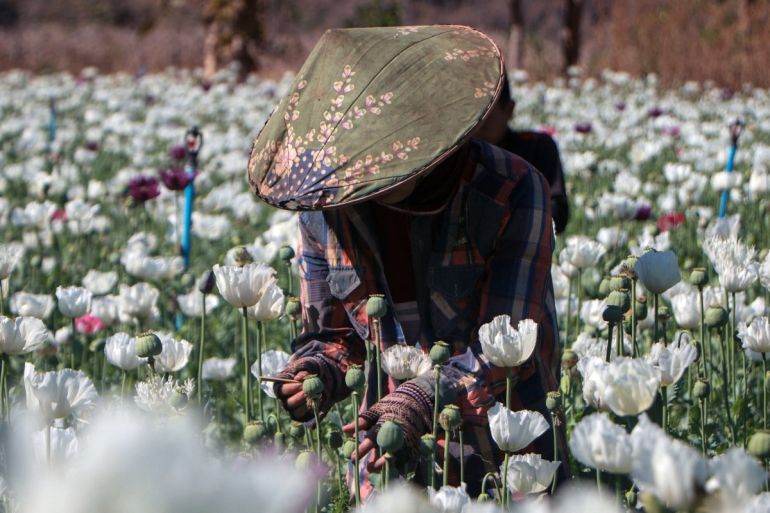
A man working in the illegal poppy fields
A displaced resident working in illegal poppy fields on the border of Karen state and southern Shan state. [AFP]
By AFP
Published On 15 Mar 202415 Mar 2024

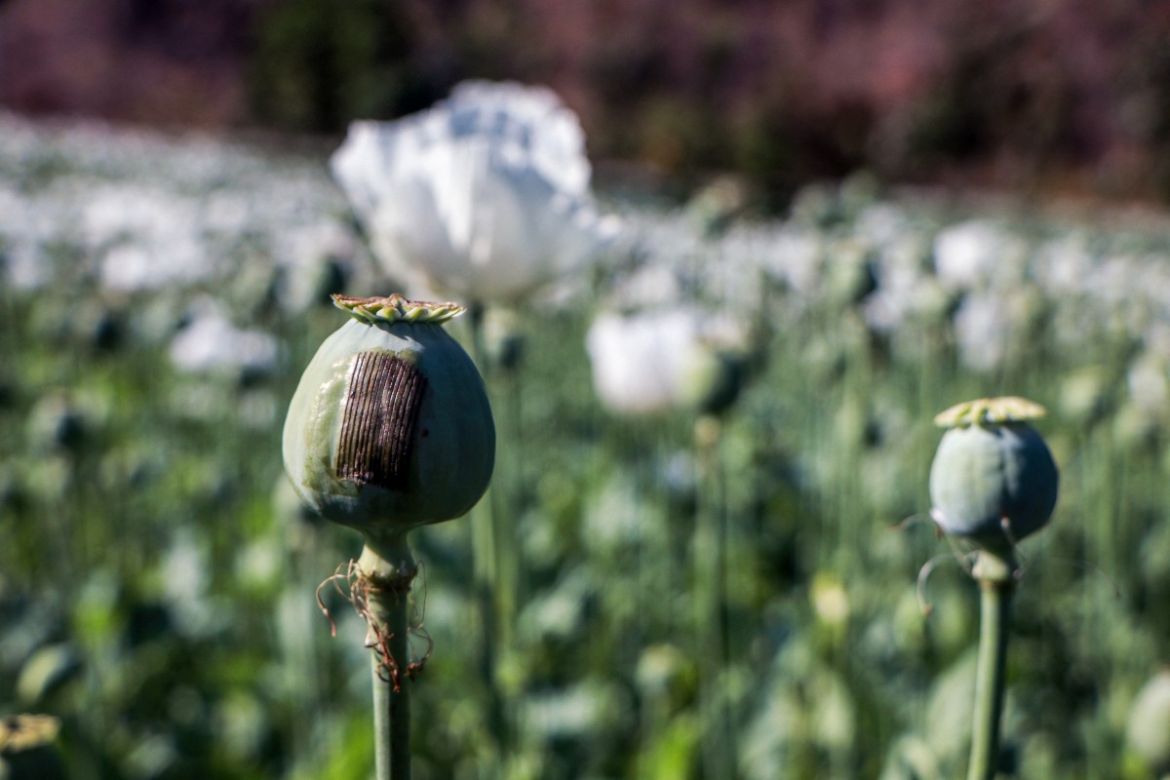
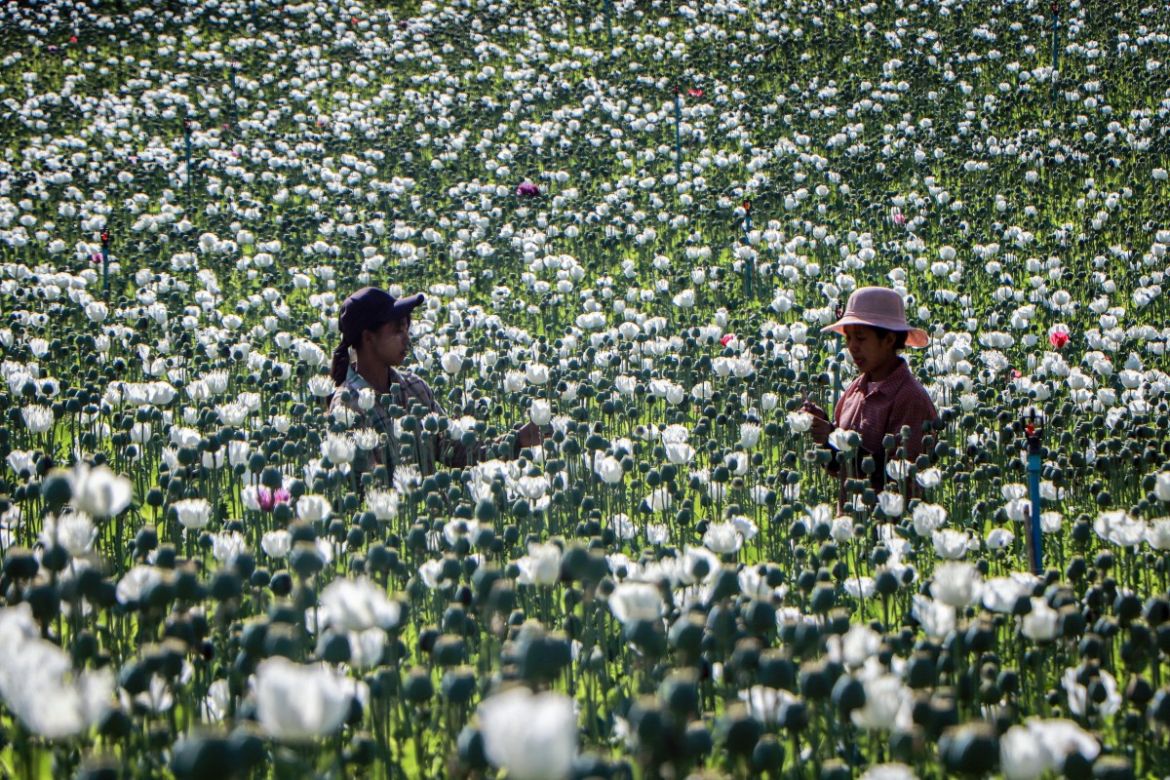
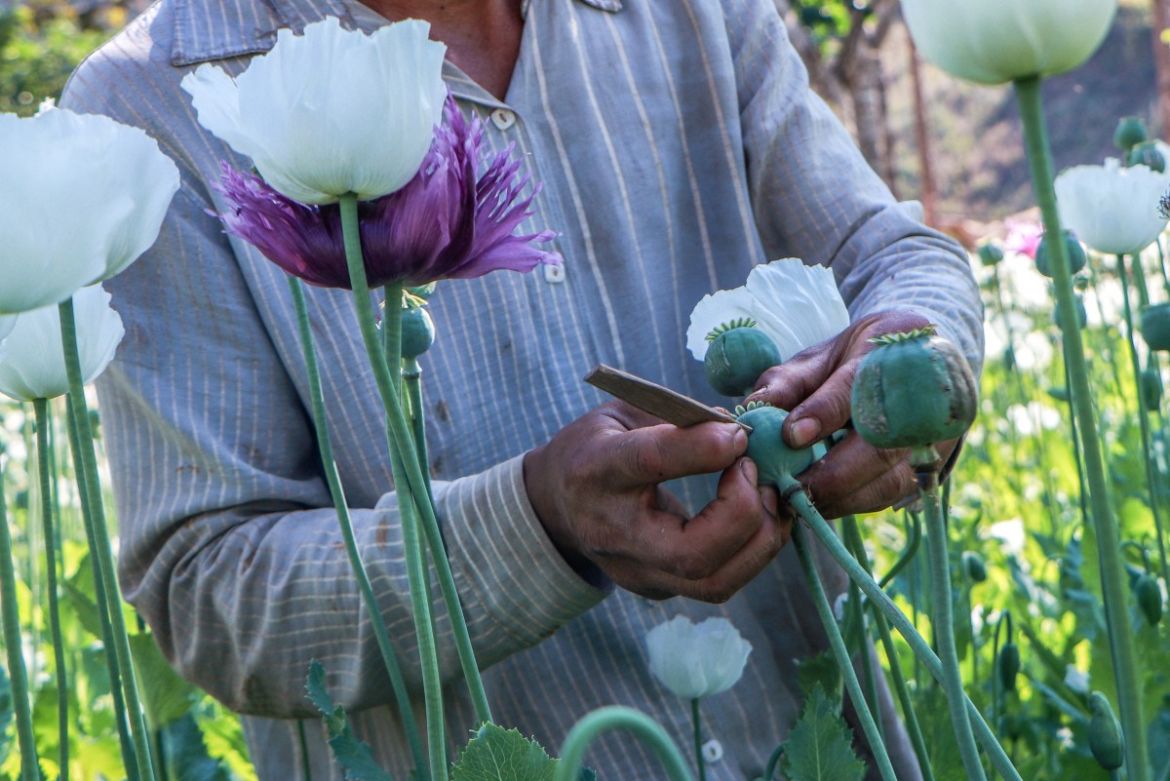
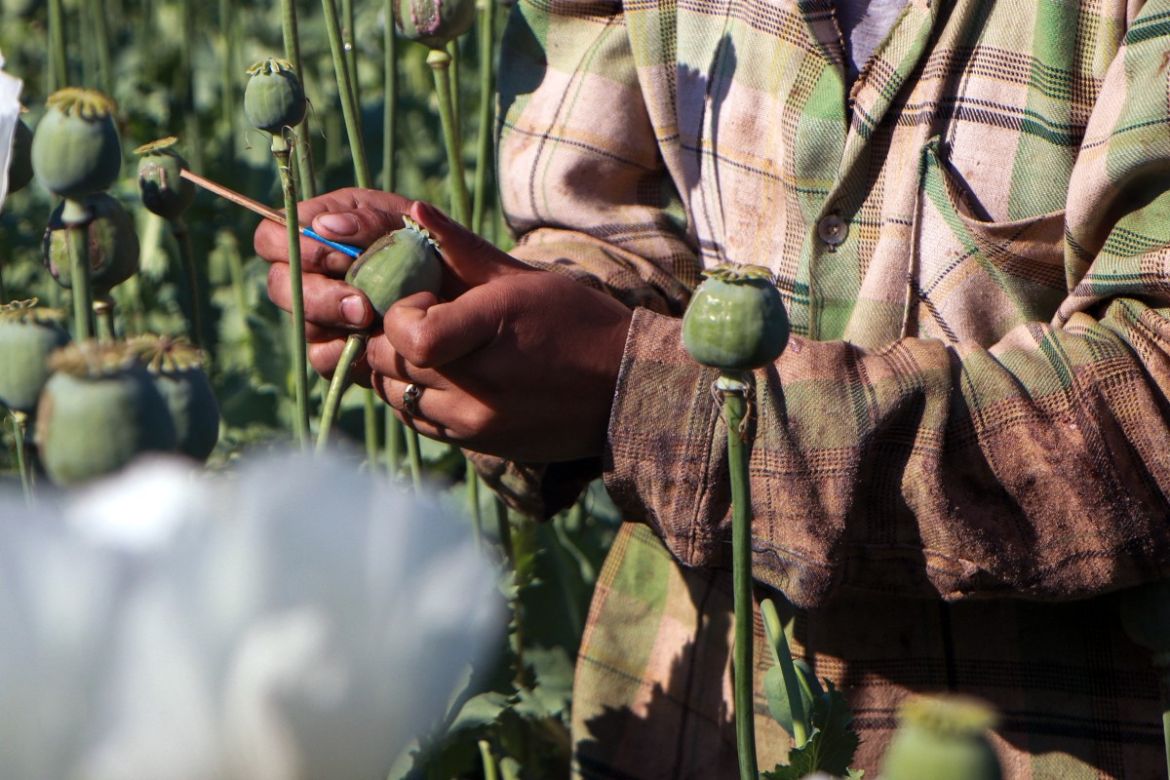
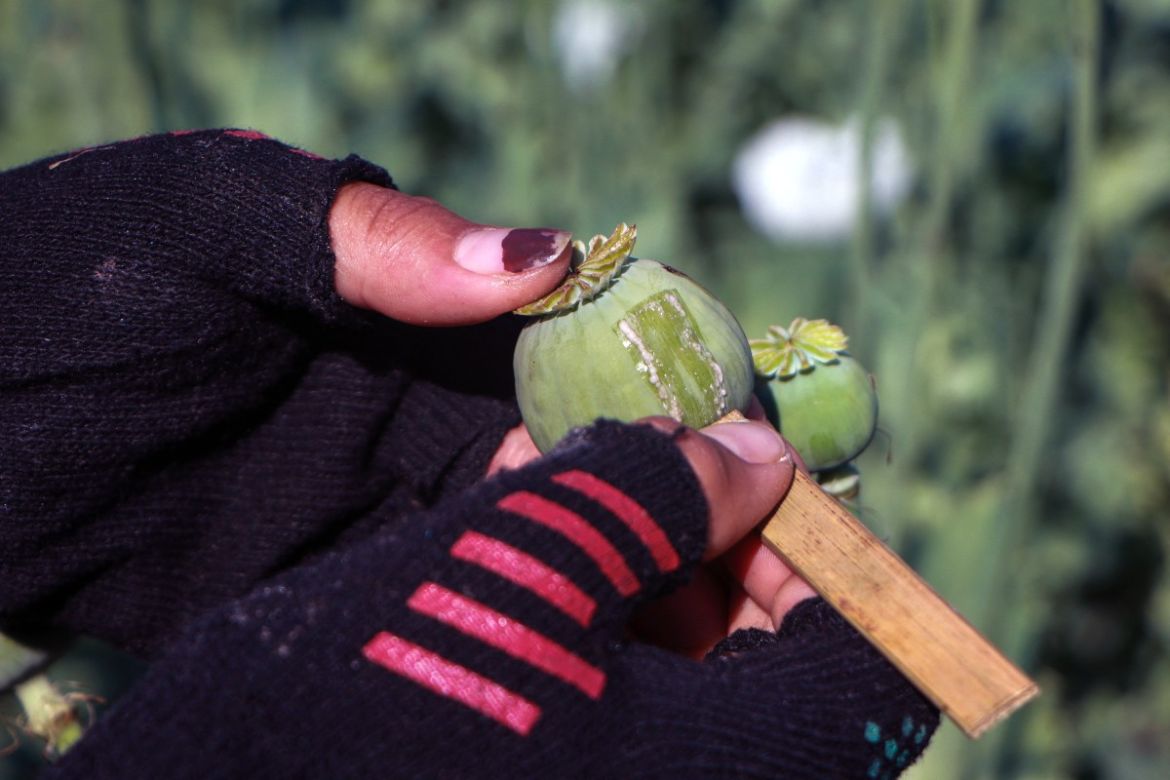
In a remote corner of Myanmar, a line of farmers moves through a field of nodding poppies, making small cuts in the greenish-purple pods to release opium resin.

The next morning they will collect the residue that has seeped out overnight and parcel it into bundles of sticky opium – the building blocks for manufacturing heroin.

Myanmar became the world’s biggest opium producer in 2023, according to the United Nations, overtaking Afghanistan after the Taliban government launched a crackdown on the crop.

Since the military in Myanmar seized power in 2021, causing social and economic turmoil and armed conflict across the country, the cash crop has become more important to some farmers struggling to get by.

“I planted poppies in recent years, but only a few,” said Aung Moe Oo, speaking from the vast field enclosed by hills on the border of Shan and Karen states.

“This year, I planted three acres.”

He expects those three acres (1.2 hectares) to yield about 16 kilogrammes (35 pounds) of poppy resin this harvest, which he hopes to sell for about $4,500.

“Growing poppies is the best way to make a living for our family,” he said, sporting a brown bucket hat and a striped grey shirt.

Aye Aye Thein, another farmer from the region, used to grow rice, corn, beans and avocado.

But when the fighting between the military and armed groups came to her home, she was forced to leave her fields.

Conflict since the coup, which ended a rare experiment with democracy in Myanmar, has displaced almost two million people, according to the UN.

Advertisement

Even before Aye Aye Thein had to leave her home, the plunging value of the local kyat currency had made buying agricultural products such as fertiliser much more expensive.

“After the political situation changed and there is fighting, we can’t grow anything in our own fields,” she said.

Aung Moe Oo agreed.

“If we send our crops to the brokers’ centre, there are lots of costs that we can’t afford,” he said. “So, we grow poppy flowers instead of corn this year.”

The raging conflict is disrupting transport and stunting the export of agricultural goods like rice and corn, the World Bank said late last year.

Meanwhile, poppy cultivation is becoming more sophisticated, the UN says, with increased investment and improved irrigation pushing up crop yields.

Myanmar produced an estimated 1,080 metric tonnes of opium last year, the world body’s office on drugs and crime said, up from an estimated 790 metric tonnes the previous year.

The opium is refined into heroin in factories hidden in the jungles and ravines of Shan state and then smuggled through neighbouring countries such as Thailand and on to the world market.
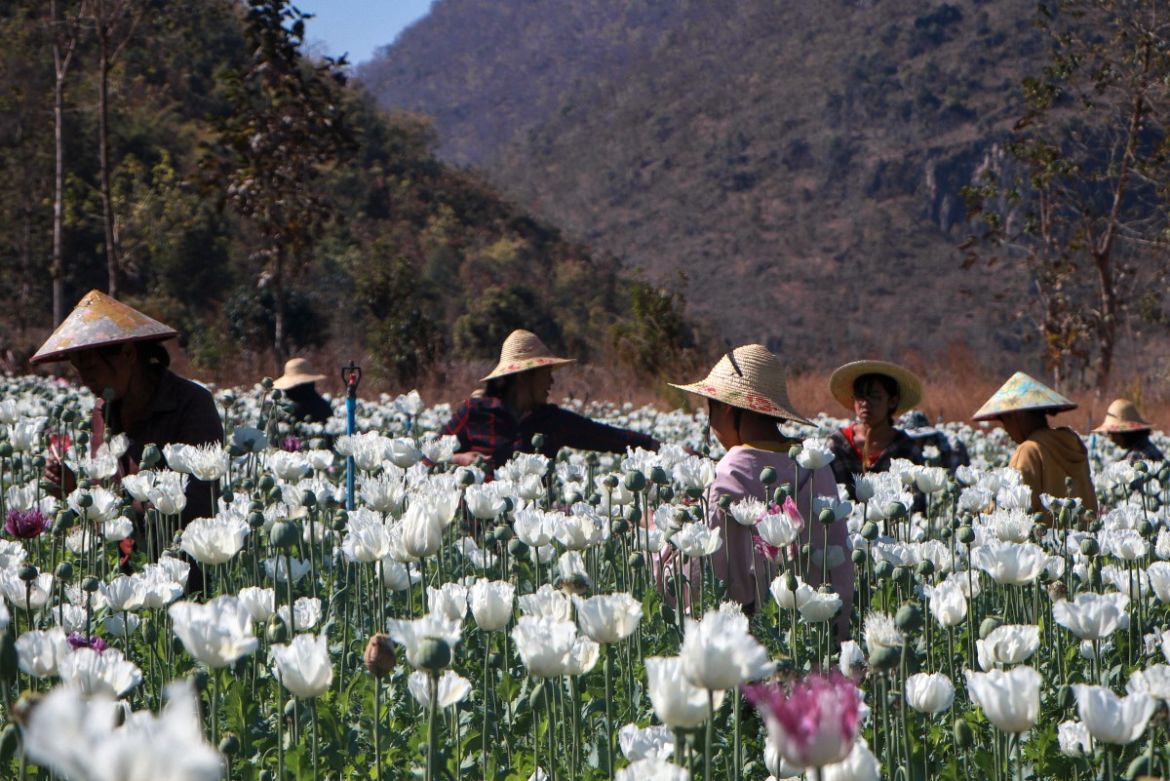
People working in the illegal poppy fields
Myanmar became the world's biggest opium producer in 2023. [AFP]
Advertisement
People working in the illegal poppy fields
A farmer makes small cuts in the greenish-purple pods to release opium resin. [AFP]
People working in the illegal poppy fields
The next morning they will collect the residue that has seeped out from the cuts and parcel it into bundles of sticky opium. [AFP]
People working in the illegal poppy fields
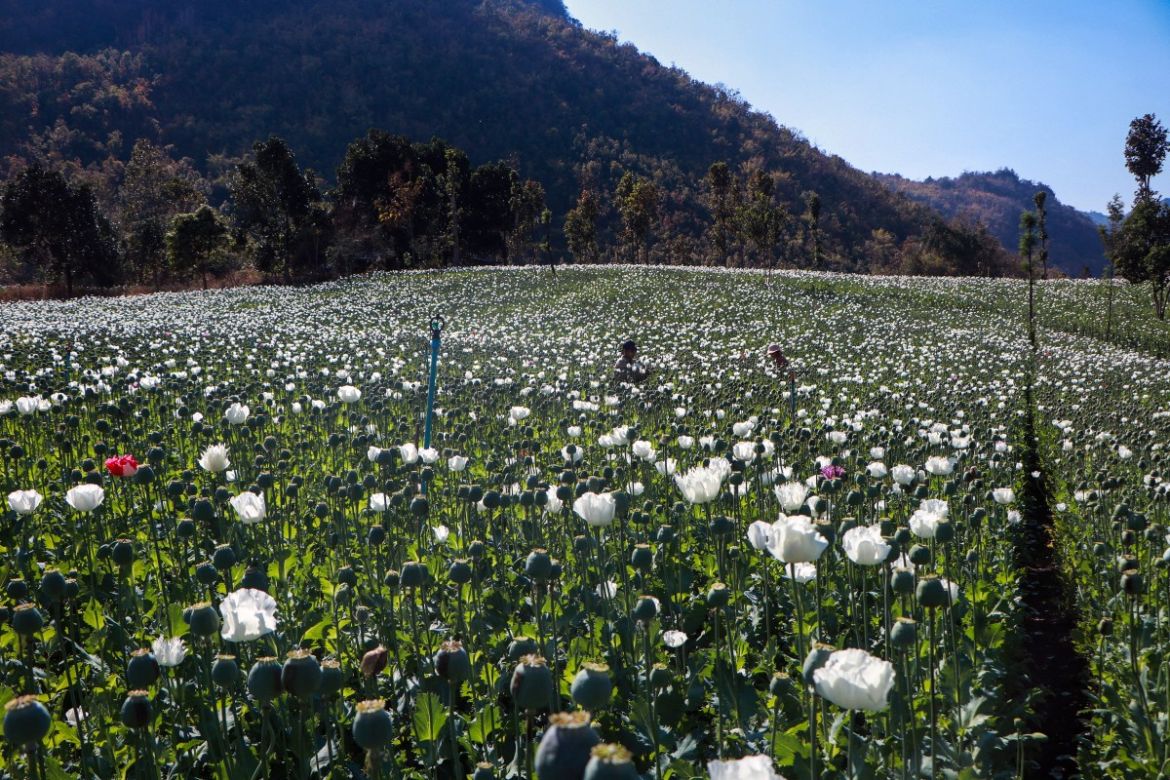
An illegal poppy field at Moe Bye in Pekon township in Myanmar's southern Shan state. [AFP]
People working in the illegal poppy fields
Poppy cultivation is becoming more sophisticated, the United Nations says, with increased investment and improved irrigation pushing up crop yields. [AFP]
People working in the illegal poppy fields
Myanmar produced an estimated 1,080 metric tonnes of opium last year. [AFP]
Advertisement
People working in the illegal poppy fields
The opium is refined into heroin and then smuggled through neighbouring countries such as Thailand and on to the world market. [AFP]
Related

  • ‘Blood and sweat’: Myanmar resistance fights to overturn military coup

    Three years after the generals’ power grab, anti-coup fighters say they want them out of Myanmar’s politics.

    Published On 1 Feb 20241 Feb 2024
    A woman fighter with the Mandalay People's Defence Force, She is travelling on the back of a truck with other fighters and is holding her weapon
  • Myanmar’s rebels see unity as key to victory over weakened military rulers

    An alliance of ethnic forces has gained much ground in military-ruled Myanmar, but some fear the movement may splinter.

    Published On 3 Feb 20243 Feb 2024
    A KTLA fighter in Myanmar's Karen State in December 2023 [Lorcan Lovett/Al Jazeera]
  • Fears of mass migration from Myanmar as military plans to draft thousands

    Myanmar’s generals aim to make up for recruitment shortfalls and battlefield losses by drafting thousands of civilians.

    Published On 10 Mar 202410 Mar 2024
    This photo taken on December 8, 2023 shows members of the Mandalay People’s Defense Forces (MDY-PDF) taking part in a flag raising ceremony at their base camp in the forest near Namhsan Township in Myanmar’s northern Shan State. - A squad of Myanmar pro-democracy fighters works quickly to ready drones for an attack on a nearby military base, the latest target in a wave of aerial assaults that has helped turn the war against the junta. (Photo by AFP) / TO GO WITH MYANMAR-COUP, FOCUS - TO GO WITH Myanmar-coup, FOCUS
  • Thailand, Laos try to ‘make junta presentable’ amid ASEAN Myanmar inertia

    With Laos as chair, the 10 members of ASEAN appear to be becoming more accommodative of reviled military regime.

    Published On 14 Mar 202414 Mar 2024
    Laos appointed ASEAN special envoy Alounkeo Kittikhoun meets Min Aung Hlaing in Naypyidaw. Min Aung Hlaing is wearing a traditional Burmese outfit and is sitting on a large ornate sofa trimmed in gold. Alounkeo Kittikhoun is sitting at a distance to the general's right in an upright chair. There is a desk with a large flower display in front of Min Aung Hlaing

More from Gallery

  • Photos: Millions of Palestinians mark 78 years since the Nakba

    Millions of Palestinians mark 78 years since the Nakba
    This gallery article has 9 imagescamera9
  • Israeli ultranationalists chant racist slogans during Jerusalem Day march

    Israeli ultranationalists chant racist slogans during Jerusalem Day march
    This gallery article has 9 imagescamera9
  • Photos: Trump in China for talks with Xi Jinping

    US President Donald Trump (R) shakes hands with China's President Xi Jinping at the Great Hall of the People in Beijing on May 14, 2026. (Photo by Kenny HOLSTON / POOL / AFP)
    This gallery article has 17 imagescamera17
  • Photos: India’s salt workers brave brutal heat on Gujarat’s desert plains

    India’s salt workers endure brutal heat in Gujarat’s remote desert
    This gallery article has 9 imagescamera9

Most popular

  • Uncertainty over US-Iran talks as Israel continues Lebanon attacks

    An Iranian military member stands guard in front of the picture of late Iranian Supreme Leader Ayatollah Ali Khamenei (top) and Iranian Supreme Leader Ayatollah Mojtaba Khamenei (R).
  • Trump-Xi summit: China, US disagree on what they agreed on

    U.S. President Donald Trump speaks with Chinese President Xi Jinping while leaving after a visit to the Zhongnanhai Garden in Beijing, China, May 15, 2026. REUTERS/Evan Vucci/Pool TPX IMAGES OF THE DAY
  • Why the Iran conflict is becoming a problem for BRICS

    (L-R, front) Indonesia's Foreign Minister Sugiono, Iran's Foreign Minister Abbas Araghchi, South Africa's Foreign Minister Ronald Lamola, Russia's Foreign Minister Sergey Lavrov, India's Foreign Minister Subrahmanyam Jaishankar, Brazil's Foreign Minister Mauro Vieira, Egypt's Foreign Minister Badr Abdelatty, Ethiopia's Foreign Minister Gedion Timothewos and Cuba's Foreign Minister Bruno Rodríguez Parrilla pose for a family photograph with delegates of partner countries during the BRICS Foreign Ministers’ meeting at the Bharat Mandapam in New Delhi on May 14, 2026.
  • Nakba: Jewish voices are challenging the stories Israel tells about itself

    Stephen Kapos and Gillian Mosely at the London screening of Planet Israel

  • About

    • About Us
    • Code of Ethics
    • Terms and Conditions
    • EU/EEA Regulatory Notice
    • Privacy Policy
    • Cookie Policy
    • Cookie Preferences
    • Accessibility Statement
    • Sitemap
    • Work for us
  • Connect

    • Contact Us
    • User Accounts Help
    • Advertise with us
    • Stay Connected
    • Newsletters
    • Channel Finder
    • TV Schedule
    • Podcasts
    • Submit a Tip
    • Paid Partner Content
  • Our Channels

    • Al Jazeera Arabic
    • Al Jazeera English
    • Al Jazeera Investigative Unit
    • Al Jazeera Mubasher
    • Al Jazeera Documentary
    • Al Jazeera Balkans
    • AJ+
  • Our Network

    • Al Jazeera Centre for Studies
    • Al Jazeera Media Institute
    • Learn Arabic
    • Al Jazeera Centre for Public Liberties & Human Rights
    • Al Jazeera Forum
    • Al Jazeera Hotel Partners

Follow Al Jazeera English:

  • facebook
  • twitter
  • youtube
  • instagram-colored-outline
  • rss
Al Jazeera Media Network logo
© 2026 Al Jazeera Media Network