US petrol prices 50 percent higher than before war on Iran
The average price of petrol in the United States has reached $4.48 per gallon, according to AAA.
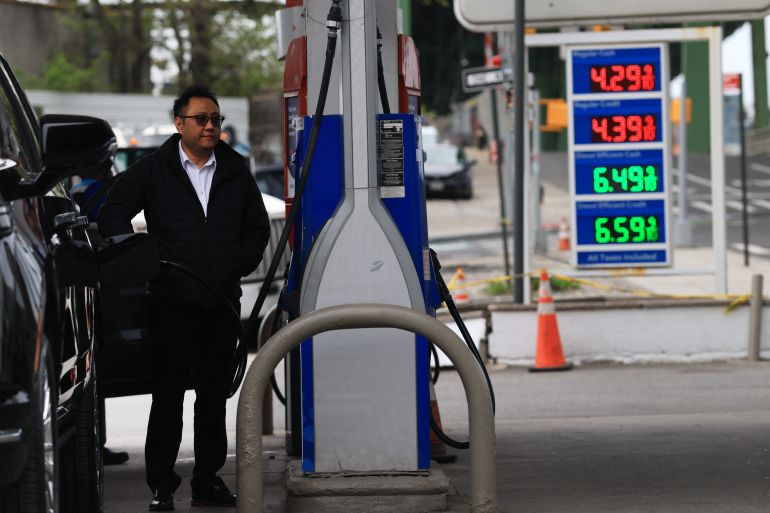

The price of a gallon of regular petrol climbed 31 cents in the past week, spiking to an average of $4.48 per gallon, according to the American Automobile Association, rising 50 percent since the US-Israel war on Iran began.
AAA’s website listed the price at that rate as of Wednesday, despite US President Donald Trump earlier pausing the military’s “Project Freedom” operation to open the Strait of Hormuz.
Recommended Stories
list of 4 items- list 1 of 4US, Iran, UAE trade Hormuz attack claims: What we know
- list 2 of 4Strait of Hormuz blockade and other major naval sieges in modern times
- list 3 of 4Oil prices flat as Trump’s plan for Strait of Hormuz fails to calm market
- list 4 of 4Oil prices surge as violence flares in Strait of Hormuz
The global energy crisis caused by the US-Israel war on Iran has sent the price of crude oil soaring. Crude oil is the main ingredient in petrol. The Strait of Hormuz, the narrow passage of the Gulf through which a fifth of the world’s crude oil normally passes, has been blocked, with oil tankers stranded and unable to deliver the crude.
Many US drivers were hopeful in mid-April when the ceasefire was announced, amid signs that the conflict could be winding down, and petrol prices fell daily for almost two weeks. But as the war continued, petrol prices reversed course and began increasing again.
“There’s a fundamental shortfall that will exist globally, or fundamental struggle to meet that demand that will drive up price,” Rob Smith, director of global fuel retail at S&P Global Energy, told The Associated Press news agency.
“No matter what a government says or what any market person thinks, there is a true kind of upward pressure that’s being exerted on prices every day the Strait of Hormuz is constrained.”
The spike in energy prices has been spurring inflation and economic uncertainty, adding to Trump’s political woes. The US president’s approval rating is hitting record lows amid growing discontent with the war on Iran, recent public opinion polls suggest.
Since the start of the war, Trump and his allies have been trying to frame the hike in petrol prices as a temporary price worth paying to achieve the aims of the military campaign.
However, oil prices do not drop automatically after hostilities stop. Despite the ceasefire reached on April 8, the cost of gas in the US has continued to climb.
The longer the flow of oil is constrained through the Strait of Hormuz, the higher prices will go, and the longer it will take to get back to normal, Smith said.
“There will still be within the industry a risk premium associated with going through that region … The past few months have shown that it’ll be hard to convince shippers and insurance companies that the risk level will be similar to what it was in February [before the war].”