Skip linksSkip to Content
play
Live
Navigation menu
  • News
    • Africa
    • Asia
    • US & Canada
    • Latin America
    • Europe
    • Asia Pacific
  • Middle East
  • Explained
  • Opinion
  • Sport
  • Video
    • Features
    • Economy
    • Human Rights
    • Climate Crisis
    • Investigations
    • Interactives
    • In Pictures
    • Science & Technology
    • Podcasts
    • Travel
play
Live

In Pictures

News|Indigenous Rights

Papuans head to Indonesian court to protect forests from palm oil

Campaigners are taking legal action to stop four palm oil companies from clearing vast tracts of forest for plantations.
Save

Share

facebookxwhatsapp-strokecopylink
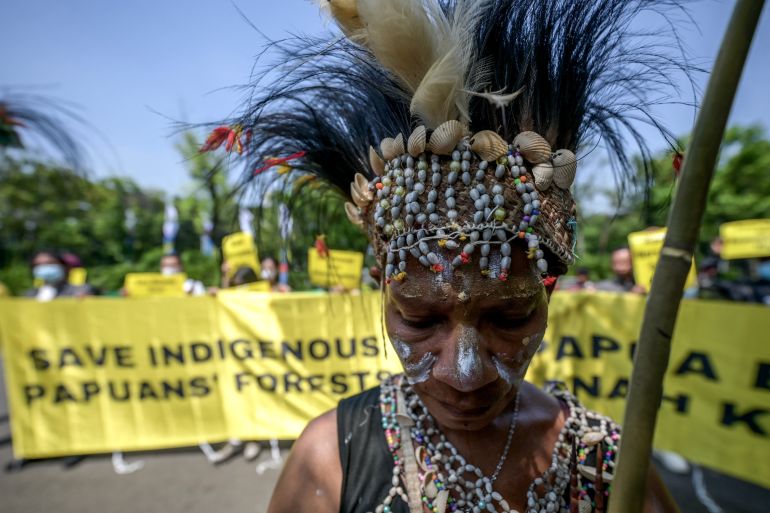
A close up of a member of the Indigenous community. They have shells and feathers in their headdress.
The Awyu and Moi say they want to stop the plantations for the benefit of their community and future generations. [Bay Ismoyo/AFP]
By Al Jazeera Staff
Published On 28 May 202428 May 2024

Indigenous activists from the Indonesian province of West Papua have held traditional ceremonies outside the country’s Supreme Court in Jakarta calling for their traditional land and forests to be protected from palm oil plantations.

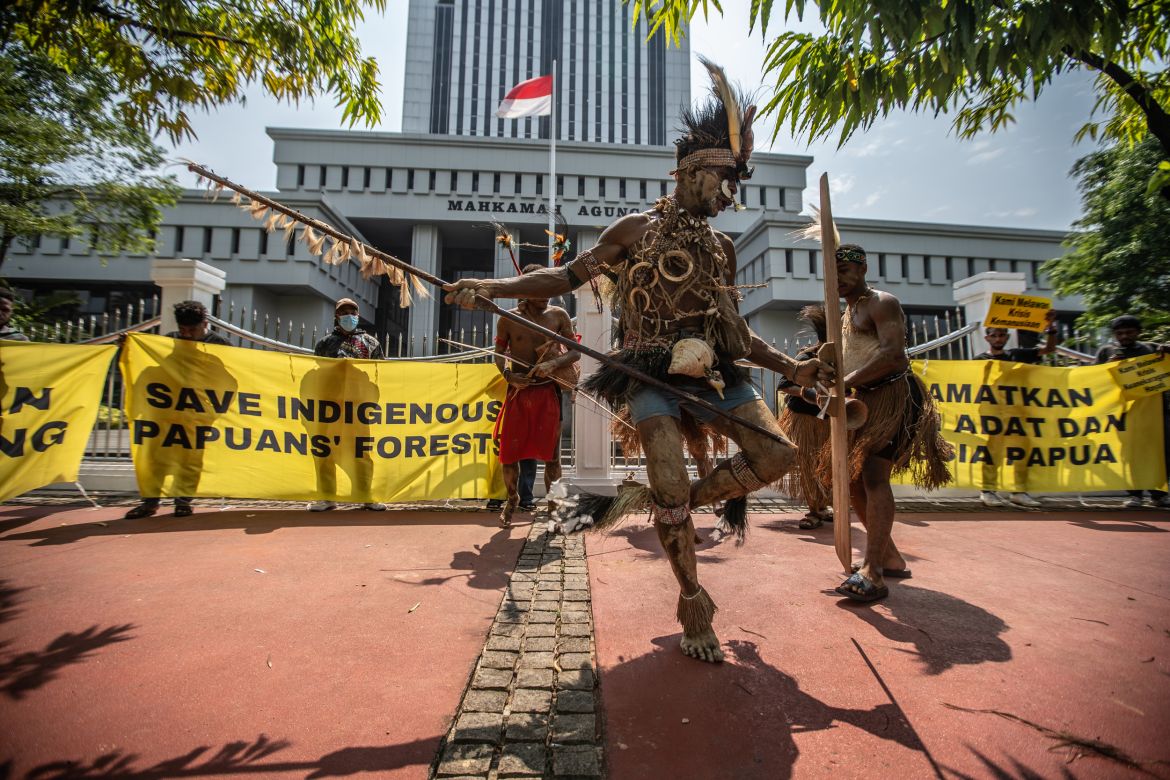
Representatives of the Awyu and Moi communities held prayers and performed dances in front of the Supreme Court building on Monday as the court was reviewing an appeal in relation to their efforts to revoke permits for four palm oil companies whose proposed plantations threaten their customary forests. Indonesia began legally recognising customary forests in 2016.

“We have taken the long, difficult and expensive path from Tanah Papua [Papua homeland] to end up here in Indonesia’s capital Jakarta, asking the Supreme Court to restore our rights, and the land that was snatched from us when these palm oil companies were issued permits over it,” said Hendrikus “Franky” Woro, an Awyu Indigenous man.

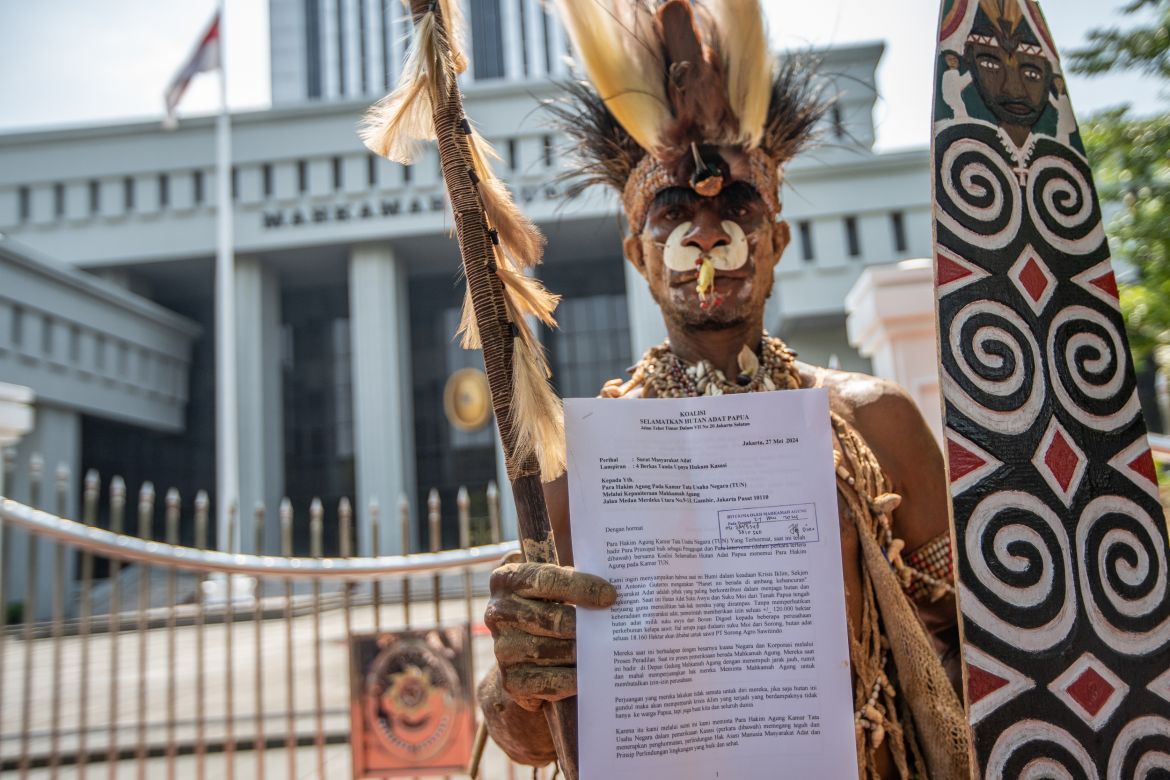
Woro filed an environmental and land rights lawsuit in the Papuan capital of Jayapura challenging the plan by a Malaysian-owned palm oil company to clear tens of thousands of hectares of previously untouched West Papuan forest, including traditional Indigenous land.

Environmental campaign group Greenpeace said the potential emissions from clearing the 26,326 hectares (65,053 acres) of primary forest in its concession would amount to about 23 million tonnes of CO2, equivalent to 5 percent of Indonesia’s annual carbon emissions expected in 2030.

The Awyu have also intervened in appeals taken by two other palm oil companies against a decision by the minister of environment and forestry to cancel permits that it had previously issued for them to clear Indigenous lands. The revocation has the potential to save 65,415 hectares (161,644 acres) of pristine rainforest, six times the area of the city of Paris, Greenpeace said.

Advertisement

The Supreme Court is the communities’ last chance to defend their customary forest and generations of ancestral heritage.

“We have been tormented for years by the threat of our traditional forests being replaced by palm oil plantations. We want to raise our children with the help of nature, and the food and materials we harvest from the forest. Palm oil will destroy our forests, we reject it,” said Rikarda Maa, an Awyu Indigenous woman.

The Moi Indigenous community, meanwhile, is fighting to protect thousands of hectares of customary forest that has also been earmarked for palm oil. The company involved had its permits revoked amid community opposition but lower courts later ruled in favour of the planter.

“The judicial panel needs to prioritise aspects of the case that relate to environmental and climate justice, the impact of which will not only be felt by the Awyu and Moi but the entirety of the Indonesian people,” Tigor Hutapea, a member of the legal team from Pusaka Bentala Rakyat, said in a statement.

Global Forest Watch, a monitoring platform run by the World Resources Institute, said last month that since 1950, more than 74 million hectares (183 million acres) of Indonesian rainforest — an area twice the size of Germany — had been logged, burned or degraded for the development of palm oil, paper and rubber plantations, nickel mining and other commodities.

Indonesia is the world’s biggest producer of palm oil, and Malaysia number two. Indonesia is also a major exporter of commodities such as coal, rubber and tin.

Protesters carrying yellow placards reading 'Kami Bersama Suku Awyu' {We're with the Awyu people'] They are walking next to a police truck
The Indigenous communities were joined in Jakarta by environmental activists. [Jurnasyanto Sukarno/Greenpeace]
Advertisement
Representatives of the Awyu and Moi Indigenous Peoples from West Papua dance outside the Supreme Court gates. They are wearing traditional clothing. There is an Indonesian flag hanging from the court building.
Representatives of the Awyu and Moi hold a traditional dance outside the Supreme Court building. [Jurnasyanto Sukarno/Greenpeace]
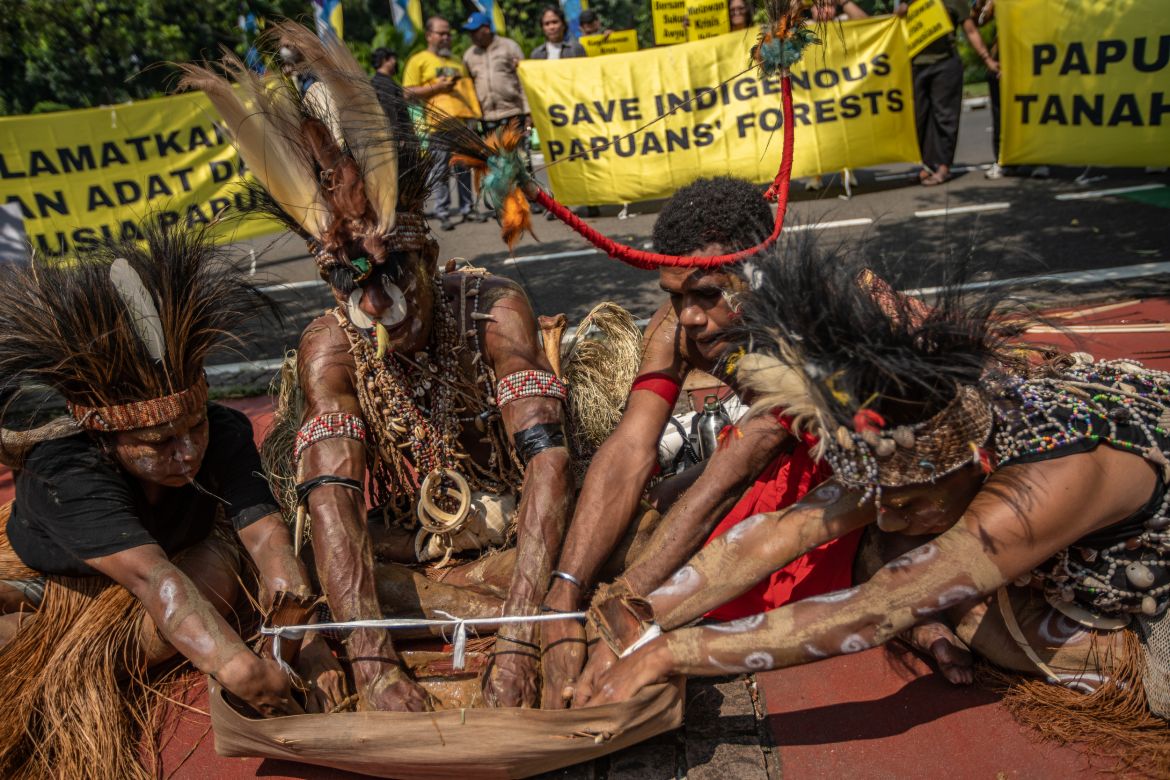
Indigenous people from West Papua sitting around a bark container with the soil of their homeland. The container is in the middle and they are seated around it. Their hands are outstretched.
The Indigenous representatives also brought soil from their customary land to hand over to the Supreme Court. [Jurnasyanto Sukarno/Greenpeace]
Hendrikus Woro, a representative from the Papuan indigenous community of Awyu, holding a paper showing their concerns. He is in traditional clothing and is also carrying a staff and shield.
Hendrikus Woro, who filed one of the cases, holds a letter for the court. Greenpeace estimates that if the plantation is allowed to go ahead and the forest is cleared the CO2 emissions will reach some 23 million tonnes. [Jurnasyanto Sukarno/Greenpeace]
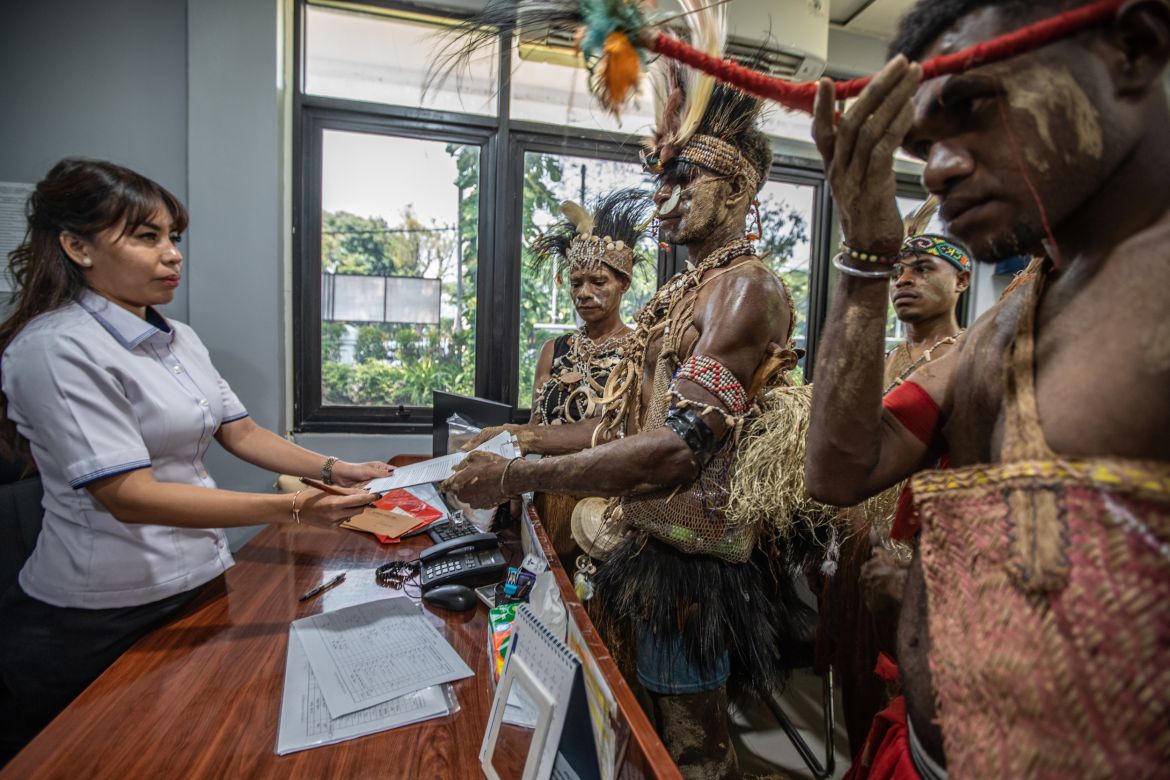
Indigenous representatives handing a letter to a court official.
Representatives from the Awyu and Moi in West Papua meet a court official in Jakarta. This is their last chance legal effort to stop the development of plantations on their customary land. [Jurnasyanto Sukarno/Greenpeace]
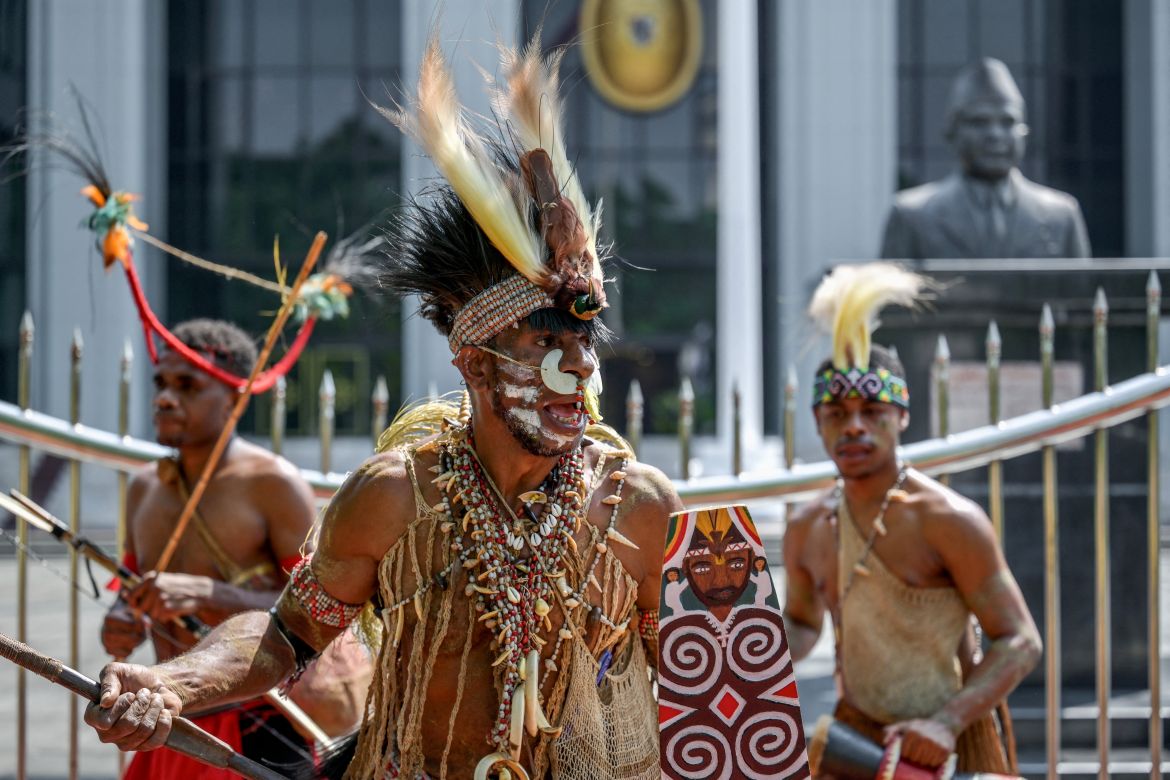
Representatives of the Awyu and Moi indigenous tribes dance in front of the court. They are in traditional clothing and wearing feather headdresses.
Indonesia began the legal recognition of customary land in 2016. [Bay Ismoyo/AFP]
Advertisement
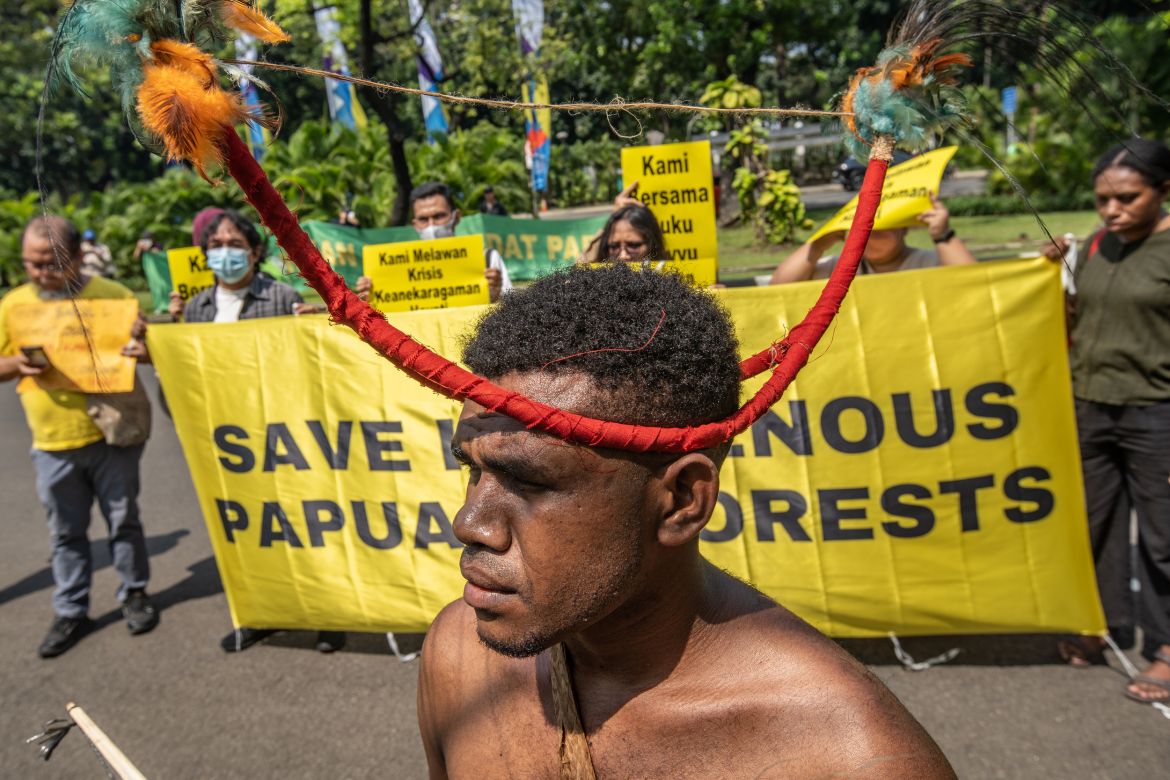
A Papuan man in a traditional headdress. It is made up of two curved red poles.
The forests of the Awyu and Moi are some of the most biodiverse parts of the world and a crucial habitat for endemic New Guinean flora and fauna. [Jurnasyanto Sukarno/Greenpeace]
Activists standing with a giant green banner reading Selamatkan Hutan Adat Papua [Save Papua's Customary Forest]
Campaigners carrying a banner calling on the court to save the customary land of the Awyu and Moi people in West Papua. [Jurnasyanto Sukarno/Greenpeace]
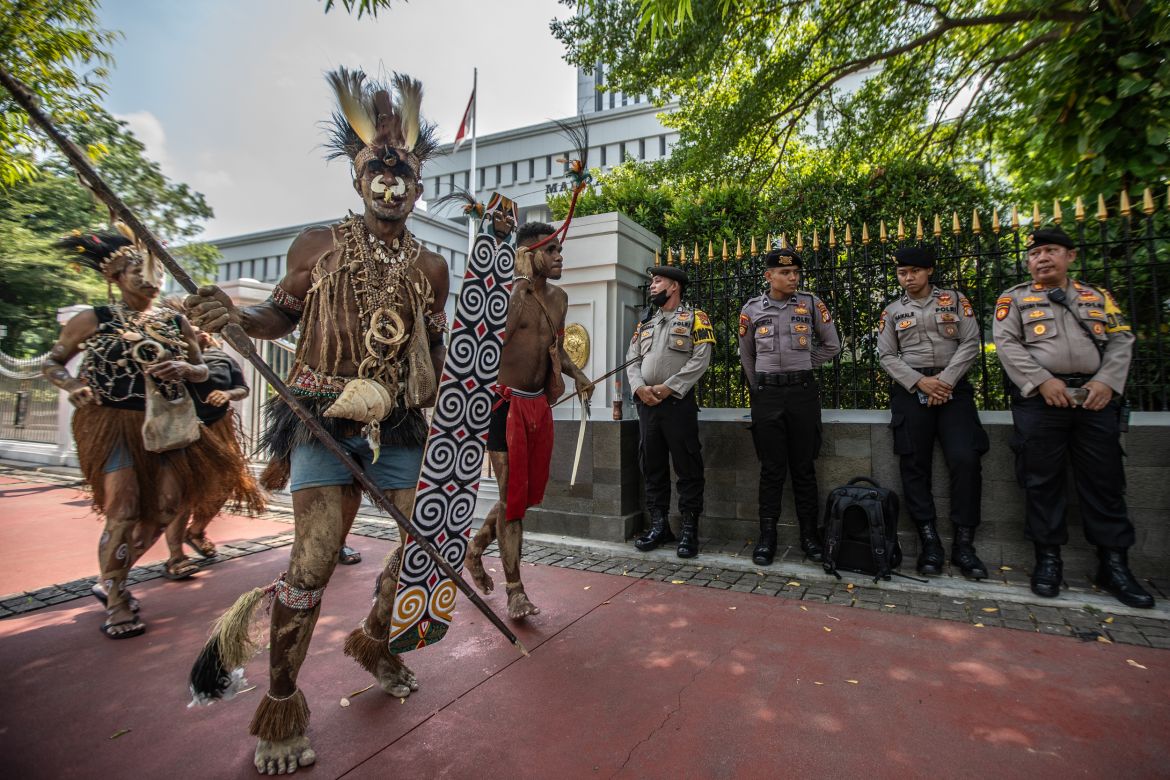
Indigenous people from Papua in traditional clothing. There is a row of Indonesian policeman leaning on the railings of the Supreme Court.
Indigenous people say they reject the plantations because of the threat they pose to their lives and culture. [Jurnasyanto Sukarno/Greenpeace]

Related

  • Orangutan seen treating wound with medicinal plant in world first

    Sumatran orangutan named Rakus was seen using a plant to treat a facial wound possibly sustained during a fight.

    Published On 3 May 20243 May 2024
    A male Sumatran orangutan named Rakus is seen two months after wound self-treatment using a medicinal plant in the Suaq Balimbing research site
  • Fire Beneath Her: Battling wildfires in Indonesian Borneo

    A young Indonesian Indigenous leader makes bold plans to protect her village from Borneo’s wildfires.

    Published On 5 Feb 20245 Feb 2024
    Video Duration 25 minutes 00 seconds play-arrow25:00
  • Forest recognition for Papua tribe raises hopes for climate

    Indigenous peoples are increasingly recognised as the most effective custodians of the world’s remaining forests.

    Published On 8 Jun 20238 Jun 2023
    A portrait of Yustina Ogoney. SHe is standing in the forest wearing a red dress with a yellow necklace. She has a blue headband.
  • Selling Out West Papua

    In West Papua, Indonesia, we investigate allegations of fraud and human rights abuses in billion-dollar land deals.

    Published On 25 Jun 202025 Jun 2020
    101 east - Selling Out West Papua
    Video Duration 26 minutes 15 seconds play-arrow26:15

More from News

  • Trump says he would not pay $1,000 to watch US at World Cup

    President Donald Trump stands on stage next to the FIFA World Cup.
  • Ukraine may have turned tide of Russian territorial gains, says think tank

    A resident with a dog and rescuers run during an air raid alarm.
  • Rubio meets Pope Leo: Can they heal White House-Vatican rift?

    This photo taken and handout on May 7, 2026 by The Vatican Media shows Pope Leo XIV during a private audience with U.S. Secretary of State Marco Rubio in The Vatican. (Photo by Handout / VATICAN MEDIA / AFP) / RESTRICTED TO EDITORIAL USE - MANDATORY CREDIT "AFP PHOTO / VATICAN MEDIA" - NO MARKETING - NO ADVERTISING CAMPAIGNS - DISTRIBUTED AS A SERVICE TO CLIENTS
  • FBI’s lack of progress on Israeli killing of journalist ‘troubling’: CPJ

    Shireen Abu Akleh smiles back at the camera.

Most popular

  • Trump says ceasefire holding despite Iran, US blows; Israel pounds Lebanon

    An Iranian woman walks next to a mural on a street in Tehran, Iran, May 6, 2026. Majid Asgaripour/WANA (West Asia News Agency) via REUTERS ATTENTION EDITORS - THIS PICTURE WAS PROVIDED BY A THIRD PARTY
  • US, Iran clash in Hormuz as war escalates: What happened, why it matters

    Iranian navy fires a missile, at an unknown location, in this still image taken from a video released May 8, 2026. Pool via WANA (West Asia News Agency)/ via REUTERS ATTENTION EDITORS - THIS PICTURE WAS PROVIDED BY A THIRD PARTY. IRAN OUT. NO COMMERCIAL OR EDITORIAL SALES IN IRAN. NO USE BBC PERSIAN. NO USE VOA PERSIAN. NO USE MANOTO. NO USE IRAN INTERNATIONAL. NO USE RADIO FARDA. Verification Lines: Reuters could not verify the date and location of the footage. No older versions were found posted online before May 8. Iran's military said the U.S. targeted two ships entering the Strait of Hormuz and carried out strikes on Iranian territory. The military said it responded by attacking U.S. military vessels east of the Strait of Hormuz and south of the port of Chabahar.
  • UK elections – early results and takeaways; will Starmer have to resign?

    Election staff count votes.
  • Iran war day 70: US, Iran trade fire in Hormuz amid ceasefire tensions

    Vessels in the Strait of Hormuz.

  • About

    • About Us
    • Code of Ethics
    • Terms and Conditions
    • EU/EEA Regulatory Notice
    • Privacy Policy
    • Cookie Policy
    • Cookie Preferences
    • Accessibility Statement
    • Sitemap
    • Work for us
  • Connect

    • Contact Us
    • User Accounts Help
    • Advertise with us
    • Stay Connected
    • Newsletters
    • Channel Finder
    • TV Schedule
    • Podcasts
    • Submit a Tip
    • Paid Partner Content
  • Our Channels

    • Al Jazeera Arabic
    • Al Jazeera English
    • Al Jazeera Investigative Unit
    • Al Jazeera Mubasher
    • Al Jazeera Documentary
    • Al Jazeera Balkans
    • AJ+
  • Our Network

    • Al Jazeera Centre for Studies
    • Al Jazeera Media Institute
    • Learn Arabic
    • Al Jazeera Centre for Public Liberties & Human Rights
    • Al Jazeera Forum
    • Al Jazeera Hotel Partners

Follow Al Jazeera English:

  • facebook
  • twitter
  • youtube
  • instagram-colored-outline
  • rss
Al Jazeera Media Network logo
© 2026 Al Jazeera Media Network